Chasing Ghosts of the Eurasian Steppe: Conservationists Battle Infrastructure to Save the Ancient Saiga Antelope

The rugged expanses of the Kazakh steppe have long served as a crossroads for empires, nomads, and migratory wildlife. Among the most resilient inhabitants of this unforgiving terrain is the saiga antelope (Saiga tatarica), an Ice Age survivor that once roamed alongside woolly mammoths and saber-toothed cats. Today, however, this ancient species faces an existential crisis. As modern industrialization, railways, and border fences carve up Central Asia, conservationists are racing against time to preserve the saiga’s historic migration routes and prevent the erasure of a migratory culture that has endured for millennia.
Main Facts and the Field Audit
The challenges facing modern conservation efforts were brought into sharp focus during a recent field audit conducted along the western edge of Kazakhstan. Accompanied by field researchers Alexandr and Albert from the Association for the Conservation of Biodiversity of Kazakhstan (ACBK)—organizations boasting over 25 years of cumulative experience tracking the species—observers braved volatile Siberian weather to monitor the annual saiga rut.
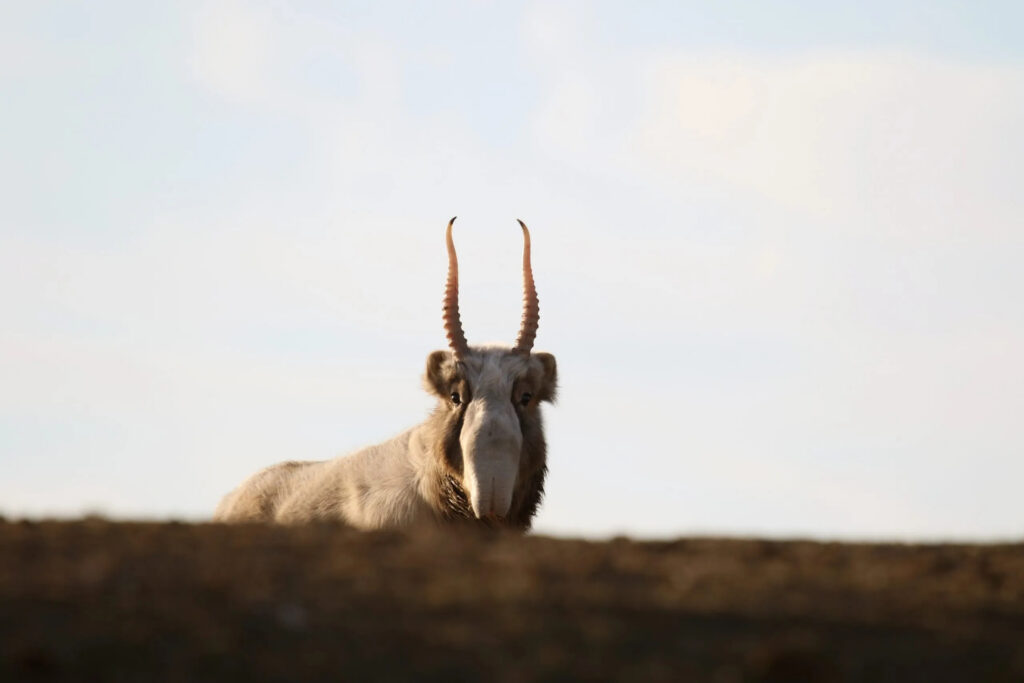
Timed to coincide with the late autumn and early winter gathering periods, the expedition captured the fragile beauty of the species. Hundreds of nomadic ungulates traversed the treeless plains, their distinctive, bulbous snouts serving a dual evolutionary purpose: filtering out choking dust during arid periods and warming sub-zero winter air before it enters their lungs. During the rutting season, mature males engage in aggressive headbutting displays to signal physical prowess, relying heavily on the visual and acoustic cues of the herd.
However, this natural spectacle is increasingly interrupted by human intervention. Where herds once moved seamlessly across open borders, they now encounter a growing labyrinth of highways, agricultural conversions, and linear infrastructure.
Chronology of the Steppe: From Ancient Caravans to Soviet Sedentarization
The history of the Eurasian steppe is inextricably linked to mobility. Archaeological and historical analyses indicate that human nomadism in the region dates back to the Early Iron Age. The term Kazakh itself derives from Turkic roots meaning "wanderer" or "vagabond," reflecting a traditional lifestyle centered on seasonal migrations between higher altitude summer pastures and sheltered winter valleys.
These ancient transit corridors eventually formed the foundational arteries of the Great Silk Road, a vast network of pathways linking Europe and Asia across the fertile banks of the Ural River. Historically, weary merchants and caravans relied on local wildlife, including saiga herds, as intuitive guides through the arid expanses.
The traditional lifestyle persisted through successive epochs under Turkic tribes, the Mongol Empire of Genghis Khan, and later the Russian Empire. A profound shift occurred during the 20th century under the Soviet Union, which implemented mandatory sedentarization policies. These programs forced nomadic human populations into collective agricultural plots—a policy that largely failed due to the poor agricultural suitability of the steppe soil—while effectively halting human mobility.
While human populations largely transitioned to sedentary urban lifestyles, the saiga antelope continued its historic migrations, unaware of the artificial political and physical boundaries dividing the landscape.
Supporting Data and Anthropogenic Fragmentation
The vulnerability of the saiga was dramatically exacerbated following the collapse of the Soviet Union, compounded by severe poaching crises in the 1990s and early 2000s that decimated populations by over 95%. Although concerted anti-poaching measures by the Kazakh government and international NGOs have allowed numbers to rebound in recent years—with populations now estimated in the millions—the threat of habitat fragmentation has emerged as the primary impediment to long-term survival.
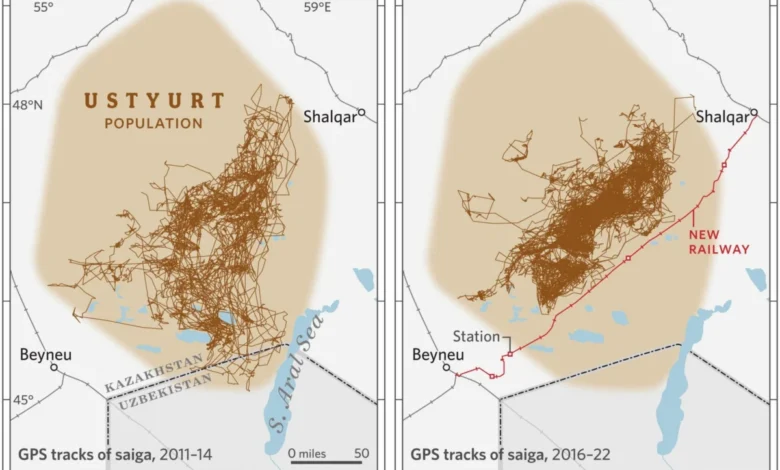
Modern tracking technology has provided conservation biologists with precise data illustrating these disruptions. Utilizing GPS collars, researchers have mapped historic migration circuits that spanned thousands of kilometers, stretching from the Caucasus Mountains through Kazakhstan and into Mongolia and Uzbekistan.
Data reviewed during the ACBK field audit highlighted specific ecological bottlenecks. For instance, spatial mapping demonstrated how a population of GPS-collared saigas historically trekked deep into Uzbekistan before their route was abruptly severed by the construction of a major railway line in 2014. Post-construction data revealed that migrating herds became disoriented, milling about uselessly on the northern side of the tracks while vital seasonal water sources and grazing lands remained inaccessible to the south.
Scientists note that such physical interruptions trigger a collapse in spatial knowledge. Much like human populations forced into sedentarization lost their generational navigational skills, young saigas learn migration routes through active observation and communal participation. When linear infrastructure divides these pathways, entire chapters of the "Saiga Silk Road" fade from collective memory.
Official Responses and Cross-Border Mitigation Strategies
Recognizing the severity of the threat, the ACBK, in close collaboration with the Kazakh and Uzbek governments, has initiated large-scale infrastructural remediation projects designed to reconcile modern transport networks with wildlife preservation.
Among the primary initiatives is the construction of specialized, saiga-friendly wildlife crossings. These structures feature gently sloping dirt ramps engineered to match the elevation of railway tracks, creating an optical illusion that minimizes hesitation in crossing animals. Additionally, strategic cattle-guard fencing placed at a distance from the tracks ensures that high-speed trains and skittish ungulates remain separated, preventing fatal collisions while preserving the permeability of the landscape.
International cooperation has also yielded diplomatic victories for wildlife conservation. ACBK has partnered with Uzbek authorities to modify traditional border security fencing. By replacing solid barbed-wire walls with X-shaped barricades, authorities have successfully maintained vehicle security while leaving precisely engineered clearances for migrating saiga herds to pass unhindered.
Furthermore, the establishment of new protected wildlife sanctuaries—informed directly by ACBK’s telemetry data—aims to secure critical core habitats where herds can congregate, mate, and calve undisturbed by industrial encroachment.
Broader Impact and Implications
The plight of the saiga antelope serves as a bellwether for grassland ecosystems globally. As infrastructure projects continue to expand across Central Asia under regional economic corridors, the degradation of migratory corridors threatens not only biodiversity but also the ecological resilience of the steppe itself.
Ecologists and anthropologists emphasize that the preservation of migratory species is fundamentally intertwined with the preservation of ecological health. Herbivores like the saiga play a critical role in seed dispersal, nutrient cycling, and vegetation management across vast, arid plains.
As conservationists continue their field audits against the backdrop of shifting weather patterns and encroaching industrialization, the success of these mitigation efforts will determine whether the saiga remains a living relic of the Ice Age or a casualty of modern development. Ensuring safe passage across the Eurasian steppe is not merely an act of wildlife management, but a crucial step in maintaining the ecological integrity of a landscape where East has met West for millennia.