Australian Zoologist Mark Gresser Completes Epic 6,023km Solo Walk Across Continent, Navigating Extreme Wilderness and Historic Routes

Mark Gresser, an Australian zoologist, has etched his name into the annals of long-distance exploration, successfully completing a monumental 6,023-kilometer solo walk across the Australian mainland. The arduous journey, which commenced on July 6, 2025, at Steep Point in Western Australia, concluded 331 days later on June 1, 2026, at Cape Byron in New South Wales. This remarkable feat, traversing the continent from its westernmost to easternmost extremities, saw Gresser navigate some of the world’s most remote and unforgiving landscapes, pushing the boundaries of human endurance and logistical planning in the vast Australian outback. His expedition followed a broad arc through the continent’s interior, skirting major deserts and passing through the geographic heart of Australia, Lambert’s Centre.
A Journey Across a Continent: The Route Unveiled
Gresser’s traverse began at Steep Point, a rugged and windswept promontory that serves as the westernmost point of mainland Australia. Characterized by dramatic cliffs, white sand dunes, and the vibrant turquoise waters of the Indian Ocean, Steep Point is already a remote destination, accessible only by four-wheel drive vehicles and known for its exceptional fishing and pristine wilderness. From this iconic starting line, Gresser embarked on a journey that would take him through the diverse and often brutal landscapes of Western Australia, a state larger than many European countries.
His chosen route was not a direct west-to-east line, which would have presented different, but equally formidable, challenges. Instead, Gresser opted for a more circuitous path, aiming to experience the profound solitude and raw beauty of the continent’s heartland. This meant charting a course that dipped significantly south to avoid the impassable expanses of the Simpson Desert, a decision he described on his website as "a sad day when I realized there was no way I’d get my cart through the thousands of sand dunes that form the desert." The Simpson Desert, known for its vast parallel sand dunes, some stretching for hundreds of kilometers, would indeed be an insurmountable obstacle for a wheeled cart.
The journey led him through remote outback regions, past the iconic Red Centre near Alice Springs, before continuing across the arid plains of South Australia. Here, he encountered some of the most challenging terrain and extreme isolation. His route also notably passed through Lambert’s Centre, the geographical midpoint of Australia, a symbolic landmark that underscored the continental scale of his undertaking. This point, marked by a cairn and a plaque, represents the exact center of the landmass, adding a unique geographical significance to his trek.
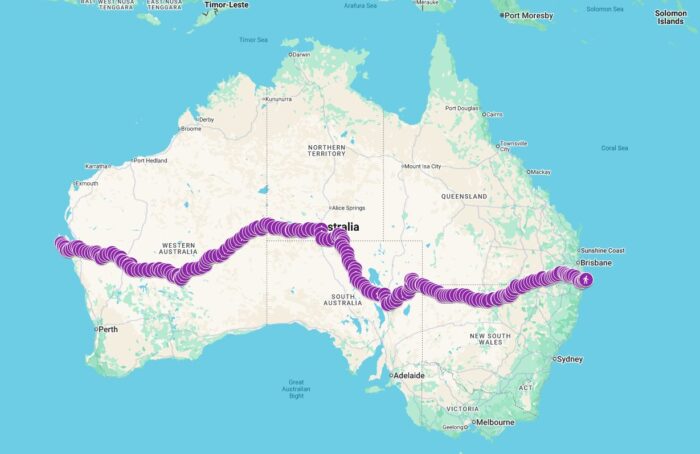
The final leg of his expedition saw him transition from the parched desert and arid zones into the more pastoral country of New South Wales and Queensland. Despite the relative increase in population density compared to the deep outback, these areas still presented significant distances between settlements and varied terrain. His destination, Cape Byron, the easternmost point of mainland Australia, is crowned by its iconic lighthouse and offers panoramic views of the Pacific Ocean, providing a stark yet welcoming contrast to the interior’s red dust and endless horizons. Reaching this point after nearly a year of continuous walking marked the culmination of immense physical and mental fortitude.
The Logistical Lifeline: Mark Gresser’s Wheeled Companion
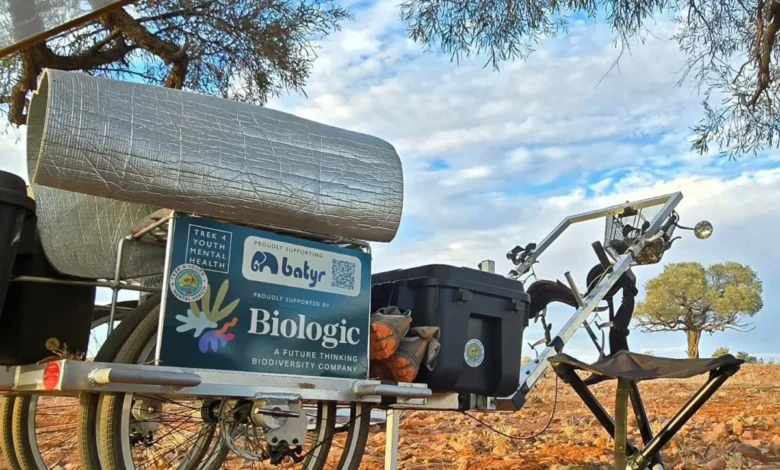
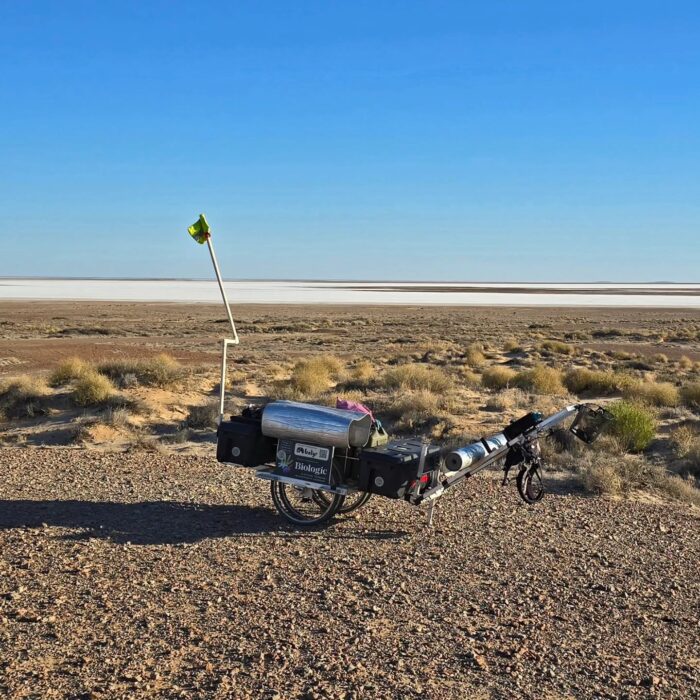
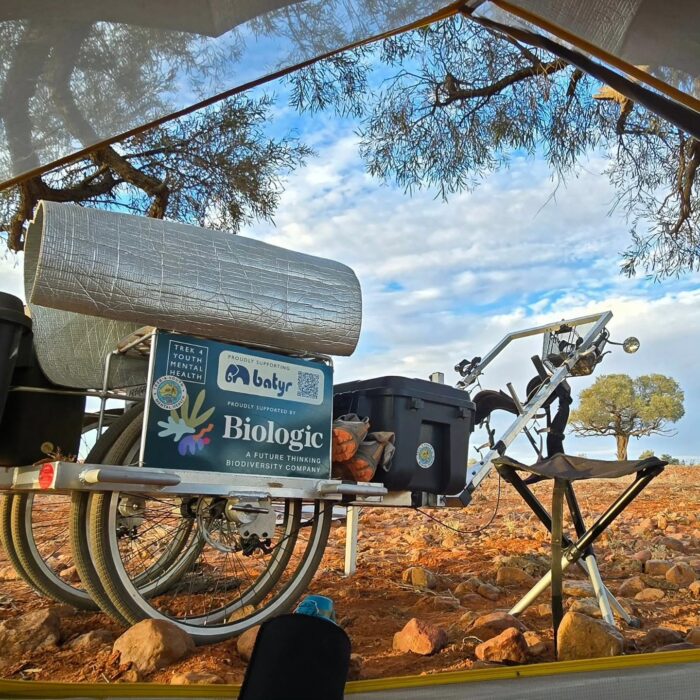
For an expedition of this magnitude, self-sufficiency is paramount, especially when traversing areas with vast distances between resupply points and limited water sources. Gresser’s solution was a specially designed 1.9-meter wheeled cart, capable of carrying a substantial payload of up to 200 kilograms. This capacity was crucial for transporting essential provisions: food, water, clothing, and various pieces of equipment necessary for survival in the harsh Australian environment. The choice of a wheeled cart, rather than a backpack, allowed for a greater volume and weight of supplies, extending the periods Gresser could spend entirely self-reliant in the wilderness.
The cart was pulled using a harness specifically designed for polar expeditions, manufactured by the Australian company Icetrek. While polar expeditions demand resilience against extreme cold, the principles of efficient weight distribution and robust construction translate effectively to the demands of hauling heavy loads over varied and challenging terrain, even in extreme heat. This specialized equipment undoubtedly played a critical role in Gresser’s ability to sustain his trek over such an extended period.
However, even the most robust gear can succumb to the rigors of the outback. Just 500 kilometers into his journey, an arm on Gresser’s cart broke. This early setback could have easily derailed the entire expedition. Fortunately, he was close to a remote work camp, a testament to the unexpected lifelines that can appear in isolated regions. The ability to have the cart repaired in such a locale highlights the importance of both preparedness and the occasional kindness of strangers in remote areas. Such incidents underscore the unpredictable nature of long-distance expeditions and the necessity of adaptability.
The logistical challenge extended beyond the cart itself. Gresser meticulously planned his nutrition, dehydrating hundreds of meals in advance and mailing them to periodic resupply points. This strategy minimized weight carried at any one time while ensuring a consistent and adequate calorie intake. On the trail, his routine was grueling: typically walking for eight to nine hours a day, often in temperatures soaring up to 50°C. In some of the most extreme conditions, particularly during intense heatwaves or when pushing for distance, he would sometimes sleep for only two or three hours, opting to rest during the cooler parts of the day – a luxury often limited by the absence of natural shade across vast sections of his route.
Battling the Elements: Extreme Conditions and Unforeseen Obstacles
The Australian outback is renowned for its extremes, and Gresser encountered them all. The scorching heat, often reaching a blistering 50°C, was a constant companion, demanding meticulous hydration and careful management of physical exertion. The landscape itself presented an ever-changing series of obstacles, from rocky tracks to soft sand and dense scrub. The vast distances between any form of human settlement meant that any problem, from equipment failure to medical emergency, had to be managed with extreme self-reliance.
One of the most dramatic challenges came near Tibooburra, a remote outback town situated near the borders of New South Wales, Queensland, and South Australia. Here, the usually parched landscape transformed under the onslaught of flash flooding and violent electrical storms. Gresser recounted sheltering on the ground in torrential rain for over an hour as lightning struck dangerously close by. Following the storm, the tracks became impassable quagmires of mud, leaving him stranded approximately 70 kilometers from the nearest town. In this instance, seeking assistance from National Park rangers became a matter of necessity, illustrating that even the most prepared adventurer sometimes requires external support when nature unleashes its full fury.
The Strzelecki Desert in northeast South Australia presented another formidable test of endurance. Gresser spent 18 arduous days covering 463 kilometers through this region, including a particularly challenging 120-kilometer stretch dominated by sand dunes. Unlike the impassable dunes of the Simpson, these could theoretically be crossed, but their steepness proved too much for his fully loaded cart. This necessitated a painstaking and repetitive process of unloading equipment, ferrying supplies in stages over the dunes, and then retrieving the empty cart to repeat the process. This method, often referred to as "shuttling," drastically slows progress and compounds the physical and mental strain, turning each kilometer into a monumental effort.
Echoes of Giants: Gresser’s Place in Australian Trekking History
Mark Gresser is not the first to undertake such an epic journey across Australia, nor is he likely to be the last. His achievement stands as a testament to the enduring human desire for exploration and endurance, placing him among a small, elite group of individuals who have conquered the continent’s vastness on foot.
Perhaps the most famous predecessor is Robyn Davidson, whose 1977 journey across 2,700 kilometers of Western Australian desert with four camels became an international sensation. Documented in a National Geographic article and later in her acclaimed book Tracks, Davidson’s expedition captured the public imagination, transforming her into a symbol of independent spirit and female resilience. Her use of camels, traditional beasts of burden in the Australian desert, represented a different approach to self-sufficiency, relying on animal companionship and centuries-old methods of desert travel. The story was later adapted into a successful feature film, further cementing its cultural impact.
Another formidable figure in Australian trekking is Jon Muir, a truly hard-core adventurer who completed a 2,500-kilometer south-to-north crossing from Port Augusta to Burketown in 2001. Muir’s 128-day expedition was characterized by an extreme level of self-reliance, as he hauled his supplies in a cart while also actively scavenging for his own food and water, pushing the boundaries of survivalism. His journey, chronicled in his book and documentary Alone Across Australia, remains a benchmark for minimalist, unsupported trekking.
Looking further back in history, Aidan de Brune, an English journalist, holds the distinction of being the first person to walk the perimeter of Australia unaccompanied. Leaving Sydney in September 1921, de Brune spent an astonishing two and a half years covering approximately 16,000 kilometers around the continent before returning to Sydney in March 1924. His pioneering trek, undertaken with far more rudimentary equipment and communication than available today, highlights an earlier era of exploration where sheer determination and resilience were the primary tools.
These historical precedents provide crucial context for Gresser’s achievement. While modern gear, navigation technology (like GPS), and communication devices (like satellite phones) offer certain advantages, the fundamental challenges of the Australian interior – the isolation, the heat, the lack of water, and the unforgiving terrain – remain largely unchanged. Gresser’s use of a wheeled cart aligns him more closely with Muir’s approach than Davidson’s camels, but his specific west-to-east route and the detailed logistical planning for food and water represent a contemporary evolution of these mega-journeys. The estimated eight people who have completed solo, unsupported walks across or around the country underscore the extreme difficulty and rarity of such accomplishments, firmly placing Gresser among the elite few.
Beyond the Steps: The Zoologist’s Perspective and Broader Implications
Beyond the sheer physical accomplishment, Mark Gresser’s background as a zoologist lends a unique perspective to his expedition. His intimate, sustained exposure to Australia’s diverse ecosystems would have provided invaluable observations on the continent’s flora and fauna, the subtle shifts in landscape, and potentially the impacts of environmental change in these remote areas. While his primary focus was undoubtedly survival and forward momentum, a zoologist’s trained eye would have absorbed countless details about the natural world that an ordinary trekker might miss. This deep connection to the environment may have also served as a powerful motivator, fostering a profound appreciation for the majesty and fragility of Australia’s interior.
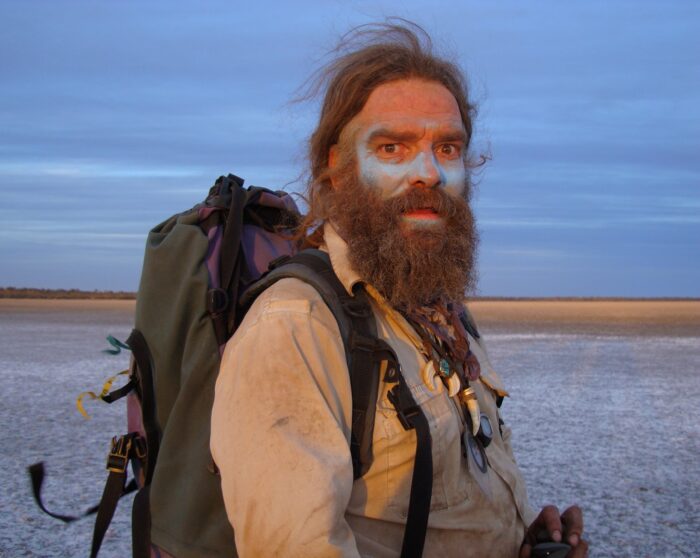
Gresser’s journey is a powerful testament to the enduring human spirit and the remarkable limits of physical and mental endurance. To sustain such an effort for 331 days, facing extreme temperatures, grueling terrain, and profound isolation, requires extraordinary resilience. His ability to adapt to setbacks, from cart breakdowns to flash floods, and to meticulously plan complex logistics, speaks volumes about the meticulous preparation and unwavering determination required for such an undertaking.
In an increasingly connected world, unsupported expeditions like Gresser’s offer a vital counter-narrative, reminding us of the wild, untamed spaces that still exist and the profound personal growth that can be found in confronting them. Such journeys inspire future explorers, demonstrating what is possible when human will is pitted against nature’s grandeur. They also implicitly call for a greater appreciation and protection of these invaluable wilderness areas, highlighting their unique ecological significance and their role in challenging and defining the human spirit. Mark Gresser’s epic walk across Australia is not merely a record of distance covered, but a vivid chronicle of human perseverance, a deep engagement with the natural world, and a profound contribution to the legacy of Australian exploration.
Related posts: