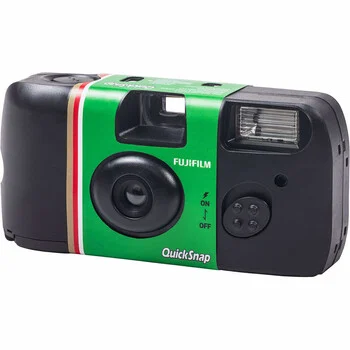
The evocative sensation of being nine years old in 1996, clutching a Kodak FunSaver on a wrist strap, its flash unit audibly cycling and the telltale red ready light blinking, is a memory etched in the minds of many. With a finite 27 exposures and the agonizing wait for prints from the grocery store photo counter a week later, this simple device offered a unique, unadulterated photographic experience. It was a camera that demanded nothing and promised only the possibility of captured moments, a feeling that has inspired a resurgence of interest in its minimalist design. The disposable camera, epitomized by the Kodak FunSaver and Fujifilm QuickSnap of childhood, represents an era of honest photography, characterized by its unpretentious functionality. Lacking autofocus, exposure meters, menus, or customizable settings, it featured a single fixed focal length, aperture, and shutter speed. Pre-loaded with 27 exposures, the certainty of not seeing any results until film processing was complete defined its essence. This straightforward approach, where the camera performed its singular function regardless of the user’s readiness, is now influencing the design of contemporary, more sophisticated photographic equipment. The photography industry, recognizing this enduring appeal, has begun to incorporate the disposable camera’s inherent constraints into high-end gear, suggesting a deeper understanding of what users truly desire from a camera when not operating under professional demands.
The Childhood Ritual of the Disposable Camera
The user experience of the disposable camera was a consistent ritual. Upon opening its cardboard packaging, adorned with stylized film graphics, one encountered a plastic body with an ergonomically textured grip and a small, rectangular viewfinder. This viewfinder, often misaligned with the actual lens, offered only a rough approximation of the final image. The advance thumbwheel on the back required a deliberate, firm pressure to engage the next frame, a tactile process that, for a child, could be slightly challenging and even a little painful as plastic teeth engaged. Failure to advance the wheel fully resulted in overlapping frames, rendering both unusable.
The integrated flash, activated by a front-mounted switch, illuminated an orange indicator light. Users had to wait for this light to cease blinking, a period that often felt interminable when attempting to capture fleeting, humorous moments. A faint, high-pitched whine accompanied the flash’s recharge cycle. By the time the ready light indicated the flash was prepared, the opportune moment might have already passed. However, the abundance of 27 exposures generally encouraged photographers to proceed, unwilling to waste a frame by overthinking the delay.
The viewfinder’s imprecision was a well-understood limitation. Parallax error meant the lens captured a slightly different perspective than what the viewfinder displayed. This often resulted in heads being partially cropped from the final images, a common occurrence that was largely accepted. The imperfections were not a cause for significant concern, as the primary value of these photographs lay not in their technical perfection but in their ability to serve as memory triggers and conversation starters. They were catalysts for shared recollections, such as, "Oh my gosh, this is when they brought out the cake with the wrong name!"
The most enduring aspect of shooting with a disposable camera was the anticipation of the results. Completing a roll during a birthday party, vacation, or sleepover meant the camera would sit on the kitchen counter for a week or two before being dropped off at the photo counter, often located within larger retail spaces like grocery stores or dry cleaners. Another week would then pass for film processing at a regional lab. The subsequent retrieval of the photograph envelope, followed by a careful perusal of the prints in the passenger seat of a car, revealed a mixed bag: many blurry, overexposed, or underexposed images, interspersed with a few surprisingly successful shots. Crucially, the context of which specific moments had been intentionally captured was often lost, leaving only the serendipity of the developed images.
The Enduring Appeal and Resurgence of Disposable Cameras
While disposable cameras did not entirely disappear from the market, their dominance waned with the rise of digital point-and-shoot cameras in the early 2000s and subsequently smartphones by the early 2010s. Nevertheless, they maintained a presence on retail shelves, catering to tourists, wedding events, and individuals seeking a carefree photographic option for beach trips.
A significant shift occurred around 2018 when a new demographic of photographers, having grown up with smartphones and with no prior experience with film cameras, began intentionally purchasing disposable cameras. The primary draw was the distinct aesthetic: the warm color casts often associated with expired film, the pronounced flash fall-off, the characteristic light leaks, and the inherent grain. This "cheapness" of image quality, an artifact that digital photography had spent a decade striving to eliminate, became a sought-after characteristic. The imperfect aesthetic, once considered a flaw, was now embraced as a desirable artistic element. Platforms like Instagram and TikTok became inundated with images captured on disposable cameras, revitalizing the 1980s-designed Kodak FunSaver and Fujifilm QuickSnap, cameras that had remained largely unchanged and had gained a new wave of popularity precisely because of their unwavering simplicity.
The economic viability of these cameras persists. Current models of the Kodak FunSaver and Fujifilm QuickSnap Flash 400 retail for approximately $20 and are widely available across major retailers and photography supply stores. Their fundamental construction remains consistent with the cameras of the past, a testament to the efficacy of their original design, which has proven to be remarkably resistant to improvement or alteration.
Lessons from the Constraints of Disposable Cameras
The absolute constraint imposed by a disposable camera is its defining characteristic. Users cannot second-guess exposure settings, as there are none to adjust. Focus is fixed, and there is no preview screen to check composition. Once a shutter is pressed, the frame is committed, and there is no option to delete it. Color rendition is predetermined by the film stock loaded at the factory. With 27 exposures, each costing approximately a dollar when factoring in the camera and development, the sole decision available to the photographer is the simple choice of whether to press the shutter at that moment or to wait for a potentially "better" opportunity.
This level of unmediated surrender is unparalleled in modern photography. Even fully manual film SLRs offer metering and composition control, while point-and-shoot cameras provide some degree of exposure adjustment. The disposable camera, however, is essentially a box with a lens that opens and closes once per frame, placing the entire responsibility on the photographer to aim and commit to capturing something deemed photographically significant.
The inherent lesson is one of overcoming overthinking. Many photographs taken throughout a lifetime are the result of excessive deliberation: multiple metering checks, white balance adjustments, compositional refinements, or numerous burst-mode shots in pursuit of the perfect frame, often followed by immediate review and reshoots. The disposable camera bypasses all of this, presenting a clear directive: "This is the shot; take it or leave it. The next frame awaits." This forced decisiveness often leads to the capture of genuinely resonant moments, images that might have been overanalyzed and ultimately compromised if the camera had offered more control.
Disposable Cameras as the Unofficial Wedding Photographer
In recent years, disposable cameras have become a popular fixture at wedding receptions. Placed on tables, often with accompanying instructions, they encourage guests to document their experiences throughout the event. The resulting rolls of film, developed in the week following the ceremony, provide couples with a candid, unfiltered perspective of their celebration, capturing moments that a professional photographer might miss.
The inherent unreliability of disposable cameras is, in this context, a feature rather than a bug. Smartphone photography at weddings often results in images that are too polished, too composed, and too algorithmically corrected, leading to a homogeneity of visual style. In contrast, disposable cameras yield photographs that are frequently blurry, imperfectly composed, and marked by flash glare, yet they possess a spontaneity and authenticity that polished digital images often lack. These candid shots capture the essence of the celebration, from the jovial uncle at late-night revelry to the handwritten notes on a napkin, offering intimate glimpses into moments beyond the professional photographer’s constant presence. Furthermore, their presence subtly encourages guests to put away their smartphones and engage more directly with the event.
Professional wedding photographers generally view these disposable cameras not as competition but as a valuable complement to their own services. Couples hire professionals for the meticulously planned portraits, ceremony coverage, and staged reception moments. The disposable cameras on the tables are intended to capture the ephemeral, the spontaneous, and the unscripted – the moments that a single photographer cannot simultaneously document across an entire venue. The juxtaposition of professional coverage and candid guest snapshots often creates a cherished collection that couples treasure for decades.
The Industry’s Acknowledgment: Digital Echoes of the Disposable
The photography industry has, in recent years, begun to integrate the core principles of disposable cameras into more advanced digital devices, demonstrating a recognition of their inherent value. Several cameras released in the past two years have deliberately incorporated these constraints, emerging as some of the most intriguing offerings on the market.
The Fujifilm X Half, launched in 2025 at a price point of $849, stands as a clear embodiment of the disposable camera ethos in a modern digital body. Its "Film Camera Mode" simulates a virtual roll of up to 36 frames, prohibiting image previews until the roll is completed. A physical film advance lever must be engaged between each shot, further mimicking the tactile experience of analog photography. Crucially, the X Half eschews raw file support, delivering JPEG images processed through Fujifilm’s renowned film simulations, committed to the memory card without an immediate preview. While its price has drawn criticism from some reviewers who question its value proposition, the X Half offers a distinct experience. It is one of the few contemporary digital cameras that intentionally evokes the anticipation of discovering the full roll of images, a direct descendant of the FunSaver’s appeal.
Another notable device is the Flashback One35, a screenless digital camera designed to replicate the disposable experience with advanced sensor technology. Lacking a display and any user-adjustable settings, it features a photo counter and aims to recreate the "take the shot and find out later" sensation pioneered by the FunSaver.
These two cameras share a design philosophy that had largely fallen out of favor in mainstream photography, signaling a potential industry-wide reawakening. Larger format cameras are also exploring similar avenues. The Fujifilm X100 series, the Leica Q3, and emerging medium format fixed-lens cameras all represent a commitment to specific functionality rather than a pursuit of universal applicability. Their philosophical lineage can be traced back to the disposable camera’s foundational insight: that a camera with fewer decision-making processes can often lead to superior photographic outcomes.
This principle, learned from the humble disposable camera, has guided subsequent photographic choices. The guiding principle is to acquire cameras that facilitate the act of taking pictures, rather than those that encourage endless contemplation of the photographic process. The disposable camera, through its absolute lack of features, excels at this, prompting users to capture moments more effectively than many other devices. The most impactful modern cameras are those that retain elements of this simplicity while incrementally adding capability. The X Half and the Flashback One35 exemplify this approach. Surviving point-and-shoot cameras are those that have accepted their niche as specialized tools, designed to be readily available when a photographic opportunity arises.
The paramount lesson of the disposable camera is not its technical superiority; by most objective measures, it produces inferior photographs compared to professional equipment. Its true value lies in the understanding that the photograph itself is not always the ultimate objective. The act of photographing is paramount, and a camera that facilitates this act, rather than impeding it, earns a place in one’s life as a tangible marker of memory. The disposable camera, despite its limitations, achieves this with remarkable efficacy. At a cost of approximately $20, it offers one of the most accessible and profound photography lessons available.