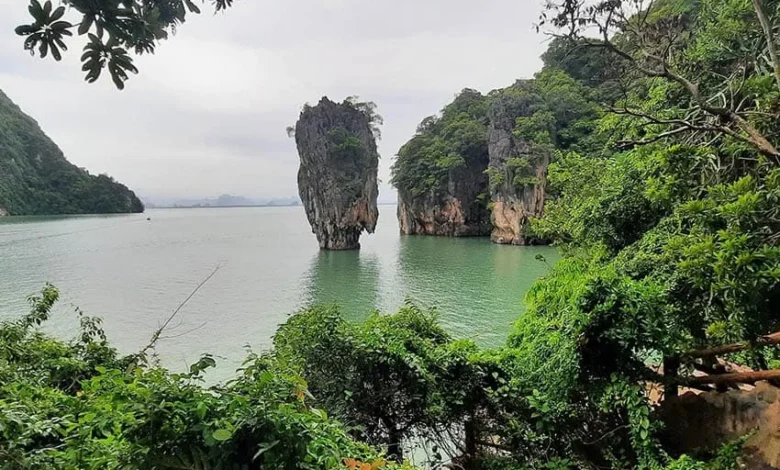
For decades, international travelers planning a marine excursion from Phuket have been greeted by a singular, ubiquitous image: a dramatic limestone pinnacle rising straight out of jade-green waters, famously featured in the 1974 James Bond film The Man with the Golden Gun. Known officially as Khao Phing Kan within the Ao Phang Nga Marine National Park, this geological wonder undeniably warrants its iconic status. However, the postcard-perfect framing often conceals a frustrating reality for modern tourists: mass congestion. Operating on rigid, synchronized timetables, standard commercial tour operators routinely funnel hundreds of visitors onto the narrow strip of beach between 11:00 AM and 2:00 PM, leaving travelers with mere fractions of an hour to absorb the scenery before the next armada arrives.
Yet, travel experts and regional marine operators point out that the broader expanse of Phang Nga Bay offers far more than its most photographed landmark. By rearranging the itinerary and shifting away from shared-vessel group tours, travelers can experience an entirely different side of southern Thailand’s maritime geography without traveling an extra nautical mile. The key differentiator is not luxury or vessel size, but control over time itself.
The Strategic Advantage of Private Charters
While luxury yacht charters are frequently marketed as exclusive status symbols, local marine veterans emphasize that booking a private boat primarily buys chronological flexibility rather than velvet-rope indulgence. Standard joined tours bind passengers to a fixed logistical clock dictating departure times, lunch stops, and turnaround windows. Conversely, chartering an entire vessel with a professional crew allows travelers to dictate their own pace, capitalizing on optimal tidal shifts and strategically bypassing the primary tourist influx.

According to maritime specialists operating out of Phuket’s major hubs, this flexibility transforms a standard sightseeing trip into an unhurried exploration. Private operators can schedule arrivals at major attractions either in the early morning hours—before the mainland fleet departs—or late in the afternoon after the commercial crowds have dissipated. This scheduling agility is particularly crucial when navigating the bay’s more dynamic natural formations, where access is dictated strictly by lunar cycles rather than human convenience.
The Tidal Imperative of Koh Hong
Among the destinations most dependent on precise timing is Koh Hong in Phang Nga Bay. In the Thai language, hong translates to "room," a literal description of an inland lagoon carved into the interior of a massive limestone island through millennia of erosion. Accessible solely through a low, narrow sea cave, the inner lagoon is a sanctuary of profound silence, enclosed by vertical rock faces rising 60 to 80 meters high. Visitors transfer from their main vessel into single-file canoes, paddling through the shadowy passage as the ambient noise of the bay completely fades.
However, navigating the entrance presents a profound logistical challenge dictated entirely by the tides. At high water, the clearance between the cave ceiling and the waterline drops too low for canoes to pass safely. Conversely, at low water, the shallow depths prevent watercraft from floating over the submerged obstacles in the passageway. The accessible window is restricted to a narrow band during mid-tide—roughly an hour on either side of the transition—which shifts daily across the lunar month.
Mass-market commercial tours struggle to accommodate these fluctuating windows, often arriving when the tides preclude entry, leaving canoes stacked unused on the upper decks of tour boats. Private charters, by contrast, consult rigorous tide tables months in advance, engineering the day’s chronological blueprint backward from the exact minute the lagoon becomes navigable.

Chronology of an Optimized Bay Itinerary
Experienced captains operating within the marine park typically recommend an itinerary designed around crowd psychology and environmental constraints rather than linear geography. A well-optimized private day tour generally follows a deliberate four-part chronological sequence:
- Morning Arrival at Khao Phing Kan: Departing Phuket marinas by 8:30 or 9:00 AM allows private vessels to reach James Bond Island by approximately 9:30 AM. This early arrival successfully preempts the massive wave of high-capacity tour boats launching from mainland piers, granting visitors unobstructed views and peaceful exploration of the site.
- Mid-Day Tidal Alignment at Koh Hong: Following the initial landmark stop, the vessel positions itself near Koh Hong precisely as the mid-tide window opens, ensuring seamless canoe entry into the inner lagoon without navigational delays or congestion.
- Afternoon Exploration of Sea Caves: During the afternoon hours, when standard tour fleets begin their hurried journeys southward back to Phuket, private charters navigate into the dark, tranquil sea caves of Koh Panak. Here, visitors can explore cavern networks in absolute quiet.
- Late Afternoon Island Respite: The return journey to Phuket is commonly broken up by a relaxed stop at the Naka Islands, allowing passengers to swim or unwind on secluded beaches before docking as the sun begins to set.
Total duration for such an itinerary typically spans eight to nine hours, incorporating freshly prepared hot meals cooked on board at anchor rather than rushed buffet lunches served in crowded tourist coves.
Logistical Realities: Marina Selection and Vessel Positioning
Phuket’s geographic footprint plays a decisive role in structuring a marine excursion. The island features four primary working marinas, and the choice of departure point dictates both travel times and operational costs.

For travelers aiming specifically at Phang Nga Bay’s northern attractions, Ao Po Grand Marina on Phuket’s northeast coast offers a distinct logistical advantage. Situated approximately 18 kilometers from Koh Hong, departures from Ao Po require a transit time of roughly 30 minutes. In contrast, southern departure points such as Chalong Pier place the same destination nearly 48 kilometers away, necessitating longer transit times and transforming a flexible half-day outing into a mandatory full-day commitment. Marine logistics planners advise families traveling with small children or individuals with limited time frames to prioritize marina proximity over vessel amenities when selecting a charter.
Economic Analysis and Seasonal Pricing Structures
Navigating the pricing structure of Thailand’s marine charter industry often requires a shift in perspective for international visitors. Unlike standard tourist excursions priced on a per-person basis, regional charters are universally quoted per vessel. This inclusive rate covers the watercraft, professional crew, fuel for an agreed-upon itinerary, and onboard dining, while national park conservation fees are typically collected separately per head upon arrival.
For the 2026/2027 tourism season, baseline pricing for private maritime excursions reflects clear tiered scaling based on vessel capacity and comfort:
- Small Speedboats (capacity up to 6 passengers): Rates open at approximately 33,900 Thai Baht (roughly US$1,000) for a standard full-day itinerary.
- Sailing Catamarans (40-foot vessels accommodating up to 15 passengers): Starting rates hover near 34,900 Thai Baht.
- Motor Yachts (42-foot vessels accommodating up to 10 passengers): Premium comfort charters begin around 39,900 Thai Baht.
- Specialized Half-Day Power Catamaran Charters (targeting Koh Hong out of Ao Po Marina): Rates commence near 50,000 Thai Baht (approximately US$1,500) for a focused five-hour voyage.
When analyzed on a per-person basis, the economic calculus shifts significantly depending on group composition. For a group of six travelers sharing a 50,000 Baht specialized charter, the cost equates to approximately US$250 per participant—a competitive rate relative to overcrowded commercial alternatives. For larger groups of twelve or more, individual costs decrease correspondingly. Conversely, intimate parties consisting of only two travelers may find private charters financially comparable to or exceeding standard group bookings.

Weather patterns also dictate operational feasibility throughout the year. The southern Andaman Sea experiences a pronounced high season from November through April, characterized by calm seas and clear skies, followed by the southwest monsoon low season from May to October. However, Phang Nga Bay remains exceptionally sheltered by surrounding landmasses, allowing marine operators to conduct safe, stable excursions year-round—even during periods when west-coast beach destinations face severe maritime restrictions.
Industry Implications and Recommendations
As regional tourism boards in Thailand increasingly emphasize sustainable destination management and visitor dispersion, marine operators are pivoting toward tailored itineraries that alleviate environmental strain on fragile ecosystems like Khao Phing Kan. Industry stakeholders suggest that educating consumers on the mechanics of tidal schedules and private charter economics not only enhances individual travel satisfaction but also distributes tourist traffic more equitably across the vast geography of the marine park.
Ultimately, marine specialists emphasize that while the famous limestone pinnacle remains a mandatory visual milestone for any journey to southern Thailand, anchoring an entire travel schedule around its rigid midday crowds overlooks the true geographic breadth and quiet majesty of Phang Nga Bay.