Western Nepal remains one of the final frontiers for high-altitude alpinism, a region defined by its rugged topography, logistical isolation, and a wealth of unclimbed 6,000-meter peaks. While the global climbing community has become increasingly concentrated on the commercialized slopes of the 8,000-meter giants, a different breed of explorer continues to seek the silence of the unknown. Swedish alpinist Fredrik Strang and Norwegian climber Sindre Kolbjornsgard recently ventured into this remote landscape, seeking the purity of a first ascent. Their journey, which culminated in the summiting of a striking 5,337-meter rock formation, offers a profound reflection on the evolving nature of adventure in an increasingly mapped world.

The expedition was born from a growing dissatisfaction with the modern, industrialized state of high-altitude mountaineering. Having collectively participated in 18 expeditions to 8,000-meter peaks, Strang and Kolbjornsgard had witnessed firsthand the transformation of once-wild summits into hubs of fixed-rope queues, helicopter noise, and constant radio communication. Seeking a return to the roots of the sport, they adopted a philosophy famously articulated by Ed Viesturs: "The point is to climb, not just to summit." This ethos prioritized the process, the autonomy, and the technical challenge of exploring uncharted terrain over the prestige of a checklist ascent.
The Logistical Hurdles of the Remote West
The logistical reality of Western Nepal stands in stark contrast to the infrastructure found in the Khumbu or Annapurna regions. The team’s objective, located in the Nyalu Lek area north of Simikot, required navigating a precarious path through a landscape where even basic access is frequently compromised. The journey began in Surkhet, with a grueling two-day transit to Simikot by road. During this phase, the team encountered the immediate impact of climate and terrain volatility, as landslides had significantly damaged the primary transit arteries.

Upon reaching Simikot, the expedition faced its first major setback: the Nyalu La, a critical 5,000-meter mountain pass, was deemed impassable due to the accumulation of early-season snow and damaged trail conditions. This forced a strategic pivot. Rather than attempting a high-risk crossing with their support team, pack animals, and porters, the pair re-evaluated their trajectory. They established a base camp at Phendol Kermi, a location that offered access to several secondary peaks despite the encroaching winter conditions.
A Chronology of Exploration
The expedition’s timeline was dictated by the volatile weather patterns typical of late autumn in the Himalayas. On October 6, the team completed their first successful acclimatization climb on a 5,177-meter peak (30°20’49.82”N, 82°03’54.82”E). This ascent, while technically straightforward in its lower reaches, underscored the physical toll of exploration in the region; the team encountered knee-to-waist-deep snow above 4,500 meters, effectively turning every meter of elevation gain into a labor-intensive excavation.

Following this, the pair turned their attention to a second, previously unclimbed objective at 5,227 meters (30°07’50.86”N, 81°41’56.58”E). The experience was remarkably similar in terms of the environmental challenge, with deep snow hindering progress until they reached the upper summit ridge, where they encountered mixed rock and ice graded at PD+. The technical nature of these early climbs served as a vital testing ground for their eventual target.
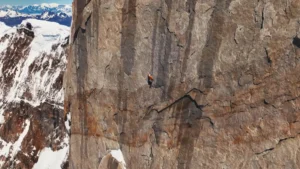
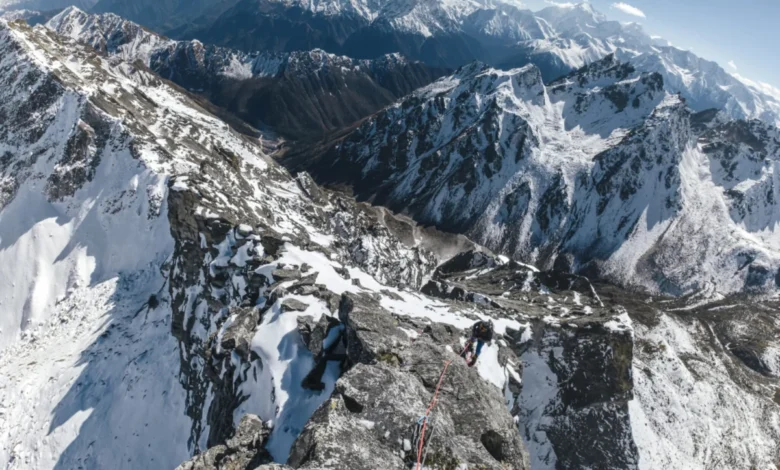
The primary objective was a dramatic 5,337-meter rock spire overlooking Yangchya Lake, which the team tentatively named "Daara Peak," derived from the Nepali word for a projecting fang. The peak was visually striking—a vertical, eight-meter overhanging pinnacle that dominated the local skyline. Their first attempt to scale the northeast headwall was thwarted by heavy, unstable snow conditions, forcing a retreat to base camp. On October 17, they launched a second, successful attempt. The ascent spanned five pitches of technical climbing, including vertical granite faces and a crux section rated at M6. The final push required navigating a narrow granite edge topped with 30 centimeters of snow, ultimately reaching the summit on October 18.

Parallel Expeditions and Scientific Observations
During their time in the Phendol Kermi region, Strang and Kolbjornsgard encountered British alpinists Mick Fowler and Victor Saunders. The presence of such seasoned veterans in the same remote valley highlights the increasing interest in Western Nepal’s untapped peaks. Fowler and Saunders had been attempting an unclimbed 6,000-meter peak known as Peak 6010. Their failure, caused by excessive snowfall, mirrored the challenges faced by the Swedish-Norwegian team and underscored the region’s unpredictability.
Data collected during the trip, including the comparison of route-finding strategies on the 5,227-meter peak, provided valuable insights for future expeditions. Strang noted that Fowler and Saunders identified a more efficient line on the western side of the peak during their subsequent attempt, a detail that reinforces the subjective nature of first ascents. The fact that the first team to encounter a feature does not necessarily find the most logical path is a hallmark of true exploratory climbing, where intuition and local conditions dictate the outcome.

The Ethical Implications of Modern Alpinism
The expedition serves as a case study for the "exploration paradox." As access to remote corners of the globe becomes easier through satellite imagery and improved, albeit fragile, infrastructure, the very solitude that explorers seek is threatened by their own presence. Strang has been vocal about the ethical weight of this phenomenon. He argues that the goal of modern mountaineering should not be the systematic mapping and climbing of every peak, but rather the preservation of the "unknown."
"The point is not to ban access, but to exercise restraint," Strang noted. The silence he experienced on the summit of Daara Peak—the absence of the mechanical hum and human clamor that defines modern high-altitude climbing—is a finite resource. If every peak is turned into a trophy or a line on a map, the unique psychological and spiritual value of the "first ascent" is fundamentally diminished.

Broader Impact and Future Outlook
The technical success of the Daara Peak ascent, combined with the successful navigation of extreme snow conditions, contributes to a growing database of information regarding the mountaineering potential of Western Nepal. However, the broader implication of the trip is one of environmental and cultural stewardship. The team’s commitment to minimal impact and their respect for local place names (such as the proposal for "Daara Peak") reflect a shift toward a more sustainable model of mountaineering—one that prioritizes the integrity of the environment over the personal glory of the climber.
As the international mountaineering community looks toward the future, the lessons from the Nyalu Lek area suggest that the next era of exploration will not be defined by the altitude of the mountains, but by the manner in which they are approached. The shift away from the "conquest" mentality of the 20th century toward a more nuanced, reflective practice is likely to define the next generation of Himalayan exploration. For Strang and Kolbjornsgard, the summit was merely a point in space; the true achievement was the preservation of a singular, silent experience in a world that is rapidly running out of places left to discover. As they descended, they left the mountain as they found it: standing in isolation, a jagged reminder that some questions are best left without a definitive, recorded answer.