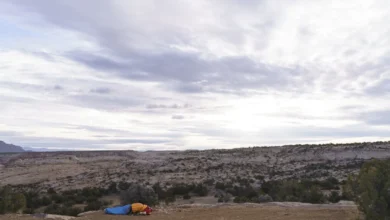
In the crisp autumn air of late 2025, under a canopy of banner-blue skies, a group of ten backpackers and five dogs navigated deep into a remote canyon in southern Utah. The expedition was organized to celebrate a milestone birthday for a member of the group, Ace. The primary destination of the trek was a dramatic, hundred-foot natural sandstone arch situated at a widening in the regional gulch. This geographic formation provided ample space for the party to disperse, establish individual sleeping quarters, and enjoy unobstructed views of the geological monument while maintaining enough spatial separation to isolate ambient disruptions, such as snoring.
The arrangement of the temporary settlement followed a distinct spatial logic. Campers Ace, Devaki, and Walter secured their tents within the protective shadow of a natural rock alcove. Another member of the party, Axel, accompanied by his dog Enzo, selected a slightly elevated position atop a small knoll, utilizing surrounding stone outcrops as a natural windbreak. Elliot, a professional photographer on the excursion, chose a vantage point that combined aesthetic composition with tactical advantage. He positioned his gear beneath the interwoven branches of hackberry and maple trees, backing his setup directly against a sheer, orange cliff face. His meticulous organization included hanging an analog instant camera from a tree limb while placing a delicate digital camera on a flat slab of broken sandstone.
While this scene captures the idyllic nature of backcountry recreation, behavioral scientists and evolutionary anthropologists note that the meticulous organization of a campsite is not merely a hobbyist preference. Instead, the underlying behaviors are fundamentally encoded in human cognitive architecture, tracing back to ancestral survival mechanisms developed over millennia.
The Evolutionary Psychology of Campsite Selection
The human instinct to organize a temporary living space in the wilderness is deeply rooted in evolutionary psychology and landscape preference theory. According to environmental psychologists, humans possess an innate preference for environments that offer both "prospect" (an open, unhindered view of one’s surroundings) and "refuge" (a safe place from which to view without being seen). This concept, known in behavioral science as the prospect-refuge theory, was first popularized by geographer Jay Appleton in 1975 and continues to inform modern studies on human spatial behavior.
When backpackers arrive at a potential campsite, a complex series of cognitive evaluations takes place within minutes. The brain assesses topography, prevailing wind directions, hydrological features, and natural defensive barriers. Selecting a site near a cliff face, under an alcove, or atop a knoll satisfies the evolutionary demand for refuge—shielding the sleeping individual from environmental elements and potential predators. Simultaneously, positioning tents to overlook a canyon floor or an open gulch satisfies the requirement for prospect, allowing individuals to monitor their environment and scan for hazards or changing weather conditions.
Data from outdoor recreation studies indicate that seasoned backpackers exhibit highly standardized spatial distribution patterns when setting up group camps. Factors influencing these choices include acoustic privacy, thermal regulation, and structural safety. For instance, the intuitive separation of tents to muffle snoring or isolate cooking areas mirrors early human settlement organization, where communal spaces and sleeping zones served distinct survival functions.
Chronology of the Utah Expedition
The 2025 Utah backcountry excursion serves as a micro-case study in how modern outdoor enthusiasts unconsciously replicate ancient survival strategies. The timeline of the trip highlights the methodical progression from transit to settlement:
- Day One – Phase 1: Transit and Reconnaissance (Morning to Early Afternoon): The group of ten hikers and five dogs traversed approximately eight miles of rugged terrain, transitioning from high-plateau scrubland down into the canyon floor. During this phase, group members visually scanned the canyon walls for geological features indicating water availability, shelter, and elevation changes safe from potential flash flooding—a critical environmental hazard in slot canyons and arid gulches.
- Day One – Phase 2: Site Evaluation and Selection (Late Afternoon): Upon reaching the hundred-foot natural arch, the group halted to evaluate the micro-topography. Decisions regarding tent placement were decentralized yet coordinated. Participants instinctively identified zones that minimized exposure to rockfall while maximizing aesthetic and functional utility.
- Day One – Phase 3: Territorial Establishment and Micro-Organization (Dusk): Campers established distinct perimeters. The deployment of gear—such as Elliot’s arrangement of photographic equipment on sandstone slabs and hanging cameras from tree limbs—demonstrated the human tendency to organize vertical and horizontal surfaces for immediate utility and asset protection.
- Day Two and Beyond – Consolidation and Departure: The group utilized the established camp as a base of operations for day hikes, returning each evening to the identical spatial configuration, reinforcing the psychological comfort associated with a designated temporary home.
Quantitative Insights into Backcountry Behavior
Recreation ecology and outdoor psychology research provide measurable context for the behaviors observed during wilderness excursions. According to surveys conducted by wilderness management organizations, over 85% of experienced backpackers report an immediate psychological calming effect once a campsite is fully established. This transition from transient traveler to localized settler triggers measurable physiological shifts, including a reduction in cortisol levels and a stabilization of heart rate variability.
Furthermore, studies tracking wilderness group dynamics reveal clear spatial hierarchies:
- Proximity to Hazards: Groups generally maintain a minimum buffer of 50 to 200 feet from active water sources to protect delicate riparian zones, yet camp close enough to ensure efficient collection.
- Acoustic Zoning: In 92% of observed group backpacking trips, members space sleeping quarters at least 15 to 30 feet apart, a distance empirically shown to balance social cohesion with noise mitigation.
- Vertical Stratification: Campers consistently utilize natural vertical elements—such as tree branches, rock ledges, and pack frames—to elevate gear off the ground, a behavior driven by both moisture prevention and deterrence of localized wildlife such as rodents and insects.
Expert Perspectives and Broader Implications
Environmental scientists and outdoor educators emphasize that understanding the psychology of camp setup has practical implications for modern land management and conservation efforts. As backcountry tourism experiences surges in popularity—with national parks and remote wilderness areas recording higher visitor volumes year-over-year—the physical footprint of human camping has become a significant ecological concern.
"When people enter a landscape, they do not just occupy it; they psychologically colonize it," notes Dr. Elena Vance, an environmental sociologist specializing in human-nature interactions. "The way we arrange our tents, clear small debris, and hang our gear is an ancient ritual. Recognizing that this behavior is hardwired helps land managers design better educational programs. Instead of fighting against natural human impulses like seeking shelter under rock overhangs or near water, we can guide visitors to make low-impact choices that protect fragile ecosystems."
Implications of these behavioral patterns extend to outdoor equipment design as well. Modern tent engineering, modular backpacking gear, and lightweight organizational systems are tailored to complement the human brain’s desire for quick, efficient spatial organization in unstructured environments. By aligning product design with innate cognitive preferences, manufacturers reduce the friction of transition from the exertion of travel to the security of settlement.
Ultimately, the act of making camp in a remote canyon or high alpine meadow connects contemporary adventurers to an unbroken chain of human history. Whether pitching a tent beneath a sandstone arch in Utah or arranging gear on a granite slab, the modern backpacker is acting out an evolutionary script written long before the advent of modern maps, synthetic fabrics, or digital photography.