The Ancient Steppe Nomads: How Conservationists are Saving the Saiga Antelope from Infrastructure Fragmentation

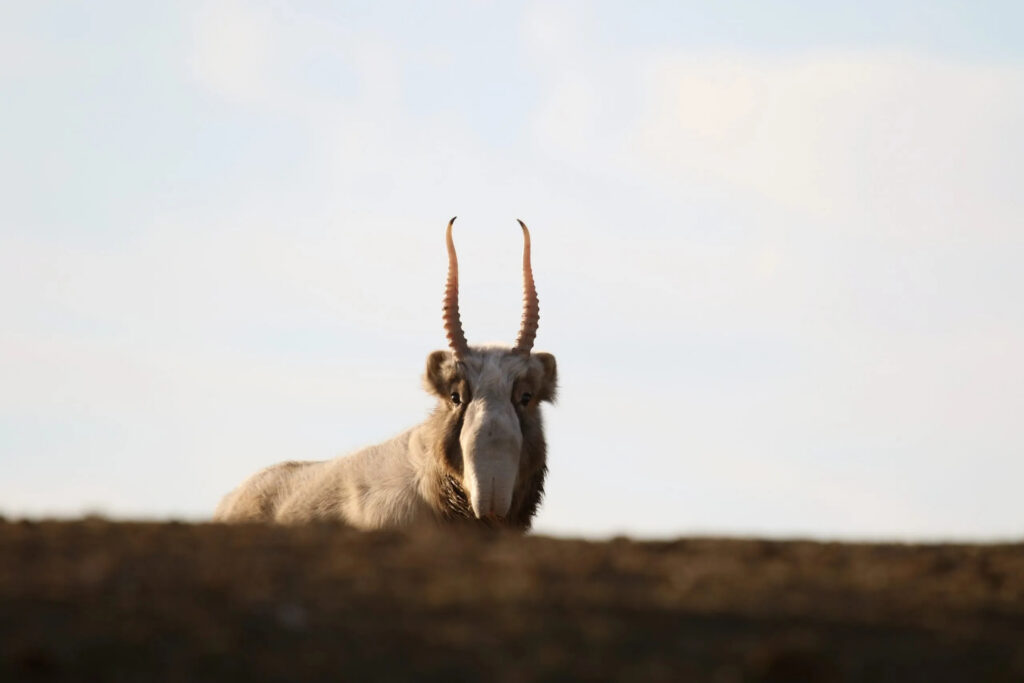
The vast expanses of the Eurasian steppe have long been defined by movement, resilience, and ancient migration patterns that predate modern human civilization. Central to this landscape is the saiga antelope (Saiga tatarica), an Ice Age survivor that once roamed alongside woolly mammoths and saber-toothed cats. Today, these distinctive ungulates—instantly recognizable by their elongated, trunk-like snouts and ringed horns—face a modern existential threat: rapid industrial development and linear infrastructure that threaten to sever their migratory corridors. Field audits conducted by conservation groups such as the Association for the Conservation of Biodiversity of Kazakhstan (ACBK) highlight both the fragility of these ancient pathways and the innovative cross-border measures being deployed to preserve them.
Historical Chronology and Evolutionary Context
The lineage of the saiga antelope extends back tens of thousands of years, anchoring them deeply in the prehistoric ecology of Central Asia. Long before human caravans traversed the harsh steppes, saigas established seasonal migration routes that spanned from the Caucasus Mountains to Mongolia. Historically, these nomadic ungulates served as vital ecological pathfinders for early human travelers navigating the arid and unforgiving terrain of the Eurasian interior.
The human history of the region mirrors this nomadic ethos. Since the Early Iron Age, local populations have engaged in seasonal migrations, giving rise to the cultural heritage of the Kazakh people—a term historically linked to wanderers or vagabonds. These traditional migration routes subsequently laid the geographical groundwork for the Great Silk Road, a network of transcontinental trade paths that utilized reliable stopovers along fertile riverbanks, such as the Ural River, which serves as the natural boundary between Europe and Asia.
However, twentieth-century geopolitical shifts, particularly the mandatory sedentarization policies of the Soviet Union, fundamentally disrupted traditional human mobility across the steppe. While human populations were largely transitioned into stationary agricultural and urban settlements, the saiga antelope maintained its ancient, sweeping migrations. This perpetual motion, while central to the species’ survival, now places them in direct conflict with twentieth- and twenty-first-century infrastructure.
Infrastructure Fragmentation and Spatial Knowledge Loss
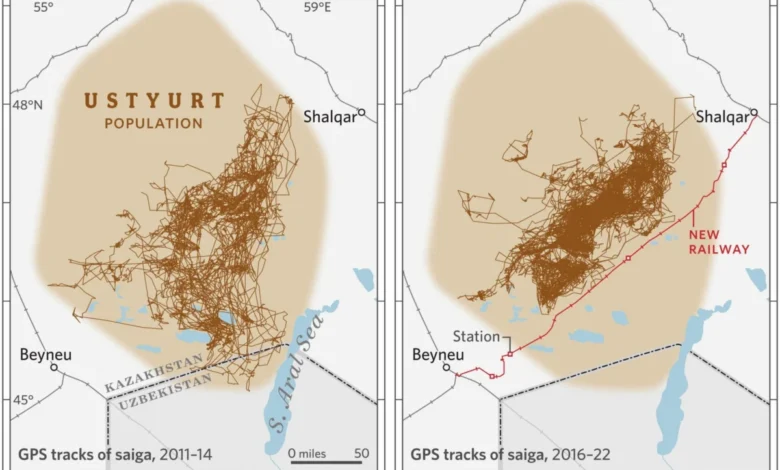
In recent decades, the rapid expansion of railways, paved highways, and border fences has fractured the Eurasian steppe. These linear barriers have increasingly segmented once-contiguous saiga populations into isolated, vulnerable groups.
Field tracking data gathered via GPS collars reveals the stark impact of such barriers. For instance, historical migration maps demonstrate that saiga herds routinely traversed international borders, moving deep into Uzbekistan before a newly constructed railway in 2014 abruptly cut off their historical pathways. Post-construction data shows herds congregating and turning back north against the tracks, unable to reach crucial southern pastures and water sources.
Conservation scientists emphasize that this physical blockage triggers a secondary crisis: the loss of spatial knowledge. Similar to how forced sedentarization eroded navigational traditions among human nomads, young saigas acquire migratory routes, foraging grounds, and shelter locations through generational observation. When infrastructure blocks these pathways, entire stretches of ecological memory fade, leading to demographic declines and behavioral disorientation among the herds.
Conservation Interventions and Cross-Border Collaboration
In response to these compounding threats, conservation organizations and governmental bodies have initiated targeted mitigation strategies. The Association for the Conservation of Biodiversity of Kazakhstan (ACBK), alongside regional authorities, has implemented structural modifications designed to restore landscape connectivity.
Among these interventions are specialized saiga-friendly crossings engineered along railway lines. These structures feature gently sloping dirt ramps that match the elevation of the tracks, creating the visual illusion of a continuous landscape. To prevent fatal collisions, engineers have installed cattle-guard fencing at a safe distance from the crossings, ensuring trains and animals remain separated while preserving the integrity of the migration route.
Furthermore, international cooperation has extended to cross-border barriers. ACBK has collaborated with Uzbek authorities to modify traditional barbed-wire border fences into X-shaped barricades. These redesigned structures effectively deter unauthorized vehicular traffic while leaving adequate clearance for saigas to traverse international boundaries freely.
Broader Ecological and Economic Implications
The preservation of the saiga antelope holds significant implications for the broader health of Central Asian grassland ecosystems. As a keystone nomadic species, saigas play a critical role in seed dispersal, nutrient cycling, and maintaining the structural integrity of the steppe. Their ability to survive extreme temperature fluctuations, harsh winters, and arid summers underscores their resilience, yet their long-term viability remains tightly coupled with landscape-level conservation policies.
From an analytical perspective, mitigating infrastructure impacts on migratory species requires a dual approach: integrating ecological corridors into national development planning and fostering robust transboundary governance between Kazakhstan, Uzbekistan, and neighboring states. As anthropogenic pressures on natural landscapes continue to mount, the ongoing efforts to safeguard the saiga serve as a critical case study in balancing infrastructural modernization with the preservation of ancient ecological heritage.