The Evolution of Ultralight Backpacking Shelter: Why the Flat Tarp is Making a Quiet Comeback in Modern Wilderness Travel

The landscape of backcountry shelter has undergone a profound transformation over the past three decades, shifting away from minimalist geometries toward highly structured, freestanding sanctuaries. Updated November 4, 2026 09:19AM, the discourse surrounding wilderness equipment reveals a striking dichotomy between absolute convenience and radical weight reduction. Many backpackers today will never pitch a flat tarp—they’ve lost ground as more secure and user-friendly ultralight tents have become ubiquitous across major trail systems worldwide. The dominant market share is currently held by double-wall freestanding tents and trekking-pole-supported pyramids that require minimal geometry knowledge to establish a secure campsite.
However, a counter-movement is quietly gaining traction among seasoned thru-hikers and traditionalists who prioritize weight-to-performance ratios above all else. If you’re willing to put in the effort to learn to rig one, you won’t find a lighter style of shelter—or a cheaper one. This renaissance of minimalist camping has forced gear manufacturers to reexamine traditional designs, bridging the gap between archaic bushcraft methods and high-tech synthetic textiles. Leading this charge into contemporary markets is equipment designed to ease novices into the methodology without sacrificing structural integrity during inclement weather events.
The Engineering and Anatomy of Modern Tarp Shelters
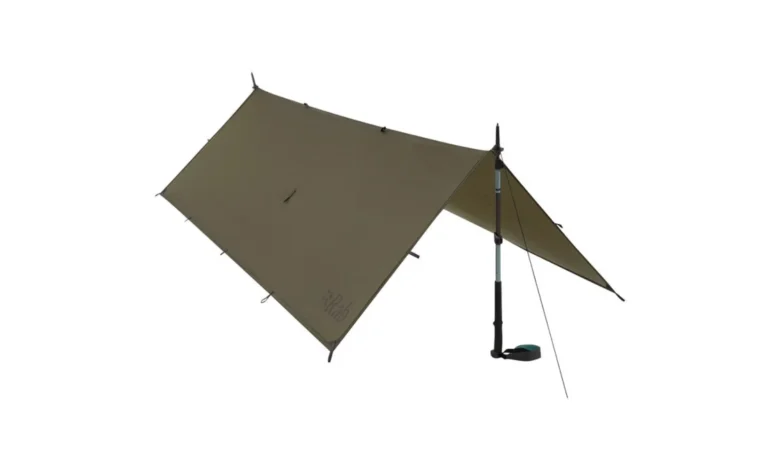
The modern flat tarp bears little resemblance to the heavy canvas sheets utilized by early explorers and mid-century mountaineers. Contemporary iterations leverage advanced chemical engineering to achieve unprecedented strength-to-weight metrics. The Rab SilTarp Plus Solo is a perfect entry-level solo shelter for the tarp-curious, exemplifying how modern fabric technology has modernized an ancient concept.
Constructed from a robust 30-denier silicone-impregnated nylon (silnylon) body, this shelter effectively fends off precipitation while maintaining a feathery footprint in a backpack. Unlike polyurethane-coated fabrics that degrade over time through hydrolysis, silnylon relies on silicone molecules penetrating the nylon threads, drastically increasing tear strength and waterproofing longevity without adding prohibitive mass. Furthermore, the inclusion of more than a dozen guy-out points lets you batten down the hatches to fend off storms or breezy conditions, offering users an extraordinary degree of pitch customizability that rigid tents simply cannot replicate.
Despite these engineering advancements, the barrier to entry remains skill-based rather than financial. Mastering the geometry of a flat tarp requires understanding tension distribution, wind direction, and knotcraft. For those transitioning from conventional tents, educational resources remain vital. (Need a refresher on tarp origami? Check out our guide to learn how to make everything from a classic lean-to to a secure tent-like pitch with doors).
Historical Context and the Shift Toward Convenience
To understand the current dominance of the enclosed ultralight tent, one must examine the evolution of the backpacking market from the 1990s through the mid-2020s. Historically, flat tarps and oilskin sheets were the default choice for hunters, trappers, and early backpackers. They represented the ultimate philosophy of self-reliance: a single sheet of waterproof material that could be manipulated into dozens of configurations depending on environmental hazards.
As the commercial outdoor industry expanded in the late 20th century, consumer preferences shifted decisively toward enclosed living spaces. The introduction of lightweight aluminum poles, breathable mesh inner canopies, and factory-taped waterproof floors transformed backpacking from a rugged endurance test into a recreational activity accessible to a broader demographic. Manufacturers capitalized on this by marketing ease of use. A tent with color-coded poles and clips required zero specialized knowledge to pitch, eliminating the anxiety of a collapsed shelter in a midnight thunderstorm.
By the early 2010s, the emergence of cottage-industry gear makers introduced Cuben Fiber (now known as Dyneema Composite Fabric or DCF) and high-end silnylons, giving birth to the modern ultralight movement. While these materials drastically lowered pack weights, they were predominantly channeled into single-wall trekking-pole tents and mid-style shelters. The traditional flat tarp was largely relegated to ultralight purists, survivalists, and minimalist thru-hikers attempting speed records on routes like the Appalachian Trail and the Pacific Crest Trail.
Chronology of Market Trends in Ultralight Shelter Design
The trajectory of gear adoption over the past ten years highlights a cyclical interest in minimalist design, driven largely by economic factors and technological refinements.
2015–2018: The Rise of the Trekking-Pole Pyramid
During this period, enclosed trekking-pole shelters dominated the ultralight conversation. Brands popularized spacious pyramids and mid-tents that offered complete floor space and bug protection while eliminating the weight of dedicated tent poles. The flat tarp was largely viewed as an obsolete relic, suitable only for emergency use or extreme ultralight veterans.
2019–2022: Material Innovation and Cost Pressures
As the cost of premium materials such as DCF skyrocketed due to global supply chain disruptions and raw material shortages, consumers began seeking cost-effective alternatives. Traditional silnylon flat tarps re-entered consumer awareness not merely as ultra-specialized gear, but as budget-friendly entry points into lightweight backpacking. A quality flat tarp could be purchased for a fraction of the cost of a high-end DCF tent, offering comparable weather resistance for those willing to master the learning curve.
2023–2026: The Hybrid Approach and Skill Renaissance
Entering the mid-2020s, outdoor educators and gear brands observed a renewed interest in primitive and semi-primitive camping skills. Driven by digital content platforms and an influx of a younger demographic seeking authentic outdoor experiences, sales of modular shelters began to rise. Manufacturers responded by engineering hybrid tarps—incorporating catenary cuts, reinforced guy-out loops, and integrated bug nets—that reduced the intimidation factor of traditional flat tarps while preserving their infinite versatility.
Supporting Data and Quantitative Analysis
Market research within the outdoor recreation sector underscores a distinct bifurcation in consumer purchasing habits. While mass-market consumers continue to purchase traditional freestanding tents weighing between three and five pounds, the ultralight niche—defined as base weights under ten pounds—has seen steady annual growth of approximately 6 to 8 percent.
| Shelter Type | Average Weight Range | Average Retail Cost | Skill Requirement | Weather Versatility |
|---|---|---|---|---|
| Freestanding Double-Wall Tent | 3.5 lbs – 6.0 lbs | $300 – $600 | Low | Moderate |
| Trekking-Pole Mid Tent | 1.5 lbs – 2.5 lbs | $350 – $700 | Moderate | High |
| Specialized Ultralight Tarp | 8 oz – 16 oz | $150 – $300 | High | Maximum |
The data reveals the undeniable appeal of the flat tarp category: an average weight savings of over 70 percent compared to conventional tents, paired with a significantly lower price point. However, the high skill requirement remains the primary deterrent for mainstream adoption. Industry analysts note that while purchase inquiries for minimalist shelters spike during economic downturns—owing to the superior value proposition—return rates or secondary market resales often correlate directly with user frustration during initial pitching attempts.
Industry Perspectives and Expert Analysis
Leading figures in outdoor gear design and wilderness education have offered nuanced perspectives on the resurgence of flat tarp camping. According to structural textile engineers, the primary limitation of a flat tarp is not its ability to shed water, but the user’s comprehension of physics under environmental stress.
"When you pitch a freestanding tent, the structure’s geometry is dictated by the manufacturer," explains a senior product developer for a prominent alpine equipment brand who requested anonymity due to industry partnerships. "You are buying a closed system. When you use a flat tarp, you become the engineer. Every rock, tree, and trekking pole becomes a variable. For some, that creative freedom is exhilarating. For others, staring at a flapping sheet of nylon in a 30-knot wind is a recipe for psychological distress."
Wilderness guides and search-and-rescue personnel often emphasize the educational value of mastering tarp geometry, even for those who primarily use traditional tents. Understanding how to anchor fabric securely against shear winds translates directly to emergency bivouac construction in survival scenarios. Environmental educators argue that minimalist shelters encourage a deeper connection with the natural landscape, as users must read terrain features, drainage patterns, and microclimates far more acutely than those enclosed within opaque tent walls.
Broader Economic, Environmental, and Cultural Implications
The micro-trend toward flat tarps carries wider implications for the outdoor industry, sustainability initiatives, and consumer culture.
Environmental Impact and Durability
From a sustainability standpoint, minimalist shelters generally require fewer raw materials, less energy during manufacturing, and smaller shipping footprints than complex multi-wall tents containing aluminum poles, mesh canopies, zippers, and waterproof floors. Furthermore, simpler designs often equate to fewer failure points. A tarp with no zippers to jam or shock-cords to snap can theoretically last decades longer than a mechanical tent, provided the fabric is treated with care. This aligns with a growing consumer desire for gear repairability and a rejection of disposable consumerism.
Economic Accessibility
As outdoor recreation costs rise due to inflation and premium material pricing, the accessibility of backpacking is threatened. The flat tarp serves as an economic equalizer. By lowering the financial barrier to achieving an ultralight base weight, beginner backpackers can access remote backcountry environments without investing thousands of dollars in specialized technical shelters. This democratization of gear encourages broader participation across diverse demographic groups.
Cultural Shift Toward Minimalism
Culturally, the revival of the flat tarp reflects a broader disillusionment with hyper-commodified outdoor experiences. In an era where many campsites resemble suburban campgrounds outfitted with heavy luxury gear, returning to a simple sheet of silnylon represents a deliberate embrace of austerity and challenge. It forces the backpacker to acquire traditional competencies, fostering self-reliance rather than reliance on engineered equipment.
Future Outlook for Ultralight Shelter Technology
As material sciences continue to advance, the boundaries between traditional tarps and modern engineered shelters will likely continue to blur. Manufacturers are experimenting with graphene-infused coatings, ultra-high-molecular-weight polyethylene fibers, and dynamically adjustable guy-line systems that automatically tension fabric based on wind loads.
Nevertheless, the core philosophy of the flat tarp will remain unchanged. It is a tool that demands engagement, practice, and respect for the elements. While it may never completely reclaim the market dominance it held centuries ago, its current renaissance proves that in the relentless pursuit of lightness and autonomy, simplicity is frequently the ultimate sophistication. For the modern backpacker willing to invest the time in mastering the craft, the rewards—measured in ounces shed, dollars saved, and wilderness intimacy gained—are unparalleled.