Fatal Rockfall Claims Two Czech Climbers and Veteran Guide on Mont Blanc’s Treacherous Goûter Couloir Amidst Soaring Alpine Temperatures

Chamonix, France – A tragic rockfall incident on Mont Blanc’s notorious Goûter Couloir has claimed the lives of two Czech climbers and their experienced UIAGM-certified guide, Pavel Zofka, 57, earlier this week. The deadly event, which also left a third team member injured, underscores the escalating dangers in the Alps, particularly on popular routes, as unprecedented heatwaves contribute to increased rockfall activity and destabilized mountain environments.
The incident occurred early Wednesday morning in a section of the mountain so infamous for its hazards that it has earned grim monikers such as the "Bowling Alley" and the "Death Couloir." The victims, including one client aged 49, were part of a guided expedition ascending the normal route to Mont Blanc’s summit when they were struck by falling debris. The third client, whose identity has not been released, sustained injuries but survived and was promptly airlifted to a hospital for treatment.
Chronology of a Catastrophe
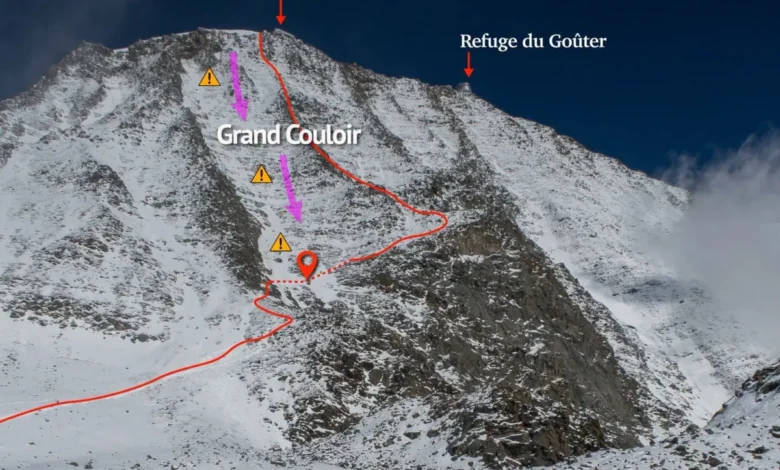
The ill-fated group had embarked from the Tête Rousse mountain hut (3,149m), a common staging point for ascents of Mont Blanc via the Goûter route. Their departure in the pre-dawn darkness was a standard safety protocol, designed to traverse the Grand Couloir du Goûter during the coldest hours of the night when ice and rock are typically most stable, minimizing the risk of rockfall. This strategy is widely considered the most cautious approach for summer climbs on Mont Blanc.
Despite their adherence to established safety practices, tragedy struck as they crossed the perilous 150-meter-wide couloir. Eyewitnesses and subsequent reports indicated that other climbing parties were also on the route toward the Goûter Refuge, a key stop before the final push to the summit. However, the Czech team was uniquely unfortunate to be in the direct path of the sudden and violent rockfall.
According to La Chamoniarde, the official blog of Chamonix’s rescue corps, the rockfall continued for a significant period after the initial incident, highlighting the severity and prolonged nature of the hazard. This persistent instability complicates rescue efforts and further endangers anyone in the vicinity.
The Infamy of the Goûter Couloir
The Goûter Couloir is an unavoidable and notoriously dangerous section of the Goûter Route, also known as the Normal Route, which is the most popular way to climb Mont Blanc from the French side. Situated past the Tête Rousse Refuge and leading towards the modern Refuge du Goûter and the subsequent summit ridge, its reputation for continuous rockfall precedes it. The couloir is a steep, often icy gully that funnels loose rock, ice, and snow, creating a highly unpredictable environment.
Climbers typically navigate this section using a fixed steel cable to aid their traverse, but speed, agility, and extreme caution are paramount. The "shooting gallery" effect, where rocks are dislodged from higher elevations and accelerate down the gully, makes it a high-stakes crossing. While early morning crossings are standard to exploit colder temperatures that bind the rock and ice, even this precaution is increasingly insufficient in the face of warming conditions.
Escalating Dangers: The Impact of Climate Change
The recent fatalities are not isolated incidents but rather a stark reminder of the growing instability in alpine regions, exacerbated by successive heatwaves scorching central Europe. These record-breaking temperatures are having a profound and dangerous impact on mountain environments.
One of the primary drivers of increased rockfall is the thawing of permafrost. Permafrost, or permanently frozen ground, acts as a natural cement, binding together loose rock and debris at high altitudes. As temperatures rise, this permafrost thaws, losing its structural integrity and leading to the destabilization of vast sections of rock. This process can trigger sudden, massive rockfalls, particularly in areas like the Goûter Couloir, where the geology is already prone to erosion.
Furthermore, warmer temperatures lead to accelerated melting of glaciers and snowpacks. The increased volume of meltwater infiltrates cracks and fissures in the rock, further weakening its structure. When this water refreezes overnight, it expands, exerting immense pressure that can prise apart even solid rock faces. During the day, as temperatures climb, the ice melts, allowing loosened rock to detach and cascade down slopes.
These environmental changes are fundamentally altering the risk profile of many classic alpine routes. What were once considered "safe" windows for climbing, based on historical weather patterns and glacial stability, are rapidly shrinking or disappearing altogether.
Statistical Evidence of a Deadly Trend
The dangers of the Goûter Couloir are well-documented. Research conducted by ISTerre Laboratories, a joint research unit of CNRS and Université Grenoble Alpes focusing on Earth sciences, revealed alarming statistics regarding incidents at this location. Between 1990 and 2017, a staggering 347 rescue operations were conducted in the couloir. This period saw 102 fatalities and 230 injuries, underscoring the couloir’s status as one of the most dangerous sections of any major alpine route. Statistically, an average of about four climbers perish here each year, a figure that the recent tragedy regrettably reinforces.
These numbers highlight a persistent and severe hazard, which, when combined with the unprecedented climatic conditions of recent summers, paints an increasingly concerning picture for mountaineering safety.
Official Responses and Mounting Concerns
The mountaineering community and official bodies have reacted with grave concern to the latest incident. Mountain guide associations, rescue services, and local authorities are grappling with how to manage the escalating risks.
On the Italian side of Mont Blanc, for instance, mountain guides have already taken decisive action. The Società Guide Alpine di Courmayeur, one of the oldest and most respected guide associations, announced earlier this month that they would halt all planned client ascents of Mont Blanc via the Italian normal route (the Gonella or Pope Route) due to the dangerously unstable conditions. This proactive measure reflects the severity of the situation and the guides’ commitment to client safety above all else. AFP reported on these closures, emphasizing the widespread concern across the Mont Blanc massif.
La Chamoniarde, the body responsible for mountain safety information in the Chamonix Valley, consistently issues warnings and updates on route conditions. Their recent observations of continuous rockfall in the Goûter Couloir serve as a stark reminder for all aspiring climbers to exercise extreme caution and to meticulously check conditions before attempting any ascent. They advise that even with established precautions like early morning crossings, the unpredictability of rockfall in warming conditions presents an elevated and unacceptable risk.
While the new Refuge du Goûter remains operational, its accessibility and the safety of the route leading to it are under constant scrutiny. Authorities are urging anyone planning to summit Mont Blanc from the French side to conduct thorough research, consult with local guides, and be prepared to abandon their plans if conditions are deemed unsafe.
Broader Implications for Alpine Mountaineering
The Mont Blanc tragedy, alongside other recent incidents, signals a critical juncture for alpine mountaineering. The traditional climbing season in the Alps, typically spanning from July to September, is becoming increasingly volatile. The long-term implications are far-reaching:
- Route Closures and Restrictions: There is a growing debate about the necessity of temporary or even permanent closures of certain routes during periods of extreme instability. While unpopular with some, such measures are increasingly seen as vital for public safety.
- Shifting Climbing Seasons: Climbers may need to adapt to shorter, earlier, or later climbing seasons to avoid the peak heat of summer, which historically was the most popular time.
- Rethinking Guiding Practices: Mountain guides, who are already at the forefront of risk assessment, may need to further adapt their strategies, potentially incorporating more rigorous risk-assessment tools and alternative routes or objectives. The UIAGM certification held by Pavel Zofka signifies the highest standard of professional guiding, yet even the most experienced guides are vulnerable to unpredictable natural phenomena.
- Investment in Monitoring and Research: There is an increased need for investment in real-time monitoring systems for rock stability, glacier movement, and permafrost temperatures to provide more accurate and timely warnings to climbers.
- Climate Change Education: A greater emphasis on educating climbers about the impacts of climate change on mountain environments and the corresponding increase in objective hazards is crucial.
A Parallel Tragedy on the Matterhorn
The dangers highlighted by the Mont Blanc incident are not unique to the massif. Earlier this week, a separate but equally tragic event occurred on the Matterhorn, another iconic peak in the Alps. Two climbers fell to their deaths shortly after commencing their descent down the normal Hörnli Ridge route. While the specific cause of that accident is still under investigation by local police, it serves as another somber reminder of the inherent risks of high-altitude mountaineering and the critical importance of caution, even on well-established routes. These concurrent tragedies underscore a period of heightened danger across the European Alps, challenging climbers and mountain professionals alike to confront the new realities of a warming world.
The loss of life on Mont Blanc is a profound tragedy that reverberates throughout the global mountaineering community. It serves as a potent warning that even the most experienced climbers, adhering to best practices, can be caught in the crosshairs of an increasingly unstable alpine environment. As climate change continues to reshape these majestic landscapes, the challenge for mountaineers will be to adapt, respect, and understand the new, evolving risks that come with pursuing their passion in the world’s great ranges.
Related posts: