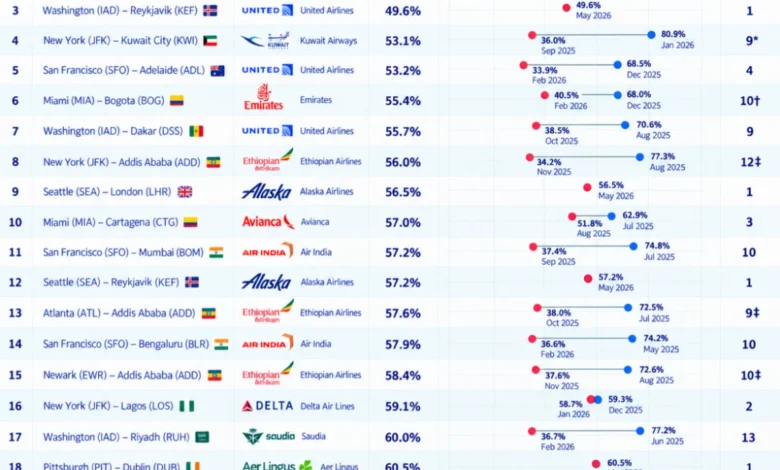
Securing an empty adjacent seat or scoring an entire row in economy class—colloquially known by frequent flyers as the "poor man’s business class"—has become increasingly difficult. As international travel demand remains remarkably robust, commercial airline executives frequently boast about high load factors and optimized cabin capacities designed to maximize revenue on every available square foot of aircraft real estate. For budget-conscious travelers or those unable to secure upgrades using cash or frequent flyer miles, a completely packed long-haul flight often feels like an unavoidable reality.
However, a comprehensive analysis of international aviation data reveals that empty seats are still widely available across select global corridors. Despite industry-wide claims of consistently full cabins, thousands of long-haul international flights departing the United States operate with significantly lower passenger loads. Understanding where these unallocated seats are most commonly found allows savvy travelers to strategically increase their chances of enjoying extra personal space during marathon journeys across oceans.
Analyzing Global Load Factors: Methodology and Data
To determine where economy cabins offer the highest probability of personal breathing room, aviation analytics examined more than a year of comprehensive load factor statistics. Covering the period from May 2025 through May 2026, the dataset provided by aviation analytics firm Cirium tracked passenger capacity utilization across dozens of airlines operating long-haul international routes departing from U.S. airports.
In the airline industry, "load factor" refers to the percentage of available passenger seats that are actually filled on a given flight. While the data offers a clear picture of utilization trends over a twelve-month horizon, industry analysts emphasize that load factors fluctuate based on seasonality, operational adjustments, and global economic factors. Furthermore, a low load factor does not necessarily indicate a failing route or imminent cancellation. Commercial carriers frequently maintain flights with sparse economy cabins due to high profitability generated in premium business-class sections, lucrative corporate contracts, heavy cargo transport, or governmental subsidies that offset passenger ticket sales.

The Role of New Routes in Passenger Spacing
Airlines frequently launch new international routes to capture emerging markets or test untapped consumer demand. For travelers tracking fare sales and award availability, newly established long-haul routes consistently serve as a valuable resource. Data indicates that these paths also function as a prime source of unallocated cabin space.
Nearly half of the top twenty emptiest long-haul international routes analyzed in the dataset were launched within the twelve months preceding the study. While newly inaugurated services represent only a small fraction of the total expansion undertaken by global carriers, the initial phase of these operations frequently features lower-than-average load factors as the routes build brand awareness and consumer loyalty.
Aviation experts note that new routes often experience a ramp-up period lasting anywhere from several months to a full year. During this transitional phase, airlines typically maintain scheduled frequencies despite sparse passenger bookings to establish permanent slots at major international hubs and fulfill contractual obligations with destination airports. Consequently, passengers booking travel on newly launched long-haul itineraries frequently benefit from lower passenger density in the main cabin.
Unique Itineraries and Fifth-Freedom Anomalies
Among the individual routes registering the lowest average load factors, unique operational models stand out. Fifth-freedom flights—routes where an airline flies between two foreign countries as part of a journey that originates or terminates in its home nation—frequently exhibit distinct booking patterns compared to traditional nonstop trunk routes.
A prominent example identified in the aviation data involves long-haul operations managed by Middle Eastern carriers operating outside their primary hubs. For instance, services connecting Miami International Airport (MIA) to El Dorado International Airport (BOG) in Bogotá, Colombia, operated by Emirates utilizing Boeing 777-300 aircraft, have registered some of the lowest average load factors in the Western Hemisphere. Over the observed twelve-month period, these flights routinely operated with roughly half of their economy seats unoccupied.

Industry observers attribute such discrepancies to intense regional competition, specialized scheduling, and the strategic deployment of widebody aircraft equipped for long-haul distances on relatively short international hops. For travelers willing to explore South American destinations via non-traditional carriers, these specific fifth-freedom segments offer exceptionally high probabilities of securing vacant adjacent seating.
Regional Trends: India, Africa, and the Middle East
Geographic analysis of the data reveals that routes connecting the United States to India, various nations across the African continent, and the Middle East account for exactly half of the top twenty positions for lowest load factors on long-haul flights. This trend aligns with historical patterns in international commercial aviation.
Routes serving these regions frequently embody the principle that low passenger loads do not equate to financial distress for the operating airline. These corridors rely heavily on niche traveler demographics, including corporate personnel traveling to engineering and manufacturing hubs, government contractors, international development workers, and diaspora communities visiting extended families. Because these specialized sectors generate steady, year-round yields regardless of seasonal tourism fluctuations, airlines can sustain operations with moderate economy cabin utilization.
For travelers journeying toward these global regions, selecting long-established flights with historically low load factors provides a reliable strategy for maximizing personal comfort. However, operational complexities must be considered; for example, certain long-haul itineraries operated by carriers such as Ethiopian Airlines linking northeastern U.S. hubs like John F. Kennedy International Airport (JFK) and Newark Liberty International Airport (EWR) to Addis Ababa (ADD) incorporate intermediate technical stops in West African cities such as Lomé (LFW) or Abidjan (ABJ), creating unique passenger flow dynamics across different flight segments.
Broader Implications and Long-Term Outlook
Expanding the scope of the analysis to encompass the top fifty emptiest routes reveals a diverse mix of established marquee destinations and emerging corridors. While ultra-long-haul services—such as nonstop journeys between New York and Auckland (AKL) operated by Air New Zealand—occasionally dip into lower load factor tiers, they serve as exceptions rather than the norm.

The comprehensive dataset highlights the increasing sophistication of airline yield-management systems. Modern forecasting algorithms and dynamic pricing models allow carriers to adjust ticket prices in real-time, effectively filling aircraft cabins closer to departure dates. By the time the data reaches the middle tier of the top fifty list, passenger utilization routinely exceeds two-thirds of total capacity. While this density remains preferable to fully packed flights operating at ninety percent capacity or higher, it underscores the shrinking margin for securing completely empty rows on mainstream global routes.
As the international aviation market continues to evolve, airline executives remain focused on maximizing revenue per available seat mile. Nevertheless, structural anomalies, seasonal lulls, newly launched schedules, and specialized regional corridors will continue to provide opportunities for observant travelers seeking enhanced physical comfort during long flights. Monitoring load factor trends, tracking inaugural route announcements, and understanding the operational economics behind global carrier networks remain essential tools for anyone looking to optimize their economy-class travel experience.