Vintgar Gorge, Slovenia: Read This Before You Book (The Walk Back Is Longer Than You Think)

The Vintgar Gorge in northwestern Slovenia stands as one of the country’s most celebrated natural monuments, drawing hundreds of thousands of visitors annually to its emerald-green waters and dramatic cliffside boardwalks. However, a recurrent issue regarding visitor logistics, specifically the extended return journey, has prompted tourism authorities and travel experts to issue comprehensive guidance for prospective travelers. While the initial 1.6-kilometer boardwalk trek through the canyon requires only a moderate 45-minute commitment, the strictly one-way nature of the route frequently surprises unprepared tourists, turning a brief morning excursion into a multi-mile trek through surrounding alpine terrain.

Geological Formation and Historical Background
Carved over millennia by the Radovna River, Vintgar Gorge slices through Triassic limestone deposits situated between the Hom and Boršt hills. Geological analyses indicate that during the Pleistocene epoch, glacial activity and moraine dams altered the local hydrology, forcing glacial meltwater to aggressively cut through the bedrock. This geological process created a steep canyon featuring sheer rock faces rising 50 to 100 meters above the riverbed, with adjacent slopes reaching up to 250 meters.

The passage through the gorge was inaccessible to the general public until its modern discovery in 1891. Jakob Žumer, then mayor of the neighboring municipality of Gorje, alongside photographer Benedikt Lergetporer, successfully navigated the length of the ravine. Recognizing the tourism potential, local civic leaders formed a development committee, secured funding, and constructed the initial network of cantilevered wooden walkways over the subsequent two summers. The gorge officially opened to the public on August 26, 1893.
Further altering the landscape in the early 20th century, the Austro-Hungarian Empire constructed a massive stone railway viaduct across the upper section of the gorge between 1904 and 1906. Spanning 33 meters above the canyon floor with 65 meters of cut stone, the bridge was engineered for the Bohinj Railway line to secure a direct freight and passenger route to the strategic port of Trieste without traversing Italian territory. The historic rail line remains operational today.

The One-Way Trail System and Logistical Realities
To preserve the fragile canyon ecosystem and manage visitor flow, park management enforces a strict one-way traffic policy. Visitors enter at the Podhom checkpoint and traverse the 1.6-kilometer wooden boardwalk downstream, terminating at the Šum Waterfall, a 13-meter drop fed directly by the Radovna River. Because the boardwalk measures approximately one meter in width in its narrowest sections—known historically as the Žumer galleries—bi-directional foot traffic is strictly prohibited to prevent bottlenecks.

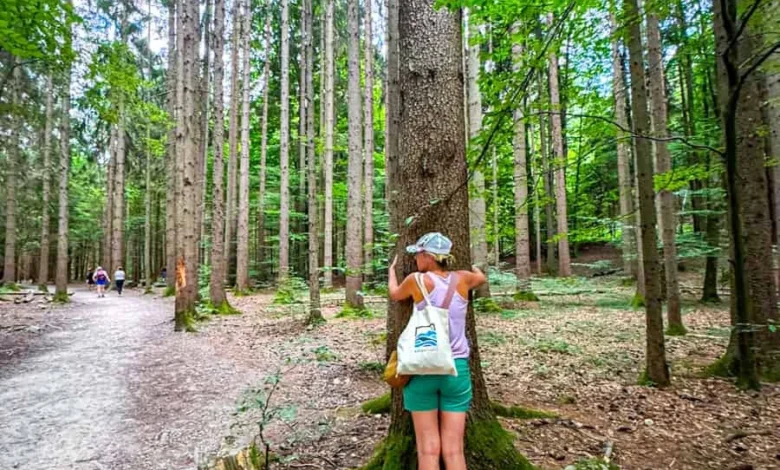
Upon reaching the exit at the Šum Waterfall, visitors discover that the path does not loop back to the initial entry point. Consequently, travelers must undertake a return journey via one of two designated forest and agricultural pathways: the Path of King Triglav or the Path of the River of Trees. These return routes measure roughly 3.5 to 5 miles in total length, winding through the rural village of Gorenje, past the historic Church of St. Catherine, and offering panoramic views of the Julian Alps and Lake Bled.
Unprepared tourists frequently encounter physical strain due to the unexpected length and elevation changes of the return paths. Local officials and regional transport operators note that a significant portion of daily visitors arrive dressed in inappropriate footwear, such as sandals or urban sneakers, and lack adequate provisions.

Ticketing Regulations and Crowd Management
In response to surging post-pandemic tourism pressures and environmental preservation mandates, the Vintgar Gorge administration implemented a mandatory timed-entry ticketing system. Daily visitor caps restrict the volume of admissions to prevent overcrowding and safeguard the natural habitat.

Tickets are priced at €15.00 for adults and €5.00 for children under the age of 15. Due to high demand during the peak summer months of July and August, tickets frequently sell out days in advance, prompting tourism boards to advise advance booking through official online channels at least 48 hours prior to arrival. Visitors are also required to wear protective hardhats during their passage through the gorge proper to mitigate the risk of falling debris from the towering limestone cliffs; these helmets are returned at the exit checkpoint prior to beginning the return hike.
Transportation Infrastructure and Regional Integration

Access to Vintgar Gorge is heavily regulated to minimize vehicular congestion in the surrounding agricultural valleys. Private vehicles are directed to the Vintgar LIP Central Car Park (P1), where motorists transfer to a dedicated shuttle service or the regional Vintgar e-bus. The transit network connects the Lake Bled central bus station to the gorge entrance via a 15-minute bus ride followed by a 7-minute shuttle transfer. Alternatively, visitors frequently utilize e-bike rentals from Lake Bled, traversing a 4-kilometer dedicated cycling route through surrounding villages.
Economic and Tourism Implications

Tourism analysts note that managing expectations at natural landmarks like Vintgar Gorge directly impacts visitor satisfaction and regional resource allocation. When tourists underestimate the physical demands of secondary trails or fail to secure advance reservations, local emergency services and park rangers experience increased demands for logistical assistance. Furthermore, structured crowd-control measures have proven effective in protecting the delicate microclimate of the gorge, ensuring the long-term viability of one of Slovenia’s premier ecological attractions.
For travelers planning an itinerary through the Upper Carniola region, allocating a minimum of three hours is strongly recommended to account for transit, the 45-minute gorge traverse, and the mandatory return hike. Comprehensive preparation—including proper footwear, hydration, and adherence to time-slotted reservations—remains essential for navigating the operational realities of this historic alpine gorge.