For generations, the private members’ club served as a stationary bastion of exclusivity. From the mahogany-paneled corridors of Mayfair’s traditional institutions to the sleek, glass-walled lounges of Manhattan skyscrapers, the hallmark of elite membership was a fixed, physical address. These spaces functioned as a "third place"—a sanctuary between home and the office—defined by a curated social circle and a sense of enduring permanence. However, as the global ultra-high-net-worth (UHNW) population increasingly adopts a nomadic lifestyle, the concept of a single, static clubhouse has begun to feel archaic. The modern elite are no longer anchored to one city; their businesses, residences, and social networks are spread across multiple continents, rendering the traditional club model geographically limiting.
In response, a new vanguard of hospitality is emerging, one that eschews the concrete of the city for the mobility of the open ocean. The superyacht is rapidly transforming from a private toy for the ultra-wealthy into a floating, shared social ecosystem, signaling a fundamental shift in how the world’s most affluent individuals define community, luxury, and access.
The Rise of the Floating Clubhouse
The shift toward nautical membership clubs is driven by a desire for both fluidity and intimacy. While the Soho House model successfully decentralized the clubhouse by creating a network of locations across major global hubs, the next generation of clubs is taking this a step further by removing the land entirely. Leading this charge is the Maybach Ocean Club, a project that redefines the economics of yachting.

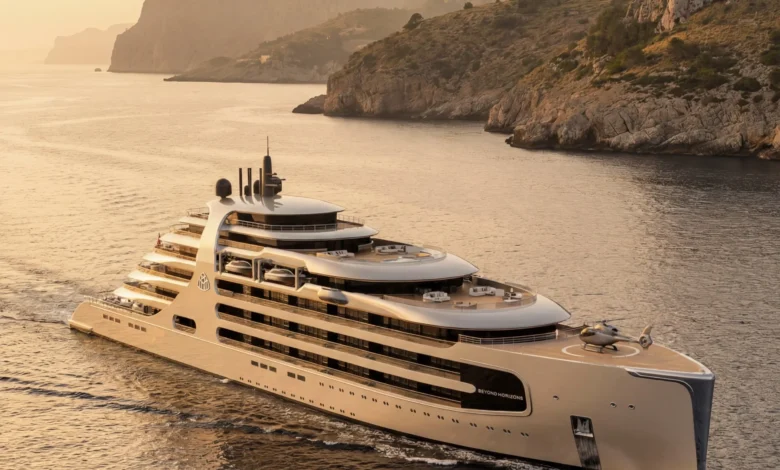
The Maybach Ocean Club operates on a fractional ownership model, centered around a 492-foot vessel. Designed to accommodate a community of 300 members, the club allows each participant to hold a stake in the vessel, granting them four weeks of use annually. The concept originated approximately six years ago, born from a partnership between co-founder and managing director Michael Hehn and the former captain of the legendary superyacht Lady Moura.
The economic rationale is compelling. Full ownership of a superyacht is an exercise in diminishing returns; the initial capital expenditure, combined with the relentless, compounding costs of maintenance, staffing, and berthing, often results in an asset that sits idle for 90% of the year. By pooling resources, the Maybach Ocean Club provides the prestige of yacht ownership while diluting the fiscal burden. Yet, the true innovation lies not in the balance sheet, but in the social architecture.
Curating the Community: The Social Due Diligence
Unlike traditional timeshares or fractional private aviation, the Maybach Ocean Club treats membership as a high-stakes social vetting process. Prospective members are subjected to rigorous due diligence, including an application process and scrutiny by a membership committee. The criteria extend beyond financial liquidity to include professional achievements and, most importantly, social compatibility.
"When you have these members on board, you want to be sure that you share it with the right people," says Hehn. The core mission is to create a community of "global citizens"—individuals who, regardless of their nationality, maintain a lifestyle that bridges London, New York, Dubai, and Singapore. The club functions as a "home away from home" for these "in-betweeners," providing a consistent social environment that persists regardless of the yacht’s current port of call.

To maintain this, the club employs a sophisticated logistics engine. A reservation system, managed with an itinerary published six months in advance, allows members to secure their four-week allocation, with a council of members providing input on the yacht’s seasonal migration—summers in the Mediterranean and winters in the Caribbean.
A New Model for Experiential Luxury
While the Maybach Ocean Club focuses on fractional ownership, other entities are exploring the floating clubhouse concept through alternative lenses. The landscape is currently defined by three distinct business models: shared ownership, event-centric participation, and access-based luxury.
The Floating Art Club represents the event-centric model. Debuting at the 2026 Monaco Grand Prix, this concept eschews the burden of ship ownership entirely. Instead, it serves as a nomadic cultural hub, gathering art collectors, creators, and enthusiasts during major international events like the Grand Prix, Miami Art Basel, and Hong Kong’s Art Week. Founder Gaelle Jaunay Calendini identifies the core tension the club resolves: the fragmentation of the luxury experience.
"People would pay for a members’ club, then separately go to a yacht hotel, then separately attend an art experience," says Calendini. "Nothing united them." By anchoring a community around a shared cultural interest rather than a permanent deck, the Floating Art Club provides the intellectual engagement that a traditional yacht trip might lack.

Simultaneously, the Armada Club is disrupting the space by focusing on pure access. Rather than requiring a capital investment in a vessel, the Armada Club offers a membership that grants access to a curated fleet of private superyachts. These vessels are utilized as exclusive venues for high-level business meetings, wellness retreats, and private dining. For co-founder Claire Hagen, the appeal is rooted in the "privacy-conscious" nature of today’s elite. As the public eye becomes more intrusive, the need for a discreet, highly controlled environment—where every staff member knows the member’s preference before they arrive—has become a premium service commodity.
Industry Data and Economic Implications
The emergence of these clubs is backed by significant trends in the UHNW sector. According to recent market analysis, the demand for "experiential luxury" has outpaced the demand for physical asset ownership among younger UHNW demographics. While the 2020s saw a surge in personal yacht purchases, the subsequent inflationary pressures on fuel, insurance, and crew wages—which can amount to 10% of the vessel’s value annually—have made shared models significantly more attractive.
Furthermore, the integration of high-end wellness and longevity services—such as the partnership between Maybach Ocean Club and the renowned Chenot Group—reflects a broader trend in the hospitality sector. The modern luxury traveler is no longer satisfied with mere opulence; they demand holistic health, sustainability, and productivity-enhancing environments. By integrating these services into the vessel, these clubs turn a transport asset into a lifestyle hub.
The Future of Exclusivity
The rise of the floating members’ club suggests a profound shift in the definition of "status." In the 20th century, status was derived from the acquisition of physical space. In the 21st century, status is increasingly defined by the ability to access, with minimal friction, a trusted network of peers and bespoke experiences regardless of one’s physical location.

The implications for the broader hospitality and maritime industries are significant. Traditional luxury hotels and land-based private clubs may find themselves competing with these agile, mobile environments. If a member can enjoy five-star dining, expert-led wellness, and a curated social network while sailing from St. Tropez to St. Barts, the incentive to maintain memberships in multiple land-locked clubs decreases.
However, challenges remain. Navigating international maritime law, managing the operational logistics of a 492-foot vessel, and maintaining the delicate social equilibrium of a 300-person community are tasks of immense complexity. The failure of any one of these clubs would serve as a warning that the "floating clubhouse" is not merely a marketing concept, but an operational minefield.
Nevertheless, the trajectory is clear. As the world becomes more digitally connected yet socially fragmented, the appeal of a "vetted, mobile community" will only grow. These clubs are not just selling a seat on a boat; they are selling the feeling of belonging in a world that is constantly in motion. Whether through the shared stakes of the Maybach Ocean Club, the cultural immersion of the Floating Art Club, or the curated access of the Armada Club, the next generation of exclusivity is clearly casting off the lines and heading out to sea.