For the intrepid traveler, the distinction between a purely physical expedition and a journey of cultural immersion profoundly impacts the necessity of language acquisition. While traversing vast, remote landscapes may not demand linguistic mastery, truly engaging with a foreign culture and returning repeatedly to a destination makes learning the local tongue an invaluable investment. This principle is vividly illustrated through one traveler’s dedicated journey into mastering Russian, a method that transformed his understanding of a complex nation.

The Transformative Power of Language for Travelers
Many expeditions, such as those through the Arctic, prioritize physical endurance and navigational skill, often allowing travelers to navigate with minimal knowledge of local languages like Inuktitut. However, when the essence of exploration shifts from physical challenge to cultural understanding, language becomes the indispensable key. It unlocks deeper connections, facilitates authentic interactions, and allows for a nuanced appreciation of a society’s intricacies. The author’s personal trajectory exemplifies this, moving from years in the Canadian Arctic where language was secondary, to a profound engagement with Russia where it became paramount. This commitment to linguistic immersion is increasingly recognized by anthropologists and seasoned travelers alike as the most effective pathway to genuine cross-cultural understanding.
A Personal Odyssey into Linguistics: From French to German to Russian
The author’s linguistic journey began early, growing up in Montreal with mandatory French education from a young age. This foundation was unexpectedly augmented by a year of Latin in high school, a choice that introduced him to the concept of grammatical cases – the inflections applied to nouns and adjectives based on their role in a sentence. This early exposure, though seemingly disparate, proved crucial for later encounters with languages possessing complex case systems.

At university, while pursuing pure mathematics, he dedicated two years to intensive German studies, attending courses five days a week. Inspired by a visit to Switzerland and an appreciation for German literature, he achieved a remarkable fluency, acquiring a vocabulary of 2,000 words by the end of the first year and 4,000 by the second, sufficient for extensive conversations. The German pedagogical approach, with its logical structure and systematic memorization of irregular verbs, resonated with his analytical mind. This period of intense study laid a cognitive groundwork for future linguistic challenges, particularly in understanding grammatical structures that deviate significantly from English. Later, a month spent independently studying Spanish grammar, purely for intellectual pleasure, further honed his analytical approach to language.
Russia’s Allure and the Decision for Self-Study
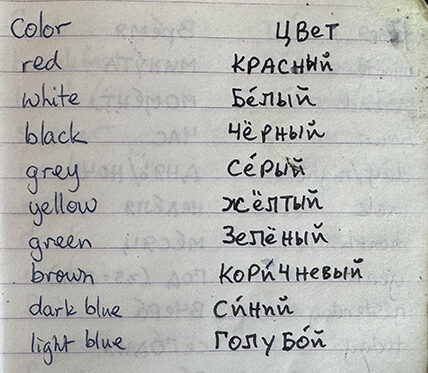
The opportunity to visit Russia emerged during a fleeting period between the rigid Soviet era and the more restrictive "Putin world," a window of relative openness that captivated the author. His initial trips revealed a country brimming with contrasts – deeply melancholic yet surprisingly humorous, often feeling surreal, like "being inside a Dali painting." This cultural richness, distinct from his physical explorations, spurred a desire for deeper engagement.
His first trip involved a group with a translator. The second, an independent journey, benefited from a German-speaking Russian companion. However, it became clear that sustained, independent exploration of Russia demanded direct communication. With reservations about formal language training’s efficacy for his specific travel needs, he resolved to learn Russian autonomously. This decision reflects a growing trend among experienced travelers to tailor their learning methods to their practical objectives, often prioritizing functional communication over academic perfection.

Crafting a Bespoke Vocabulary: The 2,000-Word Strategy
Recognizing the limitations and inefficiencies of generic language curricula, the author set a precise goal: an active vocabulary of 2,000 words to navigate Russia without a translator. He dedicated several weeks to meticulously curating this list, focusing on words essential for travel and daily life, deliberately omitting less relevant terms often found in beginner textbooks, such as "curtain" or "purple." This targeted approach is supported by linguistic research indicating that a core vocabulary of 2,000-3,000 words covers a significant portion (around 80-90%) of everyday conversational language.

His personalized lexicon included practical categories like "Outdoors" (tent, sleeping bag, ski, backpack), recognizing his adventurous pursuits, and even grammatical terms (noun, verb, idiom) to facilitate asking clarifying questions about the language itself. Nouns were categorized thematically (Color, People, Animals, Body, City, Food, Travel), reflecting a systematic approach to memory retention. This strategic selection ensured that every word learned was directly applicable to his anticipated travel experiences.
The "Walktionary" and Analog Immersion in a Digital Age

Before the advent of smartphones, the author’s primary tool was a 192-page, pocket-sized Clairefontaine notebook, dubbed a "Walktionary." This analog device served as a portable, personalized dictionary and grammar guide, allowing for constant review during mundane moments like waiting in line or walking. This method highlights a principle still relevant today: consistent, bite-sized exposure aids retention. Modern language apps like Anki or Memrise leverage similar spaced repetition techniques, but the "Walktionary" provided a tangible, always-available reference.
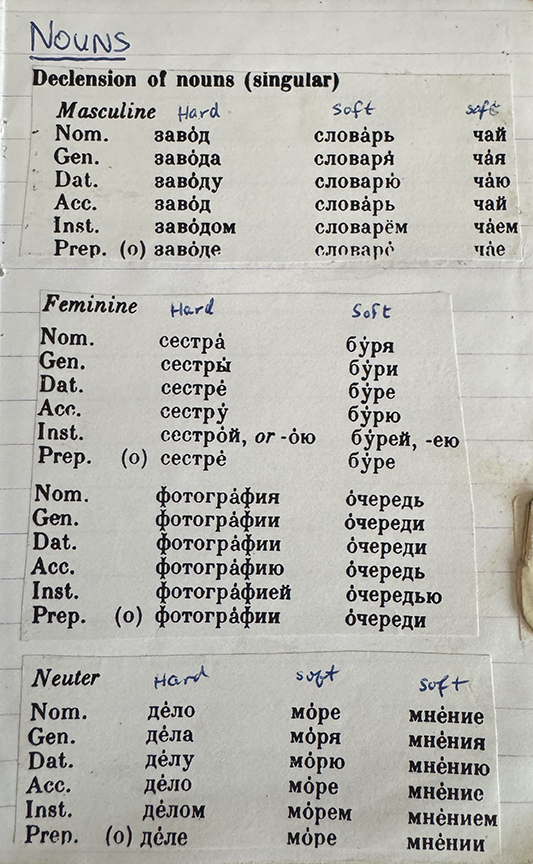
The Walktionary was meticulously structured. Beyond nouns, verbs, adjectives, and adverbs, it contained an extensive grammar section. Russian, like German and Latin, is an inflected language, featuring six cases: Nominative, Genitive, Dative, Accusative (shared with German), and the unique Instrumental and Prepositional cases. Tables of case endings, photocopied from grammar books, were glued into the notebook, enabling immediate reference during sentence construction practice. This hands-on approach to grammar, building sentences and instantly verifying inflections, solidified his understanding.
Russian verbs presented a distinct challenge, existing in two forms: perfective (for a completed action) and imperfective (for repeated or ongoing actions). The author diligently recorded both forms alongside their English equivalents, a practice crucial for mastering the nuances of Russian verbal aspect. This systematic approach, coupled with an intense personal dedication, transformed language learning into an absorbing passion. "It occupied my every waking moment," he recounted, underscoring the role of intrinsic motivation and obsession in rapid language acquisition.
Leveraging Tutors and Bridging the Cyrillic Divide
To ensure the accuracy of his 2,000-word vocabulary, the author initially hired a tutor once a week. This tutor verified his dictionary-derived Russian equivalents, ensuring he selected the correct nuances for each English term. Beyond vocabulary, these sessions became crucial for grammatical clarification. The tutor also provided audio recordings of Russian words, which the author played back repeatedly to improve his pronunciation, acknowledging his own limitations as a mimic. In today’s digital landscape, such audio support is seamlessly integrated into language learning apps, making this step more accessible than ever.
One common intimidation factor for English speakers approaching Russian is the Cyrillic alphabet. The author demystifies this, explaining it as a logical combination of familiar English and Greek letters, supplemented by a few distinct Russian characters. He notes that anyone with a science background would recognize many of the Greek symbols. This perspective helps frame Cyrillic not as an insurmountable barrier but as a readily learnable system.

To complement his self-study, the author enrolled in an intermediate Russian evening course at a local university, choosing the higher level despite never having seen Russian script before. Initially challenging, particularly adapting to Russian cursive, he quickly caught up, demonstrating the effectiveness of his parallel self-study. Within nine months, he had internalized his vocabulary, cases, declensions, and conjugations, feeling adequately prepared for immersion.
Full Immersion: The Crucible of Real-World Application
With his nine months of rigorous self-study complete, the author embarked on a three-month independent journey across Russia. This period of total immersion proved to be a profound learning experience, revealing both the strengths and weaknesses of his preparatory method. While he could articulate his thoughts effectively, a significant portion of his carefully curated 2,000-word vocabulary withered from disuse. In its place, however, he gained fluency in practical idioms like nam povislo (we were lucky) and molodets (well done!), and acquired context-specific vocabulary.
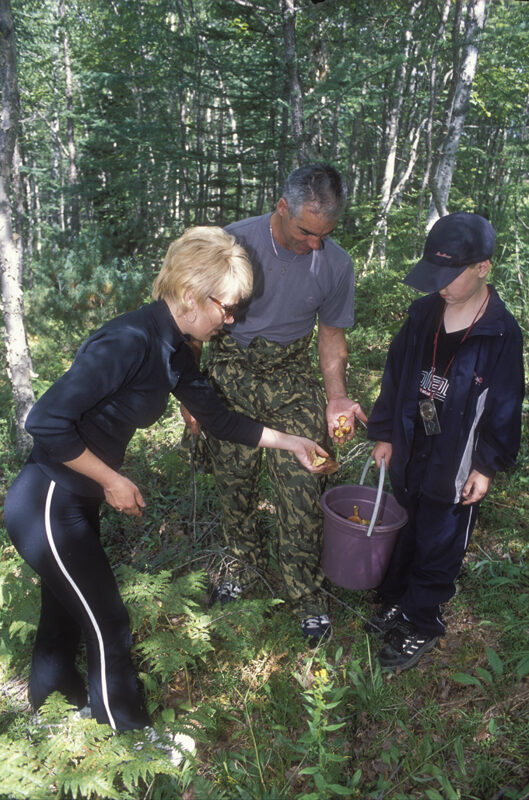
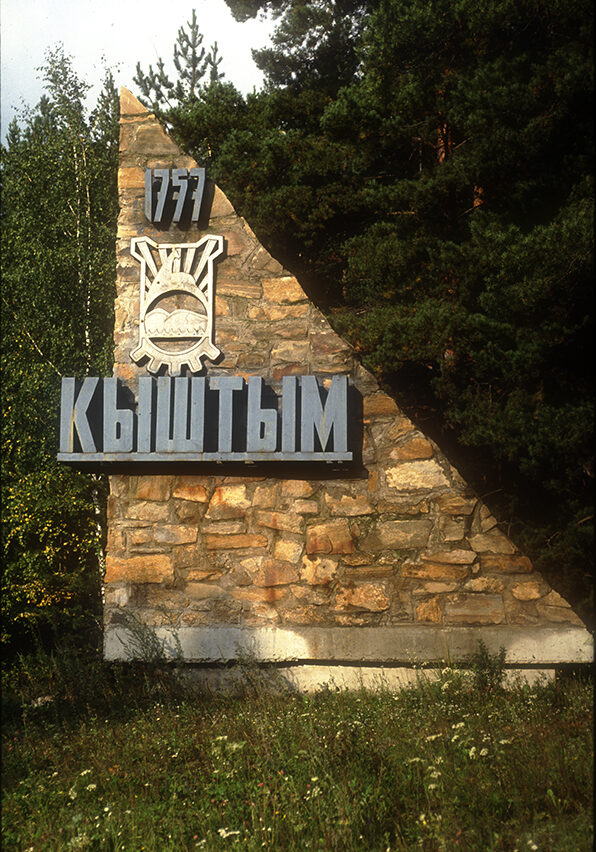
His experiences in the Siberian forests, for instance, introduced him to the language of mushroom picking, as well as crucial terms like byelonozhki (black flies) and kleshch (tick), highlighting the immediate relevance of language to survival and daily life. The prevalence of tick-borne neurological disorders meant meticulous tick checks were a common, vital practice. Other words like nelzya (forbidden) and nevozmozhno (impossible) became part of his lexicon as he navigated bureaucratic hurdles and local restrictions while pursuing his adventurous curiosity, often pushing boundaries in a country where such actions could have repercussions. His attempt to visit the closed city of Ozyorsk, site of the Kyshtym disaster, a nuclear accident worse than Chernobyl, exemplifies this adventurous spirit and the restrictive realities of Russia’s sensitive zones.
The most significant challenge during immersion was comprehension. While speaking came naturally, understanding rapid-fire Russian conversation proved mentally exhausting. He typically grasped between 25% and 90% of a conversation, relying heavily on context to bridge the gaps. He often requested speakers to slow down or repeat themselves, recognizing the cultural sensitivity of some who would oblige and speak to him "as if I were five years old." This constant mental effort, sustained for 18 hours a day, led to profound fatigue. He also discovered that his initial vocabulary distribution was skewed; while nouns remained critical, a core of about 60 verbs proved sufficient for most communication, with many others fading from active use.
Language Interference and Cognitive Limits
A striking consequence of his deep dive into Russian was the unexpected loss of his previously fluent German. After two months of speaking almost exclusively Russian, an encounter with German tourists left him tongue-tied, his German vocabulary replaced by Russian equivalents in his memory. This phenomenon, known as language interference or transfer, is a recognized aspect of multilingualism, where the intense activation of one language can suppress or interfere with the retrieval of another, especially for languages with similar grammatical structures or vocabulary. While many linguists can master multiple languages, the author’s experience suggests a potential cognitive limit or a specific susceptibility to interference for certain individuals. His German, once a vital communication tool, never fully returned.
Navigating a Sensitive Political Landscape: The Kurils Incident

The implications of his linguistic abilities extended beyond mere conversation, becoming critical during a later trip to Russia in the early years of Vladimir Putin’s presidency. While visiting the Kuril Islands – disputed territories seized by Russia from Japan at the end of World War II – he found himself interrogated by a formidable tribunal including the head of the FSB (Russia’s federal security service) for the district. The interrogation, conducted entirely in Russian, demanded absolute clarity. Unlike casual conversations where he might infer meaning, here, any misunderstanding could have serious consequences. He repeatedly asked them to clarify and repeat, frustrating his interrogators but ensuring precise comprehension.
The tribunal’s unexpected question, "Why are you so interested in Japanese cemeteries?", revealed that he had been under surveillance, a stark reminder of the heightened political sensitivities in the region. Despite the ominous circumstances, his papers were in order, and his activities were legitimate, leading to a resolution without further incident. However, he notes, "Nowadays, unfortunately, that might not be enough," a poignant observation reflecting the increasingly perilous environment for independent Western travelers in contemporary Russia.

Implications for Contemporary Cultural Travel
The author’s journey underscores several enduring lessons for language learners and cultural travelers. First, the depth of cultural immersion is directly proportional to linguistic proficiency. Second, tailored self-study, focused on practical vocabulary and grammar, can be remarkably effective, particularly when supplemented by targeted tutoring and real-world application. Third, while modern technology offers unparalleled tools for language learning, the fundamental principles of consistent practice, active recall, and genuine engagement remain timeless. Finally, in politically charged regions, language is not just a tool for connection but also a critical safeguard, enabling clear communication in high-stakes situations. The ability to understand and be understood can mean the difference between an enriching experience and a precarious one, highlighting the profound and multifaceted value of learning a language for travel.