Echoes of the Steppe: The Fight to Save Kazakhstan’s Ancient Saiga Antelopes from Modern Fragmentation

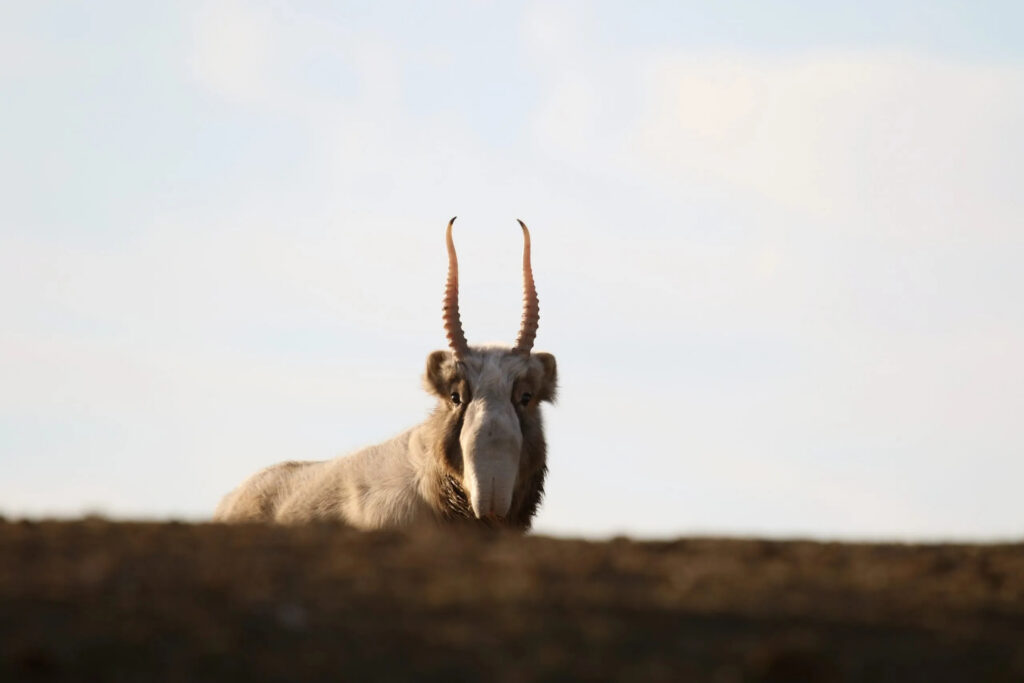
The vast and unforgiving landscape of the Central Asian steppe hides one of the world’s most resilient survivors. Across the remote grasslands of western Kazakhstan, mud tracks weave parallel to ancient migration paths traversed for millennia. Here, against biting Siberian winds, massive herds of saiga antelope move with a prehistoric momentum. Having outlived woolly mammoths and saber-toothed cats, these remarkable ungulates now face an entirely different kind of extinction threat: the relentless march of modern infrastructure.
Field audits conducted by conservationists in late autumn reveal both the tenacity of these animals and the mounting pressures they endure. Accompanied by researchers from the Association for the Conservation of Biodiversity of Kazakhstan (ACBK), field expeditions into the remote steppes coincide with the saigas’ critical rutting season. This annual gathering, vital to the species’ survival, highlights the fragile coexistence between ancient wildlife migrations and 21st-century geopolitical and economic development.
A Prehistoric Survivor on the Move
The saiga antelope (Saiga tatarica) is an evolutionary marvel, instantly recognizable by its signature, elongated, trunk-like snout. This specialized nasal cavity serves a dual purpose: it filters out choking dust during the dry summer months and warms sub-zero winter air before it enters the animal’s lungs. Historically, saiga populations ranged widely across the Eurasian steppe, stretching from the Caucasus Mountains to Mongolia.
For hundreds of thousands of years, saigas shared their expansive habitat with early human hunter-gatherers. Ancient cave paintings dating back to the seventh century BCE depict the antelope as elusive, highly adapted navigators of the steppe. Long before the establishment of formal trade routes, early human caravans relied on saiga migration corridors to traverse the arid semidesert plains. These natural transit routes ultimately helped inform portions of the historic Silk Road, particularly along the fertile banks of the Ural River—a natural boundary dividing Europe and Asia.
However, the twentieth century brought profound demographic and ecological shifts. The rise of the Soviet Union imposed mandatory sedentarization policies, forcing nomadic human populations into agrarian settlements and fracturing the region’s traditional migratory culture. While human populations adapted to stationary urban lives, the saigas continued their ancient nomadic existence, leaving them increasingly vulnerable to the rapid fragmentation of their historic range.
Infrastructure and the Disruption of Spatial Knowledge
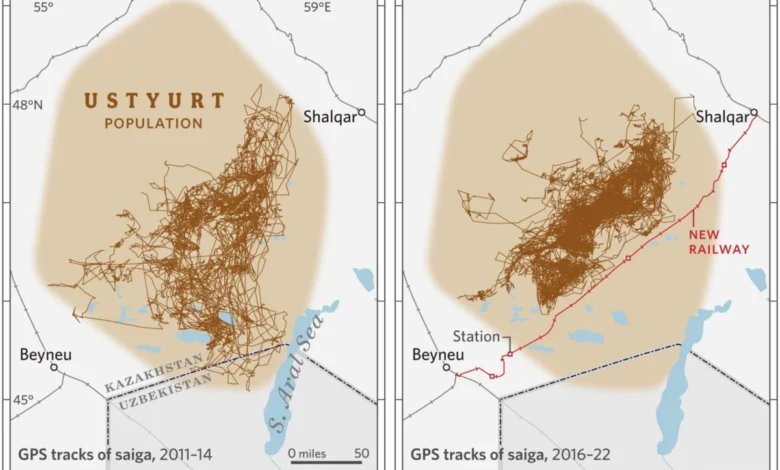
In recent decades, the expansion of linear infrastructure—including barbed-wire border fences, high-speed railways, and roaring highways—has severely disrupted the saigas’ migratory patterns. GPS-collaring data collected by ACBK and international researchers vividly illustrates this ecological bottleneck.
Historical tracking data from the early 2000s shows saiga herds freely crossing international borders, moving deep into Uzbekistan during seasonal shifts. However, the construction of a major railway line in 2014 abruptly altered this dynamic. Post-construction tracking data reveals a stark behavioral change: collared saigas frequently mill about in confusion on the northern side of the railway tracks, blocked from accessing vital southern water sources and winter pastures.
Conservation scientists emphasize that this disruption goes beyond physical blockage. It leads to a catastrophic loss of spatial knowledge—a generational cultural transmission where older animals guide younger herds along safe, reliable pathways. When railways or fences abruptly sever these corridors, entire stretches of ecological memory fade, trapping herds in increasingly restricted ranges and threatening genetic diversity.
Collaborative Conservation and Cross-Border Solutions
Recognizing the existential threat posed by rapid development, conservation groups, local communities, and regional governments have ramped up collaborative mitigation efforts. ACBK, working alongside the Kazakh government and international partners, has established new protected wildlife sanctuaries informed directly by real-time GPS tracking data.
To counteract the barrier effects of transportation networks, engineers and conservationists have designed specialized saiga-friendly infrastructure. Along key railway corridors, project teams have constructed subtle, sloping dirt ramps that align with track elevations, creating the optical illusion of a natural land bridge. Additionally, strategically placed cattle-guard fences keep locomotives and wildlife safely separated while preserving connectivity.
International cooperation has also yielded positive results along geopolitical boundaries. In partnership with authorities in neighboring Uzbekistan, conservation organizations have modified traditional barbed-wire border barriers into X-shaped wooden and metal barricades. These redesigned structures effectively prevent unauthorized vehicular traffic while leaving sufficient ground clearance for saigas to move freely between their historic ranges.
Broader Implications for Steppe Ecosystems
The ongoing efforts to protect the saiga antelope highlight a broader global challenge: balancing modern economic development with the preservation of functional ecological networks. Large-scale migratory mammals require vast, uninterrupted landscapes to thrive, yet linear infrastructure continues to expand globally.
The success of Kazakhstan’s saiga conservation initiatives offers a vital case study in modern wildlife management. By integrating empirical tracking data with targeted infrastructural adaptations, conservationists demonstrate that human development and wildlife migration can theoretically coexist. However, experts caution that continued vigilance, international funding, and strict land-use planning are essential to ensure the saiga’s survival.
As winter temperatures plunge across the Eurasian steppe, transforming the landscape into a stark expanse of white and ice, the resilient saiga herds continue to traverse the horizon. Their survival remains a testament to endurance, supported by a growing global commitment to safeguarding the ancient pathways that bind the natural world together.