Hope Takes Wing: Maverick Biologists Guide Critically Endangered Northern Bald Ibises on a New Migratory Path

In a relentless battle against the looming shadow of extinction, a pioneering team of conservationists in southern Austria is employing an extraordinary, deeply personal method to revive one of the world’s rarest birds, the Northern Bald Ibis (Geronticus eremita). Far from traditional aviculture, this innovative project sees human "foster parents" dedicate their lives to nurturing ibis chicks from birth, ultimately guiding them on an entirely new migratory route across the European continent. This audacious undertaking, combining scientific rigor with profound human-animal bonds, represents a beacon of hope for a species that vanished from Central Europe centuries ago, embodying a unique blend of ancient instinct and modern intervention.
The Genesis of Avian Parenthood – A Unique Foster Program
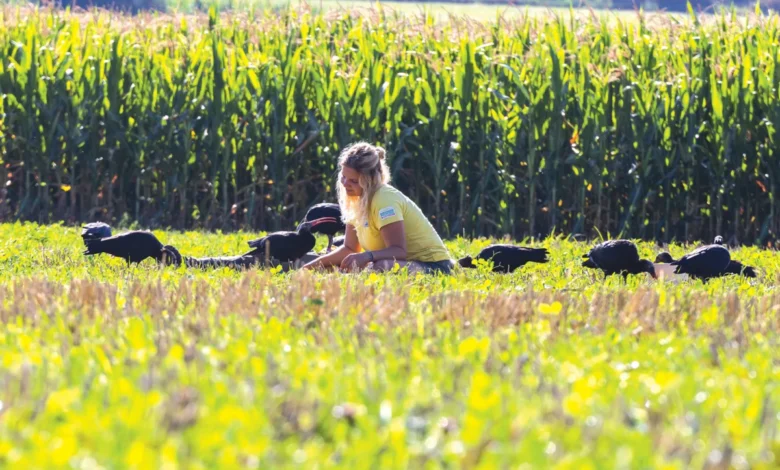
The journey begins not in a sterile laboratory, but in the heart of the lush, expansive valleys of southern Austria, a stark contrast to the rugged mountains that frame them. It was a chilly day in April 2023 when Barbara Steininger, then twenty-five, experienced a profound shift in her life. Standing mere meters from an aviary, anticipation mixed with a palpable nervousness. She was about to become a foster mother, she recounted, adding with a smile, “especially if your fosterlings are birds.” Moments later, a zookeeper from Wildlife Park Rosegg gently placed two featherless, vulnerable chicks into her warm hands. Steininger’s freckled face lit up, a testament to the immediate connection. These two were just the beginning; thirty-three more awaited their turn.
From that pivotal day forward, Steininger and her twenty-eight-year-old colleague, Helena Wehner, assumed the roles of sole caregivers to these precious Northern Bald Ibis chicks. Their commitment mirrors that of raising human infants: constant companionship, words of encouragement, and adoration delivered in gentle "baby speak" are deemed as essential as the physical nourishment. Eight times a day, the foster mothers meticulously hand-feed the growing chicks. Wehner clarified, “Just that it’s not breast milk or formula,” but a carefully prepared mix of shredded beef hearts and mice, providing the high-protein diet crucial for rapid development. This extraordinary level of devotion is not afforded lightly; it is reserved for some of the very last Northern Bald Ibises, a species teetering on the precipice of oblivion. Their meticulous work forms the very foundation of Project Waldrapp, an ambitious international conservation effort.
The Northern Bald Ibis – A Species on the Brink
The Northern Bald Ibis, with its distinctive featherless, wrinkled head and iridescent black plumage, was once a revered and widespread bird. Historically, its range stretched across Central Europe, North Africa, and the Middle East, even gracing hieroglyphs in ancient Egypt, where it was associated with the god Thoth. However, centuries of human activity have decimated its populations. By the 17th century, the last wild migratory populations in Central Europe had disappeared, victims of relentless hunting, widespread habitat destruction due to agricultural intensification, and the indiscriminate use of pesticides which contaminated their food sources.
Today, the species is classified as Critically Endangered on the IUCN Red List. Only a few fragmented wild populations persist globally. The largest stronghold is in Morocco, where approximately 700 individuals cling to existence. A tiny, highly vulnerable group was once known in Syria, though its current status in the wild is precarious, possibly extinct. Turkey hosts a semi-wild, non-migratory population. The profound challenge for reintroduction efforts, particularly in Europe, lies in the fact that the ancestral migratory knowledge – passed down from generation to generation – has been entirely lost. Without this innate guidance, young ibises released into the wild would not know where or how to migrate, rendering their survival impossible. This loss of cultural memory within the species necessitated an unprecedented, human-led intervention.
Project Waldrapp: Pioneering a New Path to Survival
Enter Johannes Fritz, the visionary biologist recognized as the driving force behind Project Waldrapp, also known as the Waldrappteam. Fritz and his dedicated team conceived an audacious solution to the lost migratory knowledge: humans would literally teach the birds their new routes. The core concept relies on avian imprinting, a phenomenon famously studied by Konrad Lorenz. By exposing the ibis chicks to human caregivers from the moment they hatch, the birds imprint on these individuals, recognizing them as their parental figures and, crucially, as their flock leaders.
The process is meticulously structured. After the intensive hand-rearing phase by foster mothers like Steininger and Wehner, the young ibises undergo rigorous flight training. This involves daily sessions where the human caregivers, donning specialized bird suits to reinforce the imprinting, lead the birds in short flights around their aviaries. As the birds grow stronger, these flights extend, preparing them for the arduous journey ahead. The pivotal moment arrives when the birds are ready for their first migration. Here, the project employs its most iconic and visually stunning technique: human pilots, flying ultra-light aircraft, lead the flock of young ibises from their breeding grounds in places like Burghausen, Germany, or Kuchl, Austria, to their designated wintering grounds in Tuscany, Italy.
These migratory journeys are fraught with challenges. The human-led flock must navigate unpredictable weather patterns, manage airspace alongside commercial air traffic, and overcome the sheer physical demands of hundreds of kilometers of flight. The logistics are immense, requiring a dedicated ground team for support, veterinary care, and public relations. Since its inception in the early 2000s, Project Waldrapp has guided hundreds of ibises across the Alps. The aim is not merely to transport them, but to instil in them the knowledge of the route. Once a bird successfully completes the migration once, it is expected to remember and repeat the journey independently in subsequent years, eventually leading its own offspring along the learned path.
Milestones, Challenges, and Scientific Insights
Project Waldrapp has achieved remarkable milestones since its inception, demonstrating the viability of this highly interventionist conservation strategy. From a starting point of zero wild migratory Northern Bald Ibises in Central Europe, the project has successfully established multiple breeding colonies and fostered a free-flying, migratory population that now numbers over 200 individuals. These birds regularly complete their annual migrations between their northern breeding grounds and southern wintering areas, a testament to the success of the human-led guidance. The formation of these self-sustaining flocks, capable of breeding and migrating independently, is a monumental triumph for a species once thought lost to the continent.
However, the path to recovery is not without its significant challenges. The first independent migration is particularly perilous for the young birds, with high mortality rates due to various factors. Predation by natural predators like eagles and foxes, collisions with power lines, and illegal hunting remain constant threats. Maintaining the integrity of the learned migratory route across generations is another complex task; while adult birds largely remember the path, ensuring their offspring follow precisely requires continued monitoring and occasional intervention. Genetic diversity within the reintroduced population is a continuous consideration, as is managing potential human-wildlife conflicts, particularly when the birds forage in agricultural areas at their wintering sites. Furthermore, securing consistent funding and managing the intricate logistics of an international, multi-year project demand relentless effort and dedication.
Scientifically, Project Waldrapp offers invaluable insights into avian migration, the mechanics of imprinting, and the complexities of reintroduction strategies for highly endangered species. It serves as a living laboratory, providing unique data on how new migratory traditions can be established and sustained, offering critical lessons for other conservation efforts globally.
Broader Conservation Impact and Future Horizons
The implications of Project Waldrapp extend far beyond the fate of the Northern Bald Ibis. This pioneering model of human-assisted migration could potentially be adapted for other critically endangered migratory species facing similar losses of ancestral knowledge. It underscores the vital role of innovative, out-of-the-box thinking in modern conservation, particularly in an era of rapid environmental change.
The project also exemplifies the power of transnational cooperation. Its success hinges on the seamless collaboration between Austria, Germany, and Italy, reflecting a unified European approach to biodiversity protection. This cross-border effort demonstrates that conservation challenges often transcend national boundaries and require concerted international action. Moreover, the highly visible and emotionally resonant nature of the project generates significant public interest and raises crucial awareness for broader conservation issues. The iconic images of humans flying alongside their avian charges captivate audiences, fostering empathy and support for wildlife protection.
Johannes Fritz articulates the profound significance of their work: "Every bird that successfully completes a migration and breeds is a triumph. We’re not just saving a species; we’re restoring a piece of Europe’s natural heritage." His sentiment is echoed by the foster mothers, whose bond with the birds is palpable. Barbara Steininger reflects, "It’s more than a job; it’s a profound connection. You become their world, and they become yours. Seeing them fly free, knowing you taught them that path, is indescribable." Conservation experts from various environmental NGOs laud the project as a testament to extraordinary dedication and interdisciplinary collaboration, highlighting its potential to redefine rewilding strategies.
The long-term vision for Project Waldrapp is to establish a fully self-sufficient, migratory Northern Bald Ibis population across Central Europe, one that thrives in its ancestral lands without the need for human guidance. The project serves as a crucial bridge to that future, demonstrating that with enough ingenuity, dedication, and a deep understanding of animal behavior, humanity can indeed help rewrite the story of extinction and offer a second chance for hope to take wing.