Conquering Wat Phu Tok: Thailand’s Most Daring Cliffside Temple Architecture in Bueng Kan Province

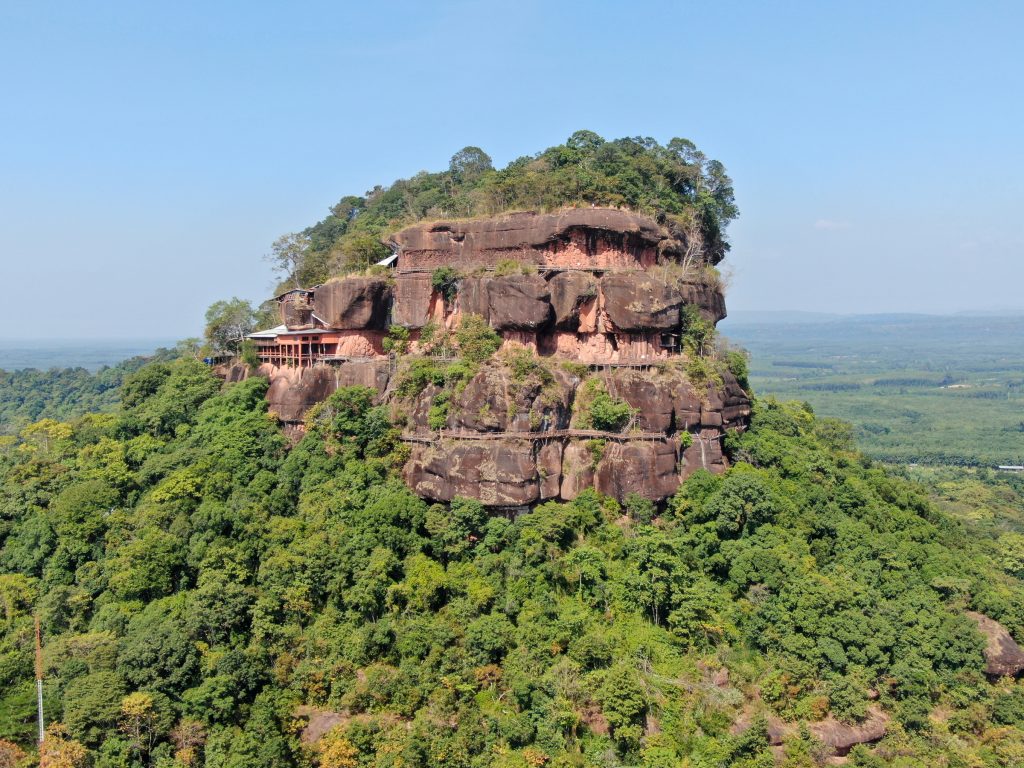
Rising sharply from the flat, agrarian landscape of northeastern Thailand, Wat Phu Tok stands as one of the kingdom’s most architectural and structural anomalies. Officially designated as Wat Jetiyakhiri, this remote sanctuary is nestled within the verdant and sparsely populated Bueng Kan province in the Isan region. The complex is defined by a 359-meter-high sandstone inselberg—locally referred to as Phu Tok, meaning "lonely mountain"—that challenges both the architectural ingenuity of its creators and the equilibrium of visitors. Drawing comparisons to Sri Lanka’s famed Sigiriya monument due to its isolated geological profile, the site is globally recognized not merely as a place of worship, but as a masterclass in vernacular engineering, utilizing sheer cliff faces to construct a vertical pilgrimage route.
Historical Foundations and the Seven Stages of Meditation
The genesis of Wat Phu Tok dates back to the late 20th century, conceived by the revered Buddhist monk Luang Pu Juan. Recognizing the mountain’s rugged terrain, dense indigenous flora, and isolation, the monk identified the site as an ideal environment for solitary ascetic practice and vipassana meditation. Historically, the isolated terrain was heavily populated by wildlife, notably venomous snakes, presenting a physical hazard that mirrored the mental and spiritual obstacles monks sought to overcome during their retreats.

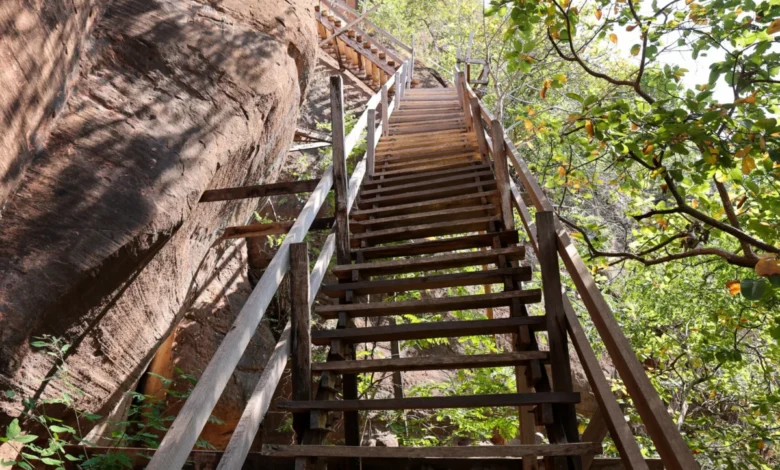
To facilitate access across the precipitous rock formations, Luang Pu Juan, alongside local devotees and monastic craftsmen, initiated the construction of an intricate network of wooden staircases, ladders, and cantilevered walkways. The architectural design was intentionally mapped into seven distinct tiers. These levels are not arbitrary; they symbolize the seven stages of Buddhist enlightenment and spiritual purification, allowing monks and pilgrims to physically ascend through the tiers of meditation. Tragically, the visionary founder did not live to see the completion of the expanded master plan; Luang Pu Juan perished in a commercial aviation accident in 1980. Despite this loss, the monastic community and regional authorities have maintained the structural integrity of the complex, preserving it as both a functioning religious site and a major architectural landmark.
Geographical Context and Arrival

Located approximately 30 minutes by road from Bueng Kan city proper, the temple grounds contrast sharply with the quiet, rural expanses of the surrounding Isan region. Upon arrival, visitors encounter a sprawling base infrastructure featuring a large temple complex, a serene lake, and dedicated parking facilities designed to accommodate regional tourism without disrupting the natural topography.
The ascent begins at the base of the mountain, where a formal gateway transitions visitors from flat ground onto the initial series of timber staircases. Initially, the trail presents a moderate slope characterized by solid, earth-bound pathways and low-angle wooden steps. However, as the elevation increases, the engineering demands intensify. The stairs grow progressively steeper, eventually transitioning into near-vertical wooden ladders anchored securely into the red sandstone rock. Despite the visual intimidation factor and the slight flexibility of the weathered timber underfoot, structural assessments by visiting engineers and tourism authorities confirm that the foundational anchoring system remains robust, utilizing heavy-duty steel bolts and durable local hardwoods to secure the walkways against the sheer cliff faces.

Architectural Breakdown of the Seven Tiers
The functional layout of Wat Phu Tok is stratified across its seven levels, each offering distinct architectural features and varying degrees of accessibility:

Levels One through Four: Serving as the transitional phase of the pilgrimage, these initial tiers feature moderate staircases interspersed with small grottoes, minor shrines, and resting points. Vegetation is dense, and the path primarily hugs the forested slopes of the lower mountain.
Level Five: Marking a significant expansion of the site, the fifth tier serves as the primary administrative and ceremonial hub of the mountain. Here, visitors encounter the principal ordination hall (ubosot), alongside numerous subsidiary shrines, monks’ quarters, and gathering areas. Unlike the subsequent tier, the pathways on the fifth level are largely grounded on terra firma, providing a stable environment for congregation. This level also features a notable architectural detour: an elevated stone pathway leading to a secluded rock temple perched precariously on an isolated spur of the mountain, accessible via a narrow wooden suspension bridge.

Level Six: Universally cited by visitors and safety monitors as the architectural highlight of the complex, the sixth tier is defined by its dramatic cliff-hugging walkways. Approximately half of this level’s circumference consists of wooden plank pathways cantilevered directly into the vertical granite and sandstone cliff walls. While providing sweeping panoramic views of the surrounding Mekong River basin and the unbroken canopy of Bueng Kan’s forests, this tier requires absolute focus. The sheer drop-offs and narrow passages present a stark test of nerve, though safety railings and maintenance protocols have kept incident rates exceptionally low.
Level Seven: The terminal tier represents the literal and spiritual apex of the mountain. Accessible via a final, demanding series of ladders, the seventh level opens onto the forested plateau at the top of the inselberg. In accordance with local accounts and monastic warnings, this upper zone remains largely untamed and is known as a natural habitat for various species of venomous snakes. Consequently, tourist traffic is strongly discouraged beyond the sixth level. There are no constructed walkways, shrines, or permanent structures on the summit, rendering it primarily a destination for seasoned climbers and monastic practitioners seeking absolute isolation.

Safety Protocols, Infrastructure Maintenance, and Economic Implications
The operational management of Wat Phu Tok falls under a cooperative agreement between local monastic authorities, the Royal Forest Department, and the Bueng Kan provincial administration. Given the inherent risks associated with aging timber structures exposed to tropical weathering, provincial budgets regularly allocate funds for the systematic replacement of worn wooden planks, rusted anchor bolts, and handrails. Structural inspections are conducted prior to the peak dry season tourism period, which spans from November to February, when weather conditions are most favorable for outdoor recreation.

From an economic perspective, Wat Phu Tok serves as a vital anchor for tourism in Bueng Kan, one of Thailand’s youngest and least industrialized provinces, established officially as a separate province in 2011. While mass tourism remains heavily concentrated in central and southern Thailand, sites like Wat Phu Tok drive sustainable, niche travel to the Isan region, boosting local hospitality ventures, transport services, and regional commerce without inflicting the environmental degradation associated with over-tourism.
Future Outlook and Preservation Challenges

As international awareness of Wat Phu Tok grows through digital media and travel documentation, authorities face the dual challenge of accommodating rising visitor numbers while preserving the monastic tranquility that originally defined the sanctuary. Proposals to modernize the access routes—such as replacing the traditional timber pathways with steel or concrete structures—have been consistently resisted by monastic leaders and conservationists, who argue that the tactile, humbling experience of navigating the wooden pathways is integral to the spiritual and cultural identity of the site. Consequently, the emphasis remains on rigorous preventative maintenance, visitor education regarding safety protocols, and the preservation of the surrounding natural ecosystem that protects the integrity of Thailand’s most daring mountain temple.