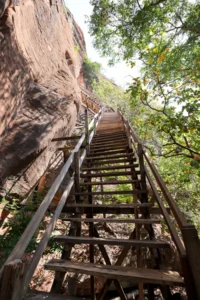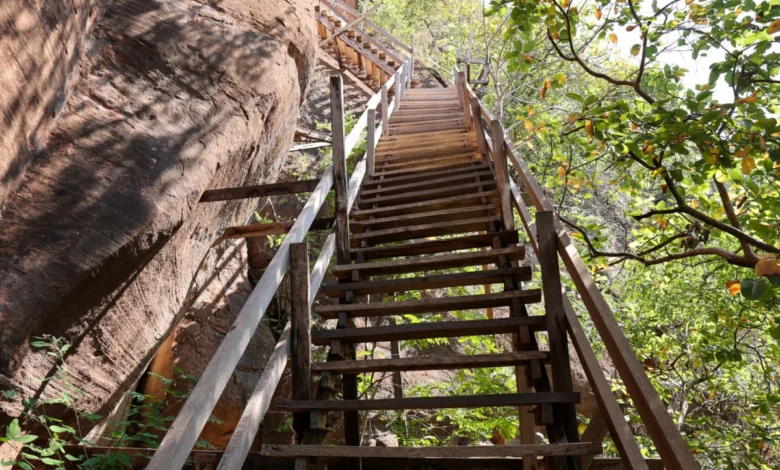
Rising majestically from the flat terrain of Thailand’s remote northeastern Isan region, Wat Jetiyakhiri—universally known as Wat Phu Tok—stands as one of Southeast Asia’s most extraordinary architectural and spiritual achievements. Located in the sparsely populated Bueng Kan province, this 359-meter-high isolated sandstone monolith challenges visitors with a network of hand-built wooden staircases, vertiginous cliff-side walkways, and a design that physically manifests the Buddhist path to enlightenment. As tourism diversifies away from Thailand’s congested southern beaches and central historical parks, off-the-beaten-path destinations like Wat Phu Tok have emerged as vital subjects of interest for cultural preservationists, domestic travelers, and adventurous global tourists seeking sustainable remote exploration.
Main Facts and Geographic Overview
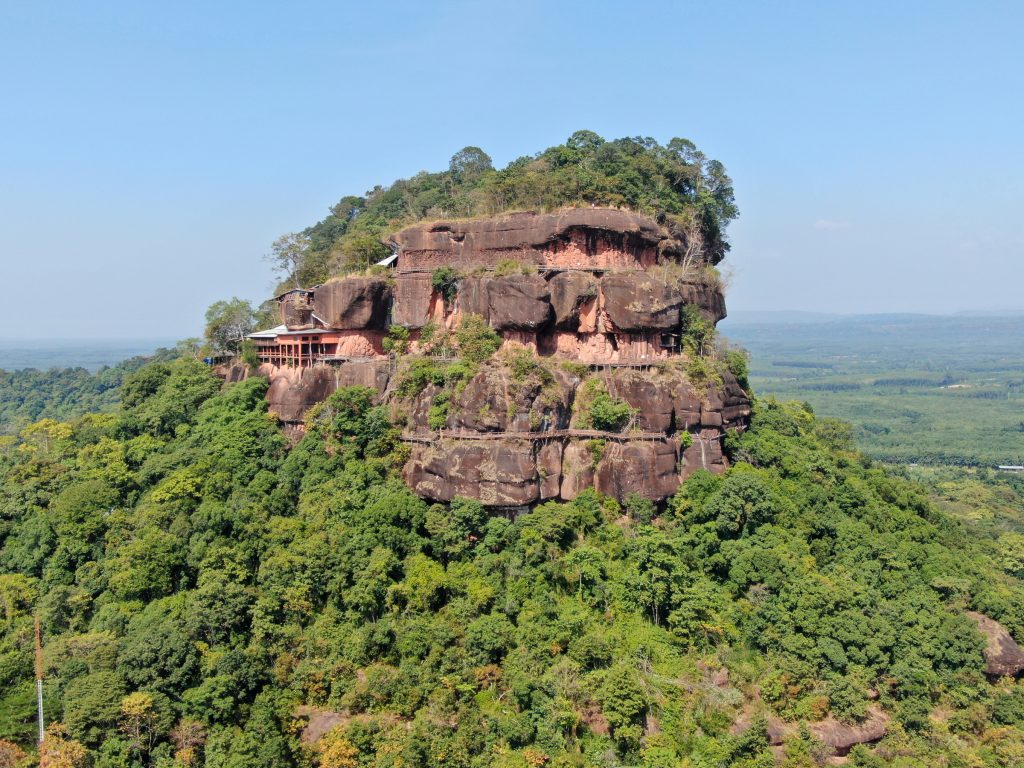
Officially designated as Wat Jetiyakhiri, the temple takes its colloquial name from the local Isan dialect, where "Phu Tok" translates directly to "lonely mountain." Rising abruptly from the surrounding agricultural plains, the geological formation bears a striking resemblance to a smaller-scale Sigiriya in Sri Lanka. The entire temple complex is engineered into and around the vertical sandstone rock faces.
The primary structural feature defining the site is its intricate system of seven tiers of wooden walkways and staircases. These pathways cling directly to the sheer rock cliffs, anchored securely into the stone. The complex covers the entirety of the 359-meter elevation, serving not merely as a tourist attraction, but as a functioning Buddhist monastery dedicated to meditation, asceticism, and spiritual isolation.
Historical Chronology and Construction

The history of Wat Phu Tok is deeply intertwined with the traditions of Thai forest Buddhism and the legacy of its founder, the revered meditation master Phra Ajarn Juan Kulachettho (commonly known as Luang Pu Juan). For generations, the rugged terrain, dense surrounding forests, and dense populations of indigenous wildlife—particularly venomous snake species—rendered the lonely mountain largely inaccessible to the general public. However, these very hazards made the isolated peak an ideal sanctuary for monks seeking solitude and rigorous meditative discipline.
In the mid-20th century, Luang Pu Juan recognized the spiritual potential of the mountain and initiated the monumental construction project. Without the aid of modern heavy machinery, the monk, alongside local laborers and devoted followers, began hand-building a series of wooden ladders, scaffolding, and pathways.
The architectural design was deliberately structured around the core tenets of Buddhist theology. The mountain was divided into seven distinct levels, engineered to symbolically represent the seven stages of spiritual awakening and enlightenment (Bojjhanga) in Buddhist doctrine. The construction evolved over decades, transforming a treacherous, impassable natural rock formation into a navigable vertical labyrinth of shrines, meditation cells, and viewing platforms.

Tragedy struck the temple’s modern history when Luang Pu Juan tragically passed away in an aviation accident in 1980. Despite the loss of its visionary founder, the monastic community and regional authorities have maintained the structural integrity of the wooden walkways, preserving the site as both a place of active worship and a cultural landmark.
Chronological Ascent: Navigating the Seven Levels
A visit to Wat Phu Tok requires physical endurance and a head for heights, guiding visitors upward through a progressively challenging architectural sequence.

The journey begins at the base of the mountain within a spacious parkland featuring a large temple complex, administrative buildings, and a scenic lake. From the base, the trail leads directly to the mountain’s lower slopes, transitioning swiftly into sturdy wooden staircases embedded into the earth and lower rock formations.
The first and second levels offer gentle inclines, flanked by dense foliage and minor religious shrines. These initial tiers serve to acclimate visitors to the verticality of the site while maintaining a relatively secure footing on solid ground.
As the ascent continues to the third and fourth levels, the staircases grow progressively steeper, eventually transforming into near-vertical wooden ladders. While the construction utilizes robust timber planks that flex slightly underfoot, engineers and maintenance crews routinely inspect the anchors to ensure structural safety, despite the psychological intimidation the height may cause.

The fifth level marks a significant transition in the layout of the complex. Unlike the narrow cliffside paths of the upper tiers, the fifth level broadens into a more expansive terraced area. This tier serves as the functional heart of the monastery, housing the primary ordination hall, numerous smaller shrines, and dedicated meditation quarters for resident monks. Visitors frequently encounter a secondary path branching off the main trail here, leading to an isolated rock temple perched on a detached segment of the mountain—a notable architectural detour connected by a slender wooden bridge.
The sixth level represents the architectural and experiential climax of Wat Phu Tok. Approximately half of the circumference of this level consists of wooden plank walkways cantilevered directly out from the sheer rock face, anchored by iron pins driven deep into the sandstone. Walking along this tier offers unobstructed panoramic views of the sprawling Mekong River basin and the verdant canopy of the Bueng Kan province. While structural maintenance remains high, the sixth level demands absolute concentration, as the drop below is sheer and unyielding.
The seventh and final level represents the symbolic peak of enlightenment. Accessible via a final, demanding vertical ladder, the seventh level is entirely devoid of artificial walkways or shrines. Instead, it consists of the natural forested summit of the mountain. Local authorities and monks advise caution on this level due to the documented presence of native wildlife, including venomous snakes. The summit offers unobstructed natural vistas, though most visitors and architectural historians identify the sixth-tier cliff walkways as the definitive highlight of the site.

Supporting Data and Tourism Metrics
Bueng Kan province, established formally as Thailand’s 77th province in 2011 after separating from Nong Khai, remains one of the country’s most economically developing and least densely populated regions. According to regional tourism data from the Tourism Authority of Thailand (TAT), the Isan region receives a fraction of the international visitor volume recorded in coastal provinces like Phuket or urban centers like Bangkok.
Wat Phu Tok serves as a cornerstone for provincial eco-tourism initiatives. Regional planners note that while the site experiences steady weekend traffic from domestic travelers and adventurous regional backpackers, it avoids the destructive over-tourism pressures impacting other Thai landmarks. Infrastructure investments in Bueng Kan have focused primarily on improving road connectivity from Bueng Kan city—a 30-minute drive—while preserving the natural and rustic integrity of the temple grounds.

Safety Guidelines and Infrastructure Management
Managing a vertical monastic complex built primarily of wood on a sandstone cliff requires rigorous oversight. The local municipality, in collaboration with the resident Buddhist order, conducts routine pre-monsoon and post-monsoon structural audits.
Safety protocols mandate that visitors wear appropriate footwear with adequate traction. Due to the exposed nature of the sixth-level cliffside walkways, local authorities temporarily restrict access during severe weather events, particularly heavy monsoonal downpours and high-velocity winds that can compromise footing on the wooden planks.

Broader Socio-Economic Impact and Implications
The prominence of Wat Phu Tok has catalyzed broader socio-economic shifts within Bueng Kan province. Historically reliant on rubber plantation agriculture and cross-border trade with Laos, the local economy has increasingly benefited from niche cultural and adventure tourism.
Economists specializing in Southeast Asian regional development point out that sites like Wat Phu Tok exemplify sustainable tourism models that distribute economic benefits away from major metropolitan centers into rural frontier provinces. By highlighting lesser-known Isan destinations, regional authorities encourage longer visitor stays and a deeper appreciation for Thailand’s diverse religious and geographical heritage.

Ultimately, Wat Phu Tok transcends its classification as a mere tourist attraction. It stands as a testament to human engineering, spiritual devotion, and the harmonious integration of sacred architecture within a formidable natural landscape, securing its place as one of Thailand’s most compelling modern landmarks.