Navigating Mortality and Meaning: Inside Bangkok’s Death Awareness Movement and One Writer’s Journey Through Grief


The intersection of tourism, psychological introspection, and cultural perspectives on mortality has increasingly driven travelers toward unconventional therapeutic experiences abroad. For Australian author and columnist Liv Arnold, a scheduled trip to Bangkok, Thailand, evolved into an unintended exploration of grief and existential awareness. Arriving in the Thai capital while her mother faced a third diagnosis of liver cancer in Melbourne, Arnold engaged with unique local institutions—most notably the Kid Mai Death Awareness Café—to confront lifelong anxieties regarding aging, impermanence, and loss.

This journey highlights a broader global trend of death positivity and experiential psychology, where individuals utilize cultural frameworks outside their own to process trauma, anxiety, and the inevitability of human mortality.
The Context of Death Awareness in Thailand
Thailand provides a distinct cultural backdrop for confronting existential dread. With approximately 90 percent of its population practicing Theravada Buddhism, daily life is heavily influenced by tenets of impermanence (anicca) and detachment. Rather than treating death as a taboo subject to be shielded from public view, traditional Buddhist practices often encourage meditation on corpses and physical decay to reduce fear, ego, and material attachment.

Capitalizing on this philosophical foundation, Buddhist philosopher and scholar Veeranut Rojanaprapa established the Kid Mai Death Awareness Café in Bangkok in 2018. Originally conceived as fieldwork for his doctoral research, the cafe was designed to test a fundamental hypothesis: that regular cognitive engagement with mortality could mitigate greed, anger, and societal corruption.
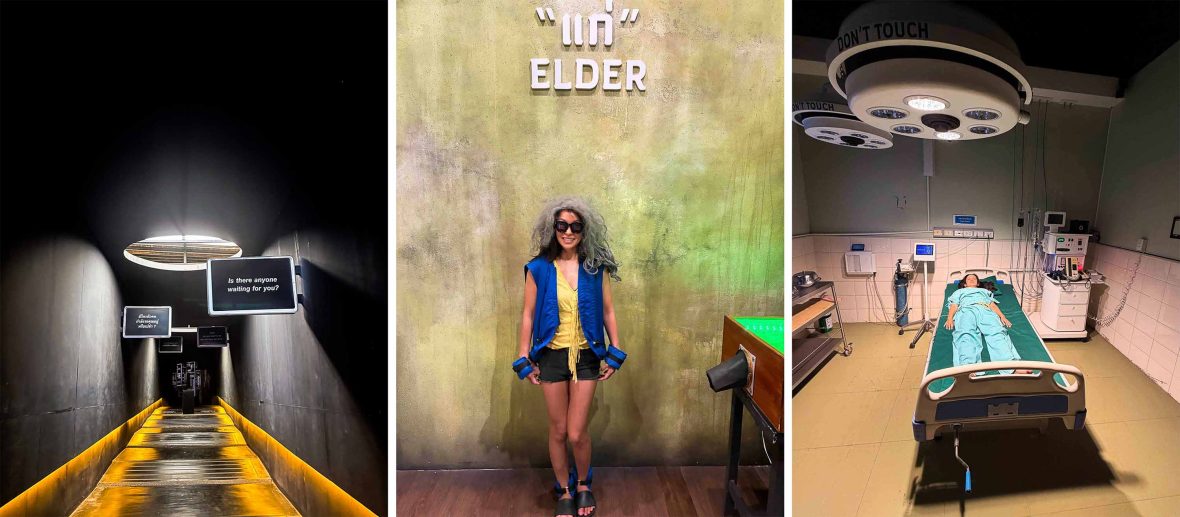
The establishment features a multi-stage interactive exhibit that guides visitors through symbolic phases of human existence: Birth, Elder, Pain, and Death. Patrons can crawl into womb-like structures, try on weighted suits and grey wigs to simulate advanced age, wear hospital gowns in simulated intensive care units, and—most famously—lie inside wooden funeral caskets. While initial community resistance arose over the delivery of caskets to a commercial district, the project sparked widespread international and domestic dialogue about mental health, palliative psychology, and the cultural sanitization of death common in Western societies.

A Chronology of Confrontation: From the Boxing Ring to the Coffin
Arnold’s immersion in Bangkok’s therapeutic landscape combined physical endurance with psychological exposure. Known for managing an anxiety disorder through high-intensity physical disciplines, her itinerary initially centered on Muay Thai training—a pursuit she humorously characterizes as "violence as a wellness practice." Training alongside elite fighters provided a visceral grounding mechanism, forcing an overactive, future-oriented anxiety into the immediate, high-stakes present of the boxing ring.
Following her physical training, Arnold undertook the experiential exhibits at the Kid Mai Death Awareness Café, structuring her visit as a chronological passage through life stages:

- The Birth Exhibit: Involving enclosure within red, womb-like installations to simulate the inception of life.
- The Elder Exhibit: Utilizing weighted vests, sandbags, and visual impairments to replicate the physical friction and administrative difficulties of advanced age.
- The Pain Exhibit: Placing participants in simulated clinical environments—complete with surgical gowns and monotonic heart monitor loops—to mimic intensive care scenarios.
- The Death Exhibit: Requiring visitors to lie within a wooden coffin in total darkness, concluding with a written reflection on what matters most in one’s final hours.
Parallel to these symbolic explorations, Arnold’s real-time reality involved coordinating remotely with her family regarding her mother’s escalating medical treatments in Australia. While the simulated hospital stay at the café concluded within minutes, her mother’s actual medical interventions spanned months of emergency hospitalizations and undisclosed physical deterioration—highlighting a generational dynamic where parents routinely shield their adult children from the full weight of physical decline.
Broader Implications: Cultural Approaches to Mental Health and Palliative Care
The intersection of tourism and mortality studies points to a growing demand for experiential mental healthcare. Modern psychological research increasingly supports the efficacy of exposure therapy—facing feared stimuli directly rather than avoiding them—to reduce generalized anxiety disorders.
Traditional Western approaches to terminal illness and grief have historically emphasized clinical detachment, palliative comfort, and private mourning. Conversely, institutions like the Kid Mai Death Awareness Café, alongside historical Thai public health initiatives such as Mechai Viravaidya’s destigmatization campaigns (exemplified by the safe-sex advocacy restaurant Cabbages & Condoms), demonstrate a societal preference for radical transparency and public integration of taboo subjects.
Public health analysts note that destigmatizing conversations around end-of-life care yields measurable benefits. Populations with higher health literacy regarding mortality tend to execute advanced directives earlier, experience lower rates of complicated grief, and engage in more constructive communication with palliative care teams. By embedding philosophical acceptance of impermanence into daily consumer spaces, Thailand’s death awareness movement offers an alternative model for psychological resilience in an era marked by rising anxiety and systemic stress.
Conclusion: Shifting Paradigms in Grief and Communication
Arnold’s journey through Bangkok did not eradicate her anxiety or provide simple resolutions to the impending loss of her mother. Instead, the juxtaposition of ancient Buddhist monuments—such as the 151-foot Reclining Buddha at Wat Pho—with modern medical realities reframed her approach to communication.
By stepping outside the passive dynamic where parents shield children from existential dread, Arnold’s final interaction in the narrative—placing a direct phone call to her mother to ask about the difficulty of aging and illness—underscores the ultimate utility of mortality awareness. Recognizing impermanence does not eliminate grief; rather, it provides the urgency required to speak honestly before the opportunity vanishes.