Tracking the Saigas of Kazakhstan: Conservationists Battle Modern Fragmentation to Protect an Ice Age Survivor

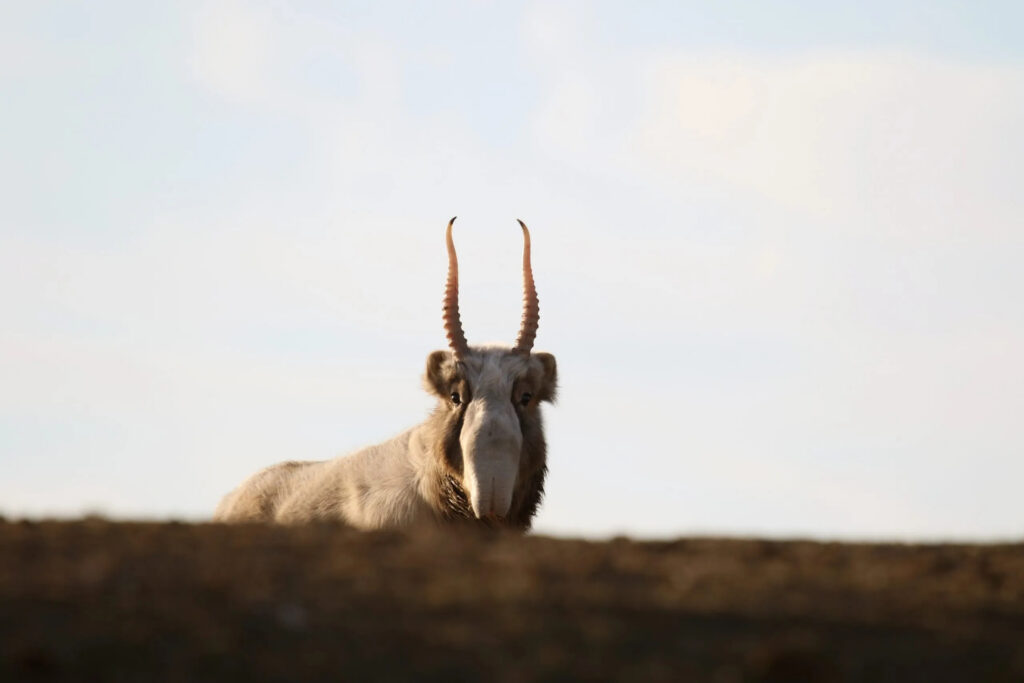
The vast expanses of the Central Asian steppe present an unforgiving landscape where the elements dictate the rhythm of survival. Skidding off the main paved route onto a rudimentary track of tire-tread mud, the boundaries between the modern world and deep prehistory begin to blur. Flanking the two-track trail are parallel pathways no more than a foot wide, crisscrossing the terrain like an ancient transit network. In the distance, howling Siberian winds drive a phantom-like movement across the horizon. Through binoculars, observers can witness a tableau seemingly untouched since Neanderthals roamed the earth: hundreds of nomadic saiga antelopes piercing the frigid air with ringed horns, inhaling brittle winter shards through distinct, tubular snouts as they sprint across the desolate plain.
This phenomenon captures the essence of the saiga, a freedom-loving ungulate that has traversed Central Asia through the rise and fall of countless civilizations. Having outlived the megafauna of the Pleistocene—including woolly mammoths, saber-toothed cats, and giant deer with 12-foot antlers—these resilient mammals once served as natural guides for pioneering human caravans navigating the harsh continental divide. Today, however, the ancient migration routes of the saiga face unprecedented disruption from modern infrastructure, prompting conservation biologists to race against time to preserve a vanishing migratory culture.
The Rutting Season and the Ecology of the Steppe
The timing of field audits conducted by conservationists is frequently anchored to the saigas’ annual rutting season, a critical window for the species. During this period, antelopes from across the region converge in massive single-file lines before engaging in competitive displays and mating rituals. For males, the rut involves intense physical posturing and headbutting to demonstrate prowess to female onlookers—an expenditure of energy so extreme that many individuals succumb to exhaustion.
Females, meanwhile, assess potential mates based on physical fitness and a particularly distinctive anatomical feature: the saiga’s floppy, elongated nose. Essential for filtering out dust in the semidesert plains and warming frigid winter air before it reaches the lungs, a large snout serves as the ultimate indicator of male virility.
The open, treeless nature of the steppe has long made saigas prime subjects for wildlife tracking. The integration of GPS collar technology has revolutionized conservation efforts, providing researchers with reliable daily movement data across landscapes once deemed too expansive to monitor effectively. Modern tracking data now informs the establishment of dedicated wildlife sanctuaries, designed to protect critical migratory corridors from encroaching industrialization.
Chronology of Human and Animal Nomadism
The tradition of nomadism in this region dates back at least to the Early Iron Age. Etymological records suggest that the word "Kazakh" derives from a Turkic term meaning "wanderer" or "vagabond." For millennia, human groups seasonally migrated between high-altitude summer pastures and sheltered winter valleys, gathering periodically for cultural festivals before dispersing across the plains.
These time-honored transit corridors ultimately helped shape portions of the historic Silk Road, an evolving web of pathways connecting reliable stopovers. The fertile banks of the Ural River in western Kazakhstan emerged as a vital transcontinental crossroads, serving as a natural boundary between Asia and Europe. Strategic settlements along the river provided weary travelers with rest, supplies, and a place to regroup before continuing their journeys.
Throughout history, traditional nomadic practices persisted through successive eras of control by Turkic tribes, the Mongol Empire under Genghis Khan, and the Russian Empire. A definitive turning point arrived in the 20th century with the rise of the Soviet Union, which implemented mandatory sedentarization policies. These initiatives forced nomadic human populations into agricultural settlements, effectively dismantling a mobile lifestyle that had endured for millennia.
The subsequent conversion of the steppe into agricultural plots largely failed due to unsuitable soil conditions. While human populations transitioned toward stationary urban life, the saigas continued their ancient nomadic patterns, setting the stage for direct conflict with modern development.
Infrastructure Fragmentation and the Loss of Spatial Knowledge
As the Eurasian steppe became increasingly accessible to vehicles, the construction of rattling railways, fenced borders, and roaring roads partitioned the landscape. For the saiga, these anthropogenic barriers represent an existential threat.
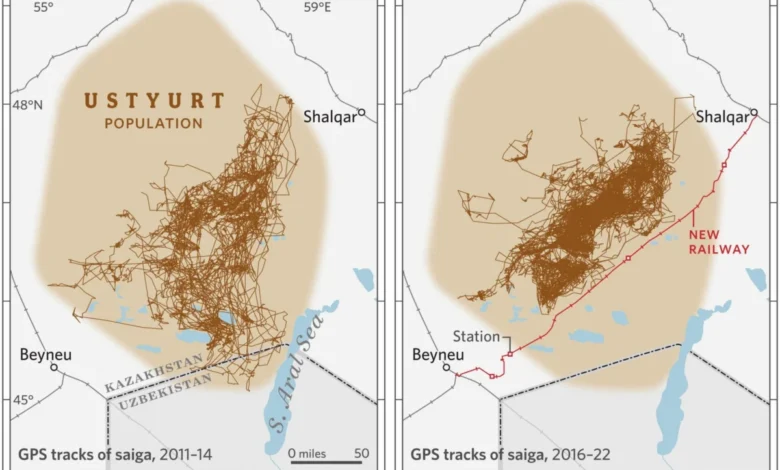
Historical tracking data reviewed by conservationists illustrates the immediate impact of linear infrastructure. Maps detailing the movements of GPS-collared saiga populations demonstrate how traditional migratory routes extending deep into Uzbekistan were severed by the construction of a major railway line in 2014. While pre-construction data reveals fluid seasonal movements across the region, post-construction data shows herds blocked by the tracks, unable to access traditional grazing grounds and water sources to the south.
Such physical interruptions trigger a collapse in spatial knowledge. Much like human populations forced into sedentary lifestyles lost their connection to ancestral navigation routes, young saigas acquire survival knowledge—including locations of food, shelter, and hazard avoidance—through active participation and generational observation. As the landscape is cleaved by development, the cultural transmission of migratory pathways fades from memory.
Conservation Strategies and Cross-Border Collaboration
To mitigate the fragmentation of saiga habitats, field biologists from organizations such as the Association for the Conservation of Biodiversity of Kazakhstan (ACBK), in partnership with state authorities, have implemented targeted engineering solutions. Conservation initiatives include:
- Saiga-Friendly Crossings: The construction of sloping dirt ramps designed to match the height of railway tracks, creating visual gaps that encourage animals to cross safely.
- Strategic Fencing: The installation of cattle-guard fences positioned away from railway crossings to prevent direct collisions between trains and wildlife.
- Border Modifications: Collaboration with the Uzbek government to replace traditional barbed-wire perimeter walls with X-shaped barricades that block vehicular traffic while leaving sufficient clearance for saigas to migrate freely.
These collaborative efforts aim to restore ecological connectivity across the plateau, rebuilding the structural pathways necessary for the species to reclaim its historic range.
Broader Impact and Implications
The plight of the saiga antelope highlights the broader ecological consequences of landscape fragmentation in Central Asia. As linear infrastructure continues to expand globally, migratory species face compounding pressures that threaten their long-term viability.
Experts emphasize that preserving migratory corridors is not merely a matter of wildlife management, but an essential component of maintaining functional ecosystems. The ongoing work in Kazakhstan serves as a critical case study in balancing infrastructural modernization with ecological preservation. By safeguarding the in-between spaces of the steppe, conservationists strive to ensure that the ancient migratory heritage of the saiga survives alongside human development.