The Interplay of Vision and Voice: A Photographer’s Reckoning with the Demands of Art

The very nature of creative endeavor, whether through the lens of a camera or the stroke of a pen, presents a perennial puzzle: which discipline, photography or writing, truly demands more from its practitioner? For years, this question has lingered, a persistent companion to my own artistic journey, each conviction about the answer inevitably dissolving with the next compelling experience that challenges my assumptions. There are mornings when the pursuit of a single page of prose can consume four hours, a meticulous dance with commas and syntax, as if rearranging furniture in a room that has lost its familiar contours. The exhaustion that follows is not physical, but a profound, almost ineffable weariness, the residue of an internal debate waged with oneself.
Conversely, photography, from an outsider’s perspective, might appear as an almost effortless escape. The image of a photographer, camera slung over a shoulder, venturing out into the world, seems to offer a stark contrast to the solitary confinement of the writing desk. It suggests a more immediate engagement with reality, a less introspective struggle. Yet, the street, in its boundless anonymity, offers a potent reminder of one’s limited dominion. The photographer does not dictate who enters the frame, the capricious dance of light, or the serendipitous convergence of two strangers at a crucial juncture. Instead, one arrives, a humble observer, ready to accept whatever the unfolding day deigns to present. Some afternoons are gifts, the city bestowing a cascade of photographic opportunities. Other days, the urban landscape withdraws, its secrets held close, impervious to experience or intention.
The notion of planning street photography often arises, and while elements can be orchestrated, the essence of the captured moment remains largely beholden to chance. A photographer may choose a specific neighborhood, opt for the ethereal light of dawn over the harsh midday sun, or dedicate time to understanding the rhythms of human movement in public spaces. However, the decisive photograph, the one that resonates, owes far more to the unpredictable currents of existence than to any meticulously crafted plan. This inherent unpredictability, perhaps, is the very fuel that sustains artistic engagement over time. Each foray into the bustling anonymity of a crowd is, in essence, a negotiation with uncertainty.
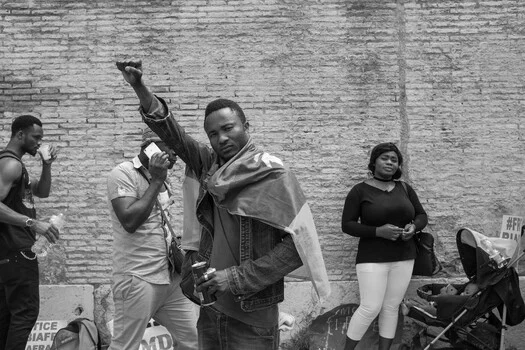
A poignant recollection surfaces from years ago, during a demonstration in Rome. Thousands of individuals, a sea of banners, the imposing presence of police, impassioned speeches, and a cacophony of sound – a scene ripe for documentation by any observer. Yet, my focus was not on the overt spectacle of the event itself. Instead, I found myself anticipating something subtler, almost spectral: a gesture that might evoke the timeless grace of a classical painting, a fleeting expression isolated for a nanosecond, or a composition that could transmute political turmoil into visual harmony without distorting the fundamental truth of the unfolding reality. For those seeking to cultivate such a nuanced perspective across diverse and unfamiliar situations, resources like "The Well-Rounded Photographer: 8 Instructors Teach 8 Genres of Photography" can serve as a valuable starting point, offering insights into a broader spectrum of photographic approaches.
These are the moments that linger, not for their inherent grandeur, but for their ephemeral revelation of something that existed for less than the blink of an eye. The peculiar alchemy of photography lies in the fact that our vision is never truly a blank slate. Every photograph we admire, every film that has left an indelible mark, every novel that has painted vivid images within our imagination, travels with us. While not consciously replicated, these past encounters subtly shape our instincts, influencing our decisions before we are even aware of making them. The popular conception of originality as the absence of influence is, I have come to believe, a misconception. True originality emerges when these myriad influences become so deeply interwoven with personal experience that they are no longer distinguishable. They cease to belong to others and become an intrinsic part of one’s unique way of seeing.
The greater challenge in photography lies not in mastering technical proficiencies like exposure or composition, which are certainly vital and teachable, but in accepting that each photograph is an inherent statement about its creator. Every frame serves as a miniature confession, not necessarily of explicit beliefs, but of what captures the photographer’s attention. And what one notices, more profoundly than any artist’s statement could ever articulate, speaks volumes about the individual.
This same truth resonates deeply within the realm of writing. Upon publishing an article, a spectrum of reactions is inevitable. Some readers will inevitably disagree, others will misinterpret its core message, and many will skim through it, the words failing to leave a lasting impression. Such outcomes, however, rarely diminish my resolve. Indeed, they are an intrinsic part of the creative process. Artistic endeavors, in their very essence, demand a willingness to expose oneself to the unknown, without foreknowledge of what might return.
The portrayal of artists as perpetual adversaries of the world often misses the mark. The more profound struggle unfolds in a quieter arena: the persistent chasm between the work one is capable of producing and the work that ultimately emerges. It is the distance between the envisioned photograph and the one captured, between the intended sentence and the one that finally graces the page. This gap, this inherent imperfection, rarely disappears entirely. And perhaps, it is precisely this enduring tension that prevents a singular choice between writing and photography. Photography offers a direct conduit to instinct, capturing the world in motion before language can intervene. Writing, conversely, compels a return to those very experiences, demanding a deeper understanding of their significance. One discipline apprehends the fleeting present, while the other engages in post-hoc reflection. Together, they transcend mere professions, evolving into distinct modalities of attentive engagement with reality.
While expressions of appreciation for my photographic work are always met with sincere gratitude, it is when a reader communicates that a particular paragraph has resonated for days, rekindling a forgotten aspect of their own selves, that a different sentiment arises. Perhaps this stems from my origins as a devoted reader long before I picked up a camera. Words, in some fundamental way, continue to feel like home. Ultimately, the effort to compartmentalize these two creative pursuits has become untenable, for they are inextricably linked, part of a singular process that leads, ineluctably, towards self-discovery and identity.
Whether navigating the urban labyrinth with a camera or confronting the stark solitude of a blank page, the underlying endeavor remains the same: an attempt to comprehend why certain moments possess such enduring power over us, and whether it is possible, even occasionally, to imbue them with a form that might, in turn, linger with another.
The photographs accompanying this essay originate from a demonstration held in Rome by members of the Biafran community. These individuals implored the global community not to avert its gaze from a tragedy that has persisted for decades. The essence of everything articulated herein is implicitly present within these images, albeit devoid of explicit prose. The pervasive uncertainty, the relentless pursuit of order amidst chaos, and the profound understanding that every impactful frame exists for mere moments – these elements are interwoven into the fabric of these photographs. In many respects, these images represent the essay in its nascent, visual form, preceding its translation into words.
The Biafran Tragedy: A Historical Context
The Biafran War, also known as the Nigerian Civil War, raged from July 6, 1967, to January 15, 1970. It was a devastating conflict fought between the government of Nigeria and the secessionist state of Biafra, which was primarily composed of the Igbo people. The war was triggered by a series of ethnic tensions, political instability, and pogroms against the Igbo in the north of Nigeria following military coups in 1966. Biafra declared its independence on May 30, 1967.
The conflict was marked by widespread famine and immense human suffering, particularly in Biafra, due to a Nigerian blockade. Estimates of the death toll vary, but it is widely accepted that between one and three million people, predominantly civilians, perished, largely from starvation and disease. International attention was drawn to the humanitarian crisis, leading to relief efforts by various organizations. The war ultimately ended with the defeat of Biafra and its reintegration into Nigeria. However, the legacy of the conflict, including lingering ethnic grievances and the trauma of the famine, has continued to shape Nigeria’s sociopolitical landscape.
The Rome Demonstration: A Call for Remembrance
The demonstration in Rome, as depicted in the accompanying photographs, likely represents an effort by the Biafran diaspora or their supporters to keep the memory of the war and its devastating consequences alive. Such events often serve multiple purposes: to educate younger generations about the historical tragedy, to lobby for international recognition of past injustices, and to advocate for continued humanitarian aid or reconciliation efforts in Nigeria. These gatherings, often characterized by their solemnity and the palpable weight of historical memory, aim to ensure that the lessons of the past are not forgotten and that similar atrocities are prevented in the future. The presence of banners and the gathering of community members underscore a collective commitment to remembrance and a plea for global awareness.
Data and Implications of the Conflict
The humanitarian crisis precipitated by the Nigerian Civil War had profound and lasting implications:
- Demographic Impact: The loss of an estimated one to three million lives represented a significant demographic shock, particularly for the Igbo population. This loss had long-term consequences for the region’s social and economic development.
- International Intervention: The scale of the famine led to significant international relief efforts, involving organizations like the International Committee of the Red Cross (ICRC) and the World Council of Churches. This period highlighted the complexities of humanitarian intervention during armed conflicts and the challenges of delivering aid in war zones.
- Political Repercussions: The failure of Biafran secession and its reintegration into Nigeria did not erase the underlying ethnic and political tensions. The war’s aftermath continued to influence Nigerian politics, contributing to subsequent periods of military rule and ongoing debates about federalism and ethnic representation.
- Economic Disruption: The war severely disrupted Nigeria’s nascent oil industry and overall economic infrastructure, delaying its potential for development. The rebuilding process was arduous and influenced by the nation’s oil wealth, which became a central factor in its post-war economic trajectory.
The Photographer’s Gaze: Capturing the Unseen
The photographer’s narrative of seeking the “quieter, almost invisible” within the chaos of the demonstration speaks to a deeper journalistic and artistic imperative. It is not merely about documenting the outward signs of protest, but about capturing the emotional and psychological undercurrents. This approach aligns with the principles of observational documentary photography, where the artist strives to convey the human experience behind an event. The search for a gesture, an isolated face, or a composition that transforms "political chaos into visual order without changing the truth of what was happening" is a testament to the power of visual storytelling to transcend mere reportage. It aims to evoke empathy, encourage contemplation, and offer a more profound understanding of the human condition within historical contexts. The photographs, in this sense, become a visual thesis, a silent argument for the importance of bearing witness to suffering and injustice. They serve as a crucial counterpoint to historical narratives that might otherwise overlook the individual stories lost within grand political events.
Related posts: