The Ancient Steppe Nomads: Conservation Challenges Facing the Saiga Antelope of Central Asia

The boundless Eurasian steppe, stretching from the Caucasus Mountains to Mongolia, has long served as a theater for some of the world’s most remarkable wildlife migrations. At the heart of this ancient landscape moves the saiga antelope (Saiga tatarica), a critically resilient ungulate whose lineage dates back to the Late Pleistocene epoch. Having outlived woolly mammoths, saber-toothed cats, and giant deer, the saiga now faces a modern suite of existential threats born from human infrastructure, agricultural expansion, and industrial development. Field audits conducted by conservation groups, such as the Association for the Conservation of Biodiversity of Kazakhstan (ACBK), reveal that while historical resilience has kept the species extant, the fragmentation of its traditional migratory routes threatens the preservation of a distinctly irreplaceable ecological heritage.
Chronology of the Steppe and Human Encroachment
The historical narrative of the Eurasian steppe is inextricably linked to mobility. Since the Early Iron Age, human nomads and indigenous wildlife have shared these vast transit corridors. The Etymology of the word "Kazakh" stems from the Turkic root qaz, signifying wanderers or vagabonds who traversed high altitudes during summer months and sought sheltered valleys before the arrival of harsh winter winds. These historic migration paths eventually helped form portions of the legendary Silk Road, transforming western Kazakhstan along the Ural River into a critical transcontinental crossroads where Asia meets Europe.
For millennia, saiga populations moved freely across this unbroken expanse, numbering in the millions as recently as the mid-20th century. However, the mid-20th-century rise of the Soviet Union brought mandatory sedentarization policies. These state-enforced measures halted traditional nomadic human practices, converting vast tracts of the fragile steppe into agricultural plots. Although many of these farming initiatives ultimately failed due to the unsuitability of the soil, the physical infrastructure they left behind—along with subsequent road networks, railways, and border fencing—permanently altered the topography of Central Asia.
Field Audits and Behavioral Impacts of Infrastructure
Modern monitoring by ACBK field researchers, including veteran conservationists Alexandr and Albert, utilizes advanced tools such as GPS telemetry to track saiga movements across newly established wildlife sanctuaries. These tracking datasets offer empirical insights into how physical barriers disrupt wildlife behavior.
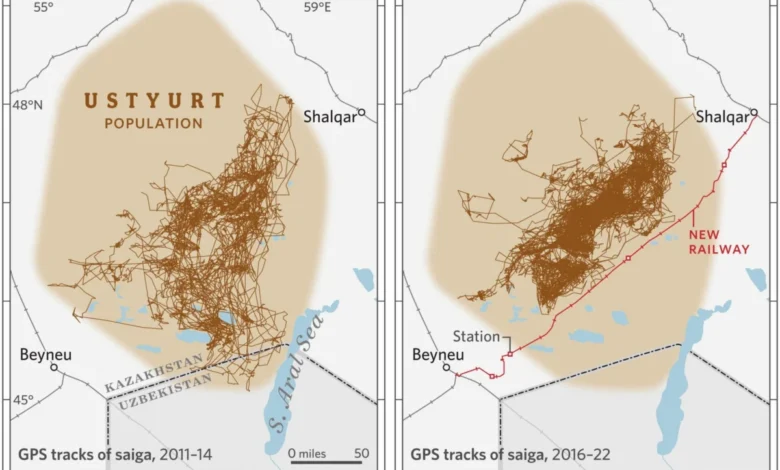
During seasonal rutting periods, saiga herds gather to engage in competitive rituals and mating displays, relying heavily on unobstructed landscapes to complete these high-energy cycles. However, linear infrastructure introduced in recent decades has heavily disrupted these ancestral patterns. Data compiled by ACBK illustrates that the construction of new rail lines—such as a barrier completed in Uzbekistan in 2014—abruptly severed traditional migration paths. Telemetry maps demonstrate that collared saigas, once accustomed to trekking deep into southern ranges, now frequently congregate on the northern side of these tracks, unable to access traditional water sources and seasonal pastures lying just beyond the rails.
This physical fragmentation precipitates a cognitive loss among the herds. Similar to the cultural erasure experienced by human populations forced into sedentary lifestyles, young saigas acquire spatial knowledge—routes to food, water, and shelter—through active observation and participation in herd migrations. When barriers cleave these landscapes, entire stretches of ecological knowledge fade, leading to demographic bottlenecks and vulnerable isolated populations.
Cross-Border Conservation Responses and Mitigation Strategies
Recognizing the severity of habitat fragmentation, international conservation coalitions and regional governments have initiated targeted infrastructural remedies. ACBK, in close partnership with the Kazakh and Uzbek governments, has begun implementing structural modifications designed to reconcile modern industrial needs with wildlife preservation.
Among these initiatives are the construction of saiga-friendly railway crossings. These engineered dirt ramps elevate the ground level to match the height of adjacent train tracks, creating the illusion of a natural gap in the line. Combined with cattle-guard fencing placed at strategic distances, these interventions prevent direct collisions between trains and ungulates while maintaining migratory pathways. Furthermore, collaborative efforts in border regions have modified traditional barbed-wire barriers into X-shaped barricades. These structures successfully deter unauthorized vehicular traffic while leaving sufficient clearance for saigas to move unhindered between territories.
Implications for Biodiversity and Regional Ecology
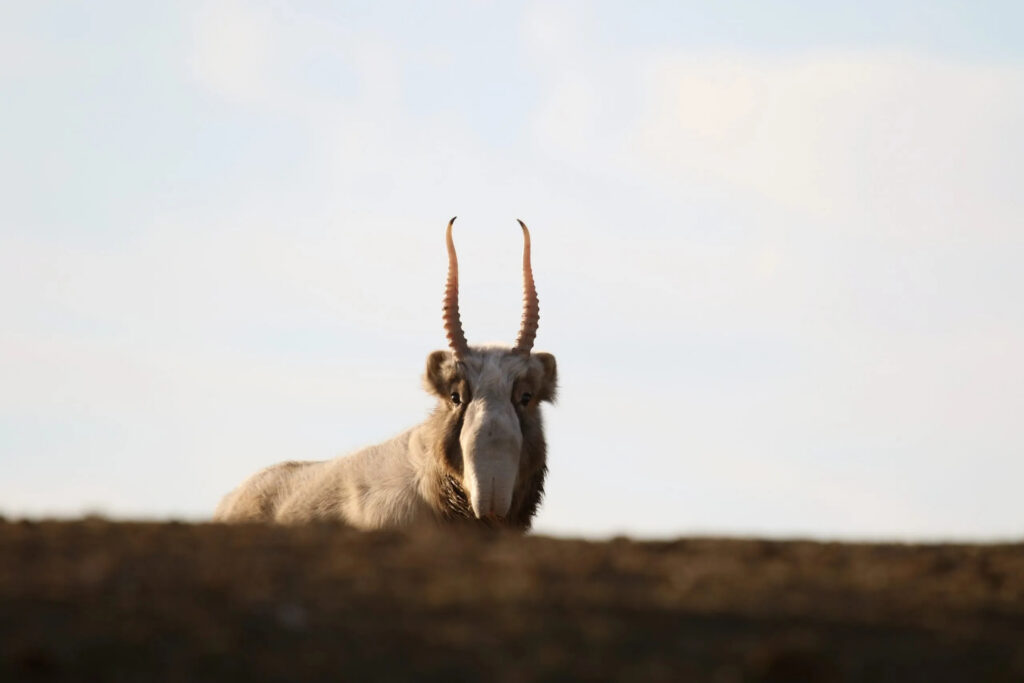
The preservation of the saiga antelope carries significant implications for the broader Eurasian steppe ecosystem. As an umbrella species, the saiga plays a vital role in nutrient cycling and vegetation management across semidesert plains where few other large herbivores can survive. Its distinct physical adaptation—the elongated, flexible snout utilized for filtering dust and warming frigid winter air—represents an evolutionary masterpiece tailored to extremes.
The ongoing efforts to secure migration corridors highlight a broader lesson in conservation biology: the necessity of maintaining ecological connectivity in an increasingly human-dominated world. As industrial development continues to expand across Central Asia, the survival of the saiga depends heavily on the institutional willingness of governments and non-governmental organizations to restore and protect the ancient pathways that have sustained life on the steppe for millennia.