Berlin stands as a dynamic metropolis where centuries of turbulent European history intersect with a thriving contemporary arts and cultural landscape. As the capital and largest city of Germany, Berlin houses approximately 3.85 million residents within its city limits, while its broader metropolitan region accommodates over 6 million people. The city operates as a central political, cultural, and scientific hub within the European Union, drawing millions of international visitors annually who seek to explore its unique blend of neoclassical architecture, Soviet-era urban planning, and modern commercial development.

According to local experts and long-term residents such as award-winning journalist Yvonne Zagermann, who has resided in the German capital since 2010, the city’s enduring appeal lies in its distinct duality. Characterized by former Mayor Klaus Wowereit’s famous description as being "poor but sexy," Berlin maintains an unpretentious atmosphere that contrasts sharply with other European capitals. This comprehensive guide outlines the definitive landmarks, cultural institutions, culinary traditions, and logistical frameworks necessary for navigating the city effectively.
Historical Landmarks and Cold War Heritage
The architectural fabric of Berlin serves as a physical timeline of the 20th century, bearing the physical scars and monuments of the Weimar Republic, the Third Reich, and the subsequent division of the city during the Cold War.

1. The Brandenburg Gate
Constructed between 1788 and 1791 under the orders of King Frederick William II of Prussia, the Brandenburg Gate (Brandenburger Tor) is Berlin’s most recognizable neoclassical monument. Designed by Carl Gotthard Langhans, the twelve-column structure is topped by the Quadriga, a chariot carrying Victoria, the Roman goddess of victory. Throughout modern history, the gate has mirrored Germany’s political trajectory. During the Cold War, it stood isolated in the "death strip" adjacent to the Berlin Wall, functioning as a symbol of the Iron Curtain’s division. Following the fall of the wall in November 1989, it transformed into a global emblem of national reunification and European peace.
2. The Berlin Wall Memorial and Bernauer Strasse
Stretching along Bernauer Strasse, the Berlin Wall Memorial offers an unvarnished look at the physical fortifications erected by the German Democratic Republic (GDR) beginning on August 13, 1961. The memorial encompasses a preserved 220-meter stretch of the border strip, complete with watchtowers and interior fences. An accompanying documentation center and outdoor exhibition provide detailed accounts of the escape attempts, structural evolution of the barrier, and the human displacement caused by the division of families across East and West Berlin.

3. Checkpoint Charlie
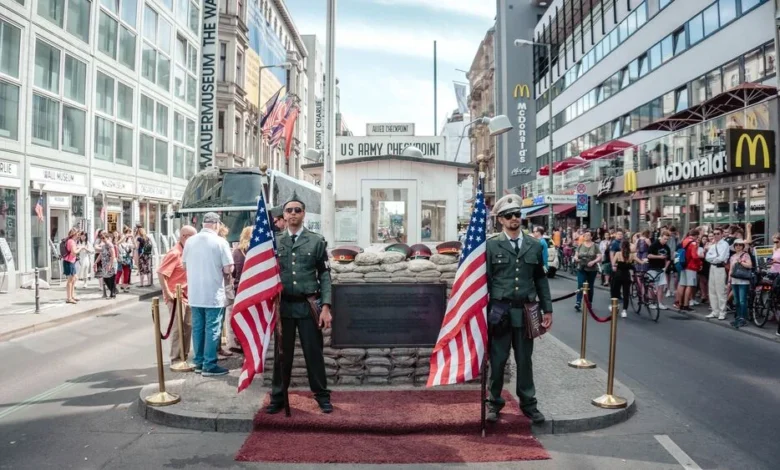
As the most famous crossing point between East and West Berlin during the Cold War, Checkpoint Charlie was the site of the tense October 1961 U.S.–Soviet tank standoff. Today, the location functions as an open-air historical site and educational hub. While the original Allied guardhouse has been replaced by a replica, the surrounding area features photographic exhibitions detailing escape narratives and border control protocols.
4. The Topography of Terror Museum
Situated on the site of the former Prinz-Albrecht-Palais—which housed the headquarters of the Gestapo, the SS, and the Reich Security Main Office during the Nazi regime—the Topography of Terror provides a documented examination of state-sponsored persecution. The indoor and outdoor museum exhibits historical photographs, official documents, and structural excavations that trace the institutional mechanisms of the Third Reich from 1933 to 1945.

5. The Holocaust Memorial (Memorial to the Murdered Jews of Europe)
Designed by architect Peter Eisenman and engineer Buro Happold, this memorial opened to the public in May 2005 near the Brandenburg Gate. Spanning an area of 19,000 square meters, the installation consists of 2,711 concrete stelae arranged in a grid pattern on a sloping field. The subterranean Place of Information houses biographical databases and historical records detailing the genocide perpetrated against European Jews.
6. The Soviet War Memorial in Treptower Park
Constructed in 1949, this monumental cemetery and memorial honors the estimated 80,000 Soviet soldiers who died during the Battle of Berlin in the spring of 1945. The site features neoclassical colonnades, bronze sarcophagi depicting military campaigns, and a 12-meter-tall statue of a Soviet soldier lowering a rescued German child while standing atop a shattered swastika.

Architectural Icons and Public Spaces
Berlin’s urban layout is punctuated by ambitious infrastructural projects and expansive green spaces designed to serve civic and recreational functions.
7. The Berlin TV Tower (Fernsehturm)
Dominating the city’s skyline at 368 meters, the Fernsehturm near Alexanderplatz is the tallest structure in Germany. Built between 1965 and 1969 by the government of the German Democratic Republic, the tower features a spherical upper section housing a viewing platform at 203 meters and a revolving restaurant that completes a full rotation every 30 to 60 minutes. On clear days, the platform offers visibility extending up to 40 kilometers across the surrounding Brandenburg region.

8. The Reichstag Building (German Parliament)
Home to the Bundestag, the Reichstag is a historic government building designed by Paul Wallot and opened in 1894. Severely damaged by fire in 1933 and during the Battle of Berlin, the structure underwent extensive reconstruction led by architect Norman Foster, who added a contemporary glass dome. This accessible dome features a mirrored cone that directs natural light into the plenary chamber below, symbolizing governmental transparency.
9. Museum Island (Museumsinsel)
Designated a UNESCO World Heritage Site in 1999, Museum Island is a complex of five world-class cultural institutions situated on the Spree Island in the historic center of Berlin. The ensemble comprises:

- The Altes Museum: Showcasing classical antiquities, Greek, Roman, and Etruscan art.
- The Neues Museum: Rebuilt after World War II damage, housing Egyptian artifacts, including the bust of Nefertiti, alongside prehistoric collections.
- The Alte Nationalgalerie: Featuring 19th-century paintings and sculptures from neoclassical to impressionist movements.
- The Bode Museum: Containing Byzantine art, sculptures, and a substantial numismatic collection.
- The Pergamon Museum: Renowned for monumental architectural reconstructions, including the Pergamon Altar and the Ishtar Gate of Babylon (note: phased closures for long-term renovations affect specific wings through the late 2020s).
10. Gendarmenmarkt and Potsdamer Platz
Gendarmenmarkt is widely regarded as Berlin’s most architecturally harmonious public square, framed by the Deutscher Dom, the Französischer Dom, and Karl Friedrich Schinkel’s Konzerthaus. In contrast, Potsdamer Platz represents modern architectural ambition, transformed after reunification from a wasteland into a dense commercial cluster featuring skyscrapers designed by international architects such as Renzo Piano and Helmut Jahn.
11. Tiergarten
Covering 520 acres in the center of the city, the Großer Tiergarten serves as Berlin’s primary urban park. Originally established as a hunting ground for electors of Brandenburg in the 16th century, the park was landscaped into an English country garden style by Peter Joseph Lenné in the 19th century. It now functions as a recreational zone featuring walking paths, memorial sites, and open lawns.

Cultural Hubs, Street Art, and Neighborhoods
Berlin’s cultural identity is distributed across distinct neighborhoods, each retaining unique demographics, architectural styles, and community practices.
12. The East Side Gallery
Spanning 1.3 kilometers along a remaining section of the Berlin Wall adjacent to the Spree River, the East Side Gallery is the world’s longest open-air mural gallery. Created in 1990 by 118 artists from 21 countries following the fall of the border, the murals reflect the socio-political optimism of the post-reunification era, most notably exemplified by Dmitri Vrubel’s painting depicting the socialist fraternal kiss between Leonid Brezhnev and Erich Honecker.

13. Kreuzberg and Mitte
Mitte contains the city’s major administrative buildings and historical monuments, while Kreuzberg reflects Berlin’s multicultural character, alternative arts scene, and historical ties to the city’s immigrant communities. Kreuzberg is known for independent galleries, vintage markets, and culinary diversity rooted in Turkish, Middle Eastern, and European influences.
14. Tempelhof Field (Tempelhof Airport)
The former Tempelhof Airport, operational from the 1920s until its closure in 2008, has been repurposed as a public park and recreation area. The expansive 386-hectare airfield, which played a pivotal role during the 1948–1949 Berlin Airlift, now accommodates cyclists, urban gardeners, kite landboarders, and runners on its historic runways.

15. The Berlin Zoo (Zoologischer Garten Berlin)
Opened in 1844, the Berlin Zoo is the oldest zoological garden in Germany and boasts one of the most comprehensive species collections globally, housing over 18,000 animals representing more than 1,400 species. Located adjacent to the Tiergarten, the facility includes a specialized aquarium featuring marine and freshwater habitats.
Culinary Traditions
Berlin’s culinary landscape extends far beyond traditional German fare, heavily influenced by its multicultural population and fast-paced urban lifestyle.

16. Currywurst
Invented in Berlin in 1949 by Herta Heuwer, Currywurst consists of steamed and subsequently fried pork sausage cut into slices and seasoned with a spiced tomato-based sauce and curry powder. It is typically served with french fries or a bread roll. Notable institutions such as Konnopke’s Imbiss at Eberswalder Straße have served the dish for decades.
17. Döner Kebab
The German iteration of the Döner Kebab was popularized in West Berlin during the early 1970s by Turkish immigrant Kadir Nurman. Unlike traditional Turkish vertical spit-roasted meat served on a plate, the Berlin version adapts the preparation into a flatbread pocket filled with sliced meat, shredded cabbage, lettuce, onions, tomatoes, and specialized garlic or herb sauces.

18. Späties (Spätkauf)
Spätkauf establishments, colloquially known as Späties, are late-night convenience stores ubiquitous on Berlin street corners. Operating outside standard German retail hours, these shops provide beverages, snacks, newspapers, and community gathering spaces late into the evening.
Nightlife and Markets
19. Berlin Nightlife and Cocktail Culture
Berlin is globally recognized for its electronic music and nightlife sectors, alongside an established cocktail bar scene. Notable venues include Beckett’s Kopf (Prenzlauer Berg), Buck and Breck (Mitte), and Klunkerkranich (Neukölln), a rooftop cultural garden providing panoramic city views. Additionally, Sunday open-air karaoke sessions at Mauerpark draw large crowds of residents and tourists.

20. Markets and Shopping
The primary retail corridor is the Kurfürstendamm (Ku’damm), which features high-end boutiques and the Kaufhaus des Westens (KaDeWe), the largest department store in continental Europe. For alternative shopping, the Mauerpark Flea Market operates every Sunday, offering vintage clothing, vinyl records, antiques, and street food.
21. Seasonal Festivals
Berlin hosts several major cultural events throughout the calendar year:

- Berlin Festival: Historically staged at venues like Tempelhof, showcasing international indie and electronic music acts.
- Festival of Lights (October): An annual event where international lighting artists project illumination displays onto historical landmarks and buildings.
- Christmas Markets: Traditional festive markets established across dozens of public squares throughout December.
Logistics, Transport, and Practical Information
Getting There
Berlin Brandenburg Airport (BER) serves as the primary international aviation hub, connected to the city center via regional rail services (FEX, S-Bahn lines S9 and S45). The German rail network (Deutsche Bahn) provides extensive high-speed (ICE) connectivity to major European cities. Regional ride-sharing applications, such as BlaBlaCar, offer alternative cross-border transit options.
Getting Around
Public transport in Berlin is managed by the Verkehrsverbund Berlin-Brandenburg (VBB), encompassing the U-Bahn (subway), S-Bahn (elevated rail), trams, and buses. Due to the high cost of individual tickets, visitors frequently utilize the Berlin WelcomeCard, which provides unlimited public transport access alongside discounted admission to over 200 cultural attractions across durations ranging from 48 hours to 5 days. Cycling infrastructure is extensive, making bicycle rentals a practical alternative for urban transit.

Best Time to Visit
The optimal period for tourism is between May and September, characterized by milder weather, outdoor dining, public park events, and swimming accessibility in regional lakes such as Wannsee and Müggelsee. While winter months bring lower visitor volumes and festive markets, temperatures frequently drop below freezing.