Tracking the Ancient Steppe: Conservationists Battle Modernization to Protect Kazakhstan’s Saiga Antelope

The frozen expanse of the Western Kazakhstan steppe offers few markers to guide the uninitiated. Skidding off the paved network onto a rudimentary two-track trail maintained only by vehicle treads, the landscape dissolves into a seamless white-and-earth horizon. Parallel lanes, worn deep into the soil by decades of passage, fork and merge across the terrain. On the far horizon, howling Siberian winds drive a moving silhouette—hundreds of saiga antelopes piercing the frigid air, their distinctive, tubular snouts filtering the sub-zero wind as they sprint across the desolate landscape.
For researchers from the Association for the Conservation of Biodiversity of Kazakhstan (ACBK), encountering these herds during the annual winter rutting season is both a scientific imperative and a race against time. Braving unpredictable weather, shifting from deep seasonal mud to sudden whiteout conditions, field biologists Alexandr and Albert conduct vital population audits. Their mission is to monitor a resilient, prehistoric ungulate whose survival is increasingly threatened by human infrastructure, borders, and modern development.
Prehistoric Survivors of the Eurasian Steppe
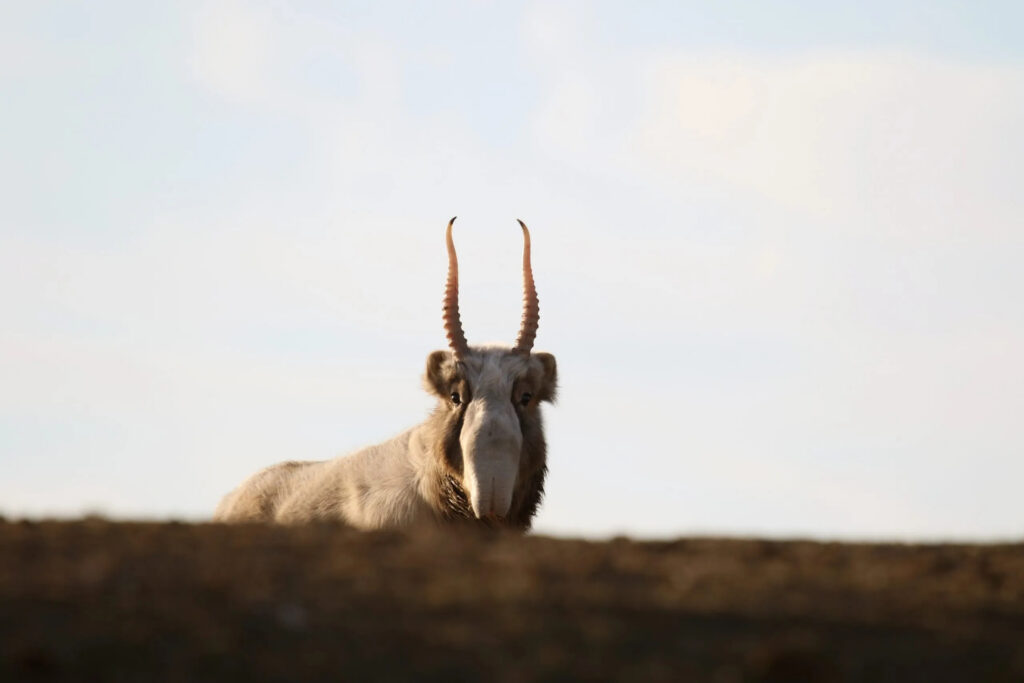
The saiga antelope (Saiga tatarica) is a living relic of the Pleistocene epoch. Existing since the last Ice Age, these animals once shared the Eurasian landscape with woolly mammoths, saber-toothed cats, and giant deer with twelve-foot antlers. While their contemporaries vanished during the Quaternary extinction event, the saiga endured, adapting to one of the planet’s most punishing environments.
Characterized by their humped, flexible snouts—evolved to warm freezing winter air and filter dust during scorching summer months—saigas are obligate nomads. Historically, their populations spanned a massive migratory range from the foothills of the Caucasus Mountains to the semi-arid expanses of Mongolia. Human history in Central Asia developed alongside these migrations. Ancient nomads and early caravans traversing the nascent Silk Road relied on saiga herds as natural pathfinders, recognizing their ability to locate water and navigate treacherous terrain.
However, the twentieth century brought sweeping disruption. The Soviet-era policy of mandatory sedentarization forced traditional nomadic human populations into agrarian settlements, dismantling ancient migratory patterns and fracturing human relationships with the seasonal landscape. While human societies urbanized, the saigas continued their ancient cycles, setting the stage for inevitable conflict with modern industrial development.
The Modern Bottleneck: Infrastructure and Migration Fragmentation
In recent decades, the expansion of linear infrastructure—including railways, fenced international borders, and asphalt highways—has fundamentally altered the Eurasian steppe. These developments have transformed a continuous, open ecosystem into a fragmented landscape.
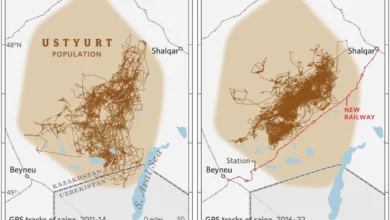
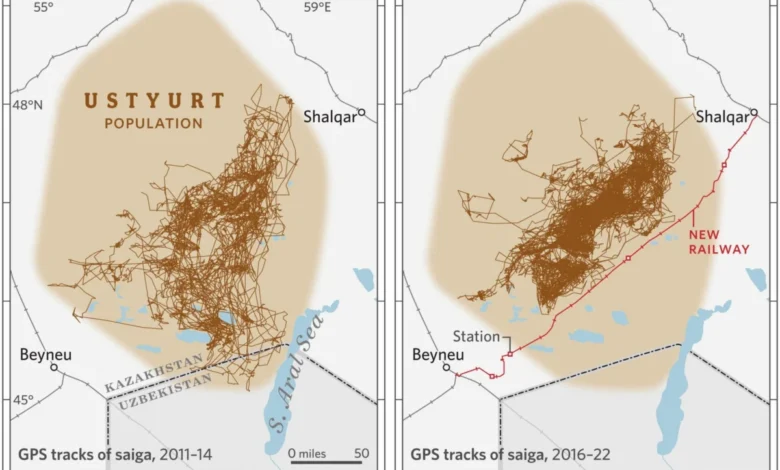
Conservation data gathered via satellite GPS telemetry illustrates the immediate impact of such barriers. Prior to the construction of a major railway line in 2014, collared saiga populations regularly migrated deep into Uzbekistan during seasonal shifts. Post-construction data reveals a stark behavioral change: herds routinely congregate and pace despondently on the northern side of the tracks, unable to cross. Meanwhile, critical foraging grounds and water sources on the southern side become inaccessible.
This spatial obstruction triggers what conservation scientists describe as a collapse in spatial knowledge. Much like human communities that lost their generational navigational traditions due to forced settlement, young saigas learn migration routes through active participation and observation alongside mature herd members. When physical barriers block these pathways, the cultural knowledge of the migration route fades from memory, isolating herds into smaller, genetically vulnerable populations.
Collaborative Conservation and Cross-Border Mitigation
To address these systemic threats, ACBK has partnered with the government of Kazakhstan and international conservation entities to implement targeted mitigation strategies. Recognizing that physical barriers are a primary driver of population decline, the initiatives focus on restoring connectivity across critical corridors.
Among the primary engineering solutions are saiga-friendly crossing points. Constructed as gently sloping dirt ramps rising to the elevation of railway tracks, these structures create the visual illusion of a natural gap in the line. Combined with cattle-guard fencing placed at a distance to prevent train-ungulate collisions, these crossings allow herds to resume traditional movements safely.
International cooperation has also yielded results along political boundaries. In collaboration with Uzbek authorities, standard barbed-wire border fences—which historically snared and killed migrating wildlife—are being retrofitted with X-shaped barricades. These modifications successfully block vehicular traffic while leaving adequate clearance for saigas to pass underneath.
These engineering efforts are supported by the establishment of new protected wildlife sanctuaries, their boundaries meticulously mapped using historical and real-time GPS tracking data collected by ACBK researchers.
Broader Implications for Steppe Biodiversity
The plight of the saiga antelope serves as a case study for large-scale mammal conservation in an era of rapid industrialization. As global infrastructure expands into remote wilderness areas, maintaining ecological connectivity is vital for preventing the collapse of migratory species.
The loss of the saiga would not only represent an irreplaceable blow to global biodiversity but also the erasure of a living link to the Pleistocene era. The ongoing efforts by Kazakh conservationists and government agencies highlight a growing recognition that ecological preservation must reconcile human economic development with the ancient, unyielding drive of nomadic wildlife.
As winter storms sweep across the steppe and the herds continue their relentless march, the success of these newly established corridors will determine whether the saiga remains a permanent fixture of the Eurasian landscape or a casualty of modern progress.