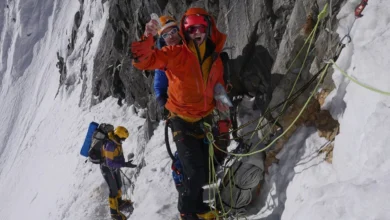
Tiphaine Duperier and Boris Langenstein have completed the first ski descent of the southwest face of Meru Central in the Indian Garhwal Himalaya.

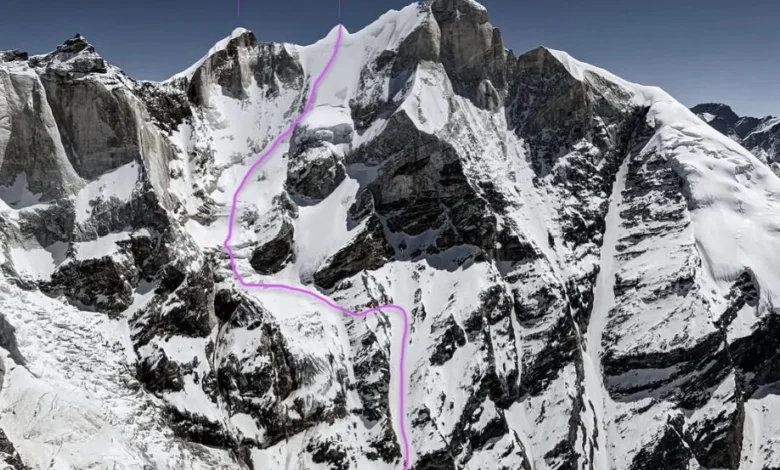
The French alpinists, renowned for their high-altitude prowess, achieved the landmark descent on the 6,310-meter peak, marking a significant milestone in extreme ski mountaineering. This accomplishment adds to their growing list of Himalayan firsts and underscores the increasing viability of technical, alpine-style expeditions that integrate high-stakes mountaineering with steep-slope skiing. The successful mission, characterized by a rapid ascent and a continuous, non-interrupted ski line, defied the duo’s own initial expectations, which were tempered by a season of challenging conditions and project failures throughout the preceding autumn months.
A Season Defined by Resilience
The expedition to Meru Central was not an isolated venture but rather the culmination of a rigorous fall season. Before arriving at the base of the Meru massif, Duperier and Langenstein had faced a series of setbacks on other objectives. In high-altitude mountaineering, atmospheric conditions and snow stability are the primary arbiters of success; early-season instability had forced the pair to abandon multiple planned routes.
Reflecting on the uncertainty that preceded the Meru attempt, Duperier noted that the team had entered the region with a guarded outlook. Their internal assessment suggested a low probability of success—a mere 30 percent chance of navigating the southwest face. The Garhwal Himalaya, known for its erratic weather patterns and complex glacial terrain, rarely offers straightforward passages. However, upon arrival, the team encountered a set of conditions they described as "generous," characterized by stable snowpack and favorable ice structures that had eluded them in previous weeks.

The Geography of the Meru Massif
Meru, situated in the Gangotri Glacier region, is a formidable objective for any expedition. It is comprised of three distinct peaks: Meru South (6,660m), Meru Central (6,310m), and Meru North (6,450m). The massif is flanked by other legendary peaks, including Shivling and Thalay Sagar, making it a focal point for elite alpinism.
The southwest face, the primary theater of this descent, is characterized by extreme verticality and complex terrain. While the Indian team that successfully summited the face in 2023 proved the viability of the route as a climbing objective, Duperier and Langenstein’s effort represents the first time the descent has been executed entirely on skis. The logistical challenge of the massif lies in the lower section, where a complex icefall creates a barrier that requires both technical climbing skill and careful navigation.
Chronology of the Ascent and Descent
The mission spanned approximately nine days of field operations. The team dedicated the first six days to reconnaissance, an essential phase in high-altitude skiing to identify safe transit lines through the icefall and to assess the stability of the upper slopes.
Once the route was established, the push to the summit was executed with characteristic speed. The climbers reached the 6,310-meter summit in less than eight hours from their high camp, adhering to a strict alpine-style protocol. This style emphasizes lightweight, fast movement without the use of fixed ropes or supplemental oxygen, prioritizing efficiency to minimize exposure to objective hazards like rockfall or shifting snow.

The crux of the climb involved a 15-meter pitch of WI4 ice—a technical grade that requires precise ice climbing skills. To ensure a safe passage, the pair placed a temporary safety rope, which they subsequently utilized for rappelling during the descent. However, once past the icefall, the descent was entirely continuous. Spanning roughly 1,500 meters of vertical drop, the line included sustained sections with slopes reaching 50 degrees. The snow, described by the pair as "hard but with good grip," allowed for a fluid descent that required total concentration. Duperier’s description of the experience—comparing their movement to "monkeys on the wires in Rishikesh"—speaks to the agility and precarious nature of navigating such steep, exposed terrain.
Technical Analysis and Implications
The achievement of Duperier and Langenstein is noteworthy for its technical purity. In the discipline of ski mountaineering, the "first descent" title is highly coveted, but the quality of the descent—the lack of rappels during the primary ski sections—is what sets this performance apart.
The fact that the duo performed this feat shortly after receiving a Piolet d’Or—the highest honor in mountaineering—for their work on Nanga Parbat provides context for their current standing in the sport. Their successful ascent of the Schell Route on the Rupal Face, followed by the first ski descent of the 8,125-meter peak, solidified their reputation as masters of the "steep and deep."
By successfully linking the physical demands of climbing a WI4 pitch with a continuous 1,500-meter ski descent, the pair has pushed the boundaries of what is considered "skiable" in the Himalayan environment. Their success also provides valuable data for future expeditions regarding the feasibility of the southwest face as a dual-purpose climbing and skiing objective. It demonstrates that with the right combination of reconnaissance, speed, and technical adaptability, even the most daunting faces in the Garhwal range can be conquered.

Broader Impact on the Alpinism Community
The mountaineering community often looks to such accomplishments as a bellwether for the evolution of the sport. As climate change continues to alter the topography of the Himalayas—often making traditional climbing routes more dangerous due to melting permafrost and unstable glaciers—the shift toward rapid, alpine-style ascents is becoming more pronounced.
The success of Duperier and Langenstein is being cited by peers as a masterclass in risk management. By acknowledging the low probability of success early on and remaining flexible in their planning, they avoided the "summit fever" that often leads to accidents. Furthermore, their transparency regarding the use of safety equipment on the icefall adds a level of honesty to the record-keeping of the ascent, ensuring that the achievement is accurately contextualized for future climbers.
As the couple returns to France, the recognition of their contribution to the sport continues to grow. With their Piolet d’Or ceremony serving as a backdrop to their latest adventure, the pair has effectively bridged the gap between traditional mountaineering and the modern, high-speed aesthetic of professional ski alpinism. Their descent of Meru Central will likely remain a benchmark for years to come, encouraging others to explore the potential of the Gangotri region while underscoring the absolute necessity of skill, preparation, and, occasionally, the "generosity" of the mountain itself.
The successful descent of the southwest face of Meru Central by Tiphaine Duperier and Boris Langenstein stands as a testament to the ongoing evolution of Himalayan exploration, where the boundaries of what is possible are continually being redrawn by athletes who view the world not just as a vertical wall to be climbed, but as a terrain to be skied.