The Unveiling of the Blaquier-Arrieta Collection: A $450 Million Masterpiece Reveal at Sotheby’s

For decades, the Blaquier-Arrieta Collection remained one of the most enigmatic chapters in the annals of the private art market—a legendary trove whose existence was widely acknowledged by connoisseurs and scholars, yet whose contents remained almost entirely sequestered from public view. This clandestine status has now come to an end as Sotheby’s prepares to present this extraordinary assembly of Impressionist and Modern masterpieces for public viewing in London, ahead of a highly anticipated marquee auction in New York scheduled for November 18. With an aggregate pre-sale estimate of approximately $450 million, the collection represents a significant influx of "fresh-to-market" material, a rarity in an era increasingly dominated by institutional acquisition and permanent collection freezes.
The provenance of the collection is rooted in the "golden age" of private collecting during the 1970s and 1980s, a period when the market for Impressionist works was characterized by greater accessibility to high-caliber masterworks. Assembled by Carlos Pedro Blaquier and Nelly Blaquier de Arrieta, the collection was curated with a discernment that bordered on the academic. For years, industry insiders whispered about the "El Dorado" of South American collections—a private repository of canvases that had never graced the walls of a public gallery or a traveling retrospective.
A Historical Context of the Collection
To understand the magnitude of this sale, one must look back to the mid-20th-century art market. The 1970s represented a distinct transition point; as public museums grew more aggressive in their acquisition strategies, the window for private individuals to secure museum-quality Impressionist works began to narrow. The Blaquier-Arrieta pair managed to build their collection by frequenting elite galleries, most notably the Lefevre Gallery on Bruton Street in London. Records indicate that seven of the twelve works currently slated for the New York auction were sourced directly from this venue, underscoring a disciplined, long-term approach to acquisition that is rarely seen in today’s high-velocity, speculative market.

Philip Hook, a veteran of the auction world with decades of tenure at both Christie’s and Sotheby’s, notes that the collection’s primary value lies in its pristine, untouched nature. "It was the El Dorado in South America, but no one knew what was in it," Hook remarked during a preview. "The collectors did not lend the pictures. You wouldn’t have seen them in the temporary exhibitions or in the great museums of the world." This absence from the public circuit has paradoxically increased the works’ allure, as they have avoided the over-exposure often associated with pieces that circulate frequently between institutions.
The Cornerstones of the Auction: Van Gogh and Cézanne
At the heart of the November sale are two works that possess the gravitas to potentially set new benchmarks for their respective artists. The first is Vincent van Gogh’s Chataignier en fleurs roses et blanches, a vibrant, emotive landscape painted in May 1890. Created shortly after the artist’s departure from the psychiatric hospital at Saint-Rémy, the painting captures the artist’s final, prolific weeks in Auvers-sur-Oise. With an estimate of approximately $180 million, the painting is viewed as a defining piece of Van Gogh’s late-mature period.
Equally significant is Paul Cézanne’s Arlequin, a profound work from the artist’s legendary series of 15 late figure paintings. Of these 15, only two remain in private hands—a statistic that highlights the extreme scarcity of the work. The remaining 13 are securely held in permanent museum collections globally. The presence of Arlequin on the open market provides a rare opportunity for private collectors to acquire a foundational work of Modernism that has effectively been removed from the circulation for generations.
A Broad Spectrum of Impressionist Evolution
Beyond the headline-grabbing prices of the Van Gogh and Cézanne, the collection offers a comprehensive look at the evolution of European art at the turn of the century. The 12-piece catalog includes:

- Pierre-Auguste Renoir: En Canot (Jeune fille à la barque), estimated between $25 million and $30 million.
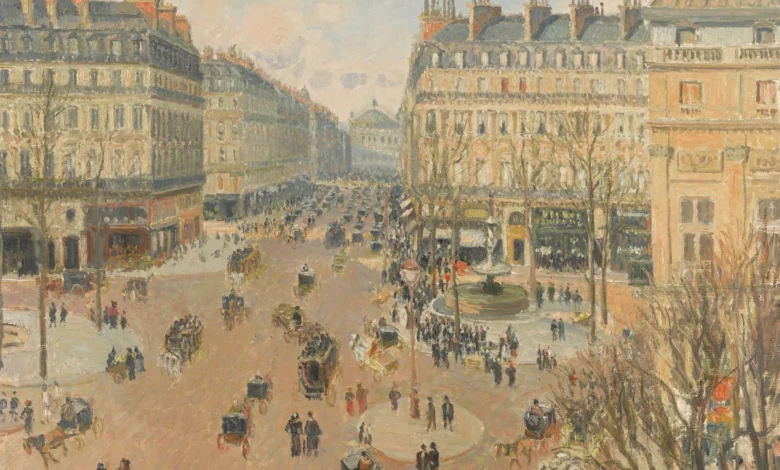
- Camille Pissarro: La Place du Théâtre-Français, soleil d’après-midi en hiver, estimated at $30 million to $40 million.
- Edgar Degas: The pastel masterpiece Avant la course, carrying an estimate of $20 million to $30 million.
These works have never been offered at auction before, adding a layer of "market virginity" that is highly prized by ultra-high-net-worth collectors. The collection also features works by Claude Monet, Alfred Sisley, Paul Gauguin, Henri de Toulouse-Lautrec, and significant Fauvist contributions from André Derain and Maurice de Vlaminck. This breadth allows the auction to function as a curated survey of the Impressionist and Post-Impressionist movements, further cementing its status as a "miniature museum" finally opening its doors.
Economic Implications and Market Sentiment
The timing of this sale coincides with a period of intensified interest in blue-chip Impressionist and Modern art. Market analysts point to the sale of the Leonard Lauder collection—which included the $236.4 million sale of Gustav Klimt’s Portrait of Elisabeth Lederer—as a primary indicator of sustained appetite among global investors. Despite fluctuating macroeconomic indicators, the market for "tried-and-tested" masterpieces remains resilient.
Helena Newman, Sotheby’s chairman of Impressionist and Modern Art, suggests that the current geopolitical and economic climate actually serves to drive interest in such tangible assets. "They know that these works have the endorsement of having stood the test of time," Newman observes. "These are tried-and-tested blue chip. That’s very important, especially in these uncertain macroeconomic political times."
Furthermore, the geographic distribution of interest is shifting. While traditional hubs in the United States and Europe remain dominant, there is significant, growing competition from Japan, Taiwan, the Middle East, China, Singapore, Indonesia, and Korea. The emergence of a new class of wealth in these regions has transformed the bidding landscape, ensuring that even at the $400 million+ price point, the competition will be global and fierce.

Analysis: The End of the "Private Museum" Era
The liquidation of the Blaquier-Arrieta Collection serves as a poignant reminder that the era of building "private museums" in the home is drawing to a close. As Philip Hook notes, "There was a time when you could walk into a top gallery in London or New York and, over a few years, build something of real museum quality. You simply can’t do that now, at any price."
The implications for the art market are twofold. First, it underscores the scarcity of the "masterpiece" supply. As more works are absorbed by institutional trusts or private foundations that forbid future sale, the pool of available, high-quality, 19th-century works shrinks. Second, the auction reinforces the "mythology" of these works. For a generation of collectors and historians who have only ever engaged with these paintings through the flat, ink-and-paper pages of catalogues raisonnés, the ability to view the physical brushwork of a Van Gogh or the structural composition of a Cézanne in person is a transformative experience.
Looking Toward November
As the auction date approaches, the industry remains focused on the potential for record-breaking bids. The sale of the Blaquier-Arrieta Collection is not merely a transfer of ownership; it is a historical event that reintroduces long-hidden works back into the cultural dialogue. Whether these paintings find their way into another private "hidden" sanctuary or into the public gaze of a major museum, their reappearance at Sotheby’s serves as a definitive moment in the 2026 art calendar.
The collection, which once lived in the quiet shadows of a private life, is now destined for the bright, high-stakes glare of the auction stage. For the art world, the suspense is not merely about the final hammer price, but about the future trajectory of these icons of Western art. As the works move from the walls of the Blaquier-Arrieta estate to the auction floor, they bring with them the weight of history and the undeniable allure of the masterpiece.