The Death of the Mall Portrait Studio: How Convenience, Technology, and Smartphones Erased an American Family Tradition

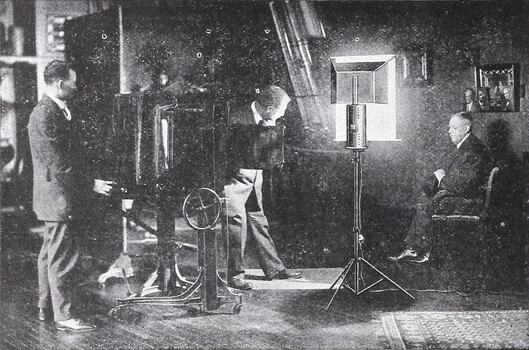
On April 3, 2013, the landscape of American family photography shifted permanently when CPI Corp. abruptly powered down more than 2,000 portrait studios across the United States in a single day. For decades, CPI Corp. operated the ubiquitous Sears Portrait Studios and PictureMe studios embedded within Walmart locations. With its sudden collapse, the familiar cultural touchstones vanished: the mottled blue backgrounds, the laser-beam light grids, and the cellophane-wrapped sheets of wallet-sized prints. For nearly a century, these neighborhood outposts served as the primary institution where working- and middle-class American families went to document their milestones. The sudden closure marked the definitive end of an era that had democratized portraiture, transforming a luxury reserved for the elite into a mass-market retail utility.
The Evolution of Affordable Photography: From Daguerreotypes to Penny Pictures
The concept that an ordinary family could own a professional portrait is a relatively modern phenomenon. Throughout most of human history, painted likenesses were exclusive luxury goods accessible only to those who could commission a professional artist. The advent of photography in 1839 fundamentally disrupted this economic model. Within a decade, street-level storefront studios were producing daguerreotypes for shopkeepers, farmers, and laborers who could never have afforded an oil painting.
The true democratization of the medium, however, arrived on wheels. Itinerant photographers traveled from town to town, establishing temporary operations near high-traffic areas, including early department stores. At tourist hubs such as Niagara Falls and Atlantic City, these operators utilized multi-lens cameras to expose grids of tiny images onto a single photographic plate. The resulting prints were sliced apart and sold for a penny each, giving rise to the term "penny picture." A family likeness that once demanded a month’s wages could now be purchased with pocket change, establishing the foundational retail blueprint: minimize session costs, place the camera where foot traffic already flows, and generate profits through the volume of paper prints sold.
The Rise of Olan Mills and the Science of High-Volume Portraiture
In the early 1930s, Olan Mills Sr. and Mary Stephenson Mills translated this high-volume model into a corporate empire. Operating initially from a modest riverfront shed in Selma, Alabama, before expanding to Tuscaloosa in 1933, the husband-and-wife duo combined photo-copying services with original portraiture. Mary Mills introduced a soft, hand-finished house style that gave the emerging company a recognizable aesthetic.
The true catalyst for Olan Mills’ massive expansion, however, was aggressive operational logistics. In 1948, the company integrated telemarketing to book portrait sessions, a strategy that reportedly quadrupled weekly sales. This was soon complemented by club plans requiring a modest upfront fee for a series of scheduled annual sessions. By removing the friction of decision-making from the consumer through direct telephone marketing, Olan Mills secured a steady pipeline of clientele.
By 1940, the enterprise employed approximately 650 workers across three shifts, producing roughly 12,000 portraits daily. At its peak, Olan Mills operated approximately 1,000 freestanding studios, generated nearly $475 million in annual revenue, and controlled close to ten percent of the domestic portrait market. Concurrently, its church-directory division photographed entire congregations, embedding its visual standards—standardized poses, careful hand placements, and soft lighting—into the cultural fabric of generations of Americans.
The Sears Partnership and the Consolidation of CPI Corp.
While standalone operations like Olan Mills flourished, the most culturally resonant portrait studios were quietly embedded inside major department stores. The dominant force in this sector was CPI Corp., whose roots trace back to St. Louis photographer Milford Bohm, who established Rembrandt Studio in 1942. Over two decades, Bohm expanded his enterprise into a multi-state chain before selling the business in 1968 to Chromalloy American, at which point it was renamed CPI Corp.
CPI’s commercial trajectory was defined by its enduring relationship with Sears, Roebuck and Co. Having photographed Sears patrons since 1959 and holding a formal license since 1961, CPI gradually consolidated its retail focus. By 1986, CPI secured exclusive status as the sole portrait studio operator within Sears stores.
This partnership capitalized on the immense real estate footprint of Sears, which dominated American retail through the 1970s and 1980s. CPI avoided the capital expenditure of building standalone facilities, instead placing cameras, posing stools, and muslin backdrops directly in the path of existing retail traffic. At its zenith, CPI operated more than 1,000 studios within Sears locations across the United States and Canada, later expanding its footprint by acquiring PictureMe Portrait Studios in Walmart stores and absorbing Kiddie Kandids locations within Babies R Us stores. By the late 2000s, CPI managed approximately 2,700 studios internationally.
The Mall Culture Boom: Glamour Shots and the Makeover Economy
As department stores captured the family demographic, enclosed shopping malls birthed a distinct commercial cousin: the portrait as an experiential night out. Spearheaded by entrepreneur Jack Counts Jr., Glamour Shots debuted in Dallas in 1988, capitalizing on a makeover-and-photography format.
For a fixed fee of around $30, patrons—predominantly women—received professional hair styling, makeup application, access to theatrical wardrobe accessories, and a soft-focus photo session. The resulting aesthetic defined late-1980s and 1990s pop culture: teased hair, heavy cosmetics, dramatic diffusion filters, and glamorous poses. The appeal lay in producing an idealized, aspirational fantasy rather than a straightforward documentary record.
The business scaled rapidly. Within three years, Glamour Shots grew from under $250,000 in annual revenue to nearly $7 million. By the mid-1990s, the chain operated approximately 380 stores globally, employing roughly 6,000 workers and generating $100 million in sales. Competitors like Picture People capitalized on similar mall-traffic dynamics, offering rapid family photography from kiosks positioned between food courts and retail storefronts.
These mall operations prioritized operational efficiency over traditional photographic artistry. Lighting setups were standardized, poses were selected from instructional binders, and operators underwent brief training regimens. The business model succeeded not through technical mastery, but through strategic real estate placement, accessible pricing, and the psychological satisfaction of physical ownership.
Technological Disruption: The Smartphone and the Collapse of Print Scarcity
The ultimate decline of the mall and department-store portrait industry was not driven by direct competitors, but by a fundamental shift in consumer technology: the rise of the digital camera and, subsequently, the smartphone.
The foundational premise of the portrait studio business model relied on the scarcity of quality photographic capture and physical print production. For generations, obtaining a sharp photograph of a child required specialized equipment, film development, and professional printing laboratories. Studios bundled these complex steps into an affordable, convenient package.
The proliferation of digital photography in the early 2000s initiated a gradual erosion of this monopoly. However, the introduction of the iPhone in 2007 and subsequent iterations equipped millions of consumers with high-resolution, pocket-sized cameras capable of instant capture and digital distribution. As smartphone penetration saturated the market, the traditional role of the portrait studio was undermined. Consumers no longer required physical prints to share images with family members, and the cost of image capture dropped to zero.
Corporate Insolvency and Mass Bankruptcies
Facing mounting financial pressures, declining foot traffic in anchor retail stores, and heavy debt loads, the major portrait studio chains collapsed in rapid succession.
CPI Corp. experienced a severe financial contraction as its fiscal losses multiplied fivefold, exceeding $60 million while revenues slid nearly 25 percent to $192.7 million. On April 3, 2013, CEO Jim Abel communicated to employees that the business declines had proven insurmountable, resulting in the immediate closure of more than 2,000 studios and leaving thousands of workers without notice and customers with unfulfilled orders. CPI subsequently filed for Chapter 11 bankruptcy protection.
Competitors faced parallel trajectories. Picture People filed for Chapter 11 bankruptcy in September 2016, underwent asset sales, and experienced subsequent sudden shutdowns of its U.S. operations in May 2018, before later reorganizing under new management. Glamour Shots dwindled from hundreds of locations to a negligible footprint by the end of the decade.
Industry pioneers also consolidated to survive. Olan Mills divested its entire portrait and church-directory operations to school-photography giant Lifetouch on November 9, 2011. Lifetouch itself was subsequently acquired by Shutterfly in April 2018 for $825 million.
Broader Implications and Cultural Legacy
Today, the commercial portrait landscape is a fraction of its former self. While Lifetouch continues to operate select JCPenney Portraits studios and manages institutional school photography, the expansive network of freestanding and department-store studios has been permanently erased.
This structural shift highlights a profound cultural irony: contemporary society produces a vastly higher volume of photographic media than any previous generation, yet prints virtually none of it. The physical artifacts generated by mall studios—though frequently critiqued for their standardized aesthetics—offered enduring tactile permanence. Shoebox collections of mottled-backdrop portraits survived decades without technological obsolescence, whereas contemporary digital archives remain vulnerable to platform deprecation, account expirations, and device failures.
Ultimately, the demise of the portrait studio industry underscores a broader economic transition. The mall studio did not fail due to inferior technical execution; rather, it succumbed to an economic reality where consumers prioritized instant, ubiquitous digital access over physical permanence, rendering a century-old retail ritual obsolete.