Scaling Thailand’s Cliffside Wonder: A Comprehensive Journalistic Guide to Wat Phu Tok in Bueng Kan Province

Rising sharply from the flat, agrarian landscape of Thailand’s remote northeastern Isan region, Wat Phu Tok stands as one of the kingdom’s most architectural and spiritual anomalies. Officially designated as Wat Jetiyakhiri, this extraordinary mountainside temple complex offers visitors a unique blend of engineering marvel, Buddhist philosophy, and adrenaline-fueled exploration. Located in Bueng Kan province—one of Thailand’s least densely populated and most tranquil administrative divisions—the site attracts travelers seeking to venture far off the conventional Southeast Asian tourist trail.
Main Facts and Geographic Overview
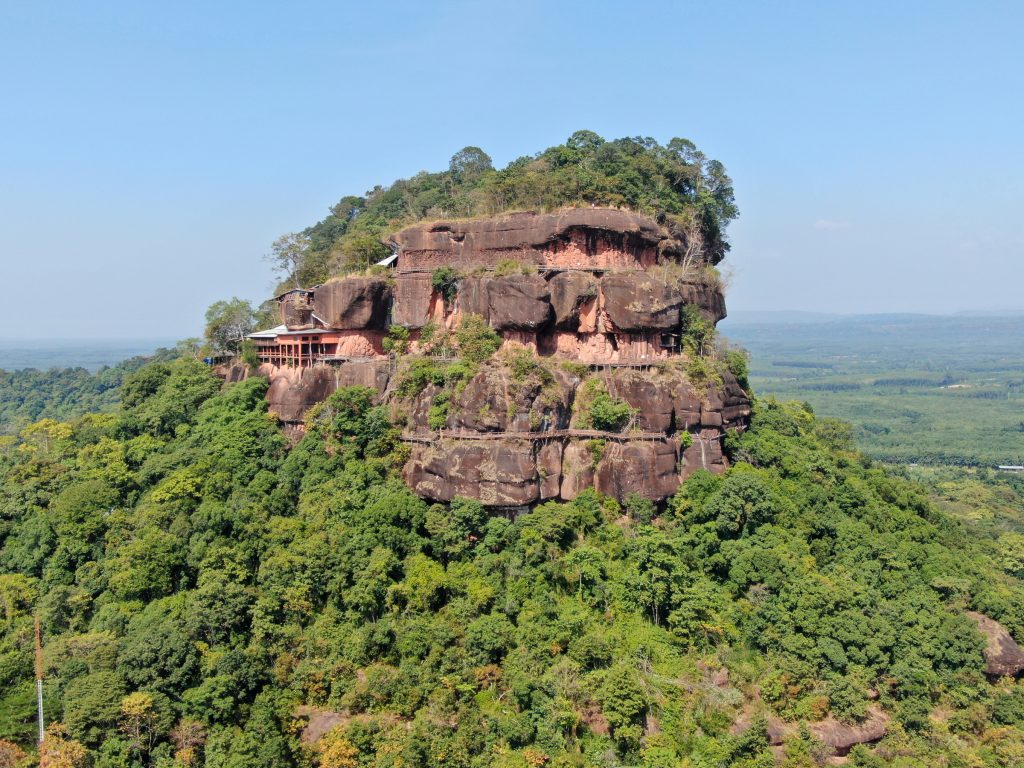
Wat Phu Tok is built upon an isolated sandstone formation that reaches an elevation of 359 meters above the surrounding plains. In the local Isan dialect, "Phu Tok" translates directly to "lonely mountain," an apt descriptor for a solitary monolith that commands an unobstructed 360-degree view of the Mekong River basin and the verdant countryside below. Reminiscent of a scaled-down version of Sri Lanka’s famed Sigiriya rock fortress, the mountain is defined by steep, vertical cliffs and dense surrounding woodlands.

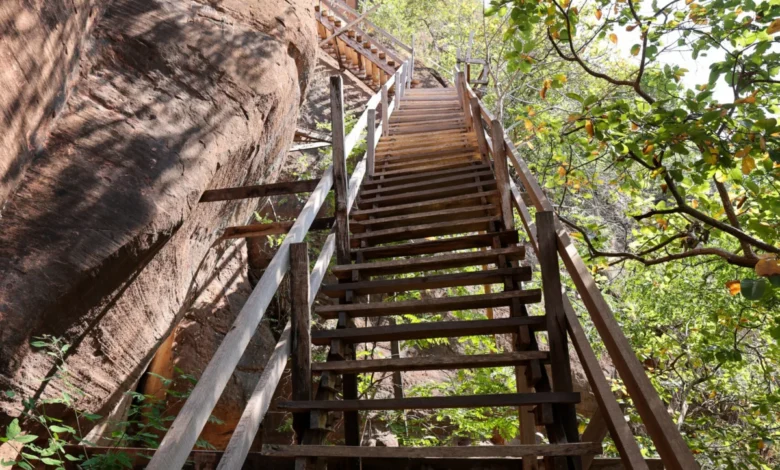
The primary architectural feature that distinguishes Wat Phu Tok is its intricate system of wooden staircases, ladders, and cantilevered walkways. These structures cling directly to the vertical rock faces, designed to facilitate both the daily maintenance of the grounds and the spiritual ascent of monks and pilgrims. The complex is divided into seven distinct levels, an architectural layout deliberately modeled after the seven stages of spiritual liberation and meditation in Buddhist theology.
Historical Origins and Construction

The historical narrative of Wat Phu Tok is deeply intertwined with the life and vision of its founder, the revered ascetic monk Luang Pu Juan. Prior to its establishment, the rugged terrain and dense vegetation of the lonely mountain rendered it largely impassable, serving instead as a natural sanctuary for diverse regional wildlife, notably including populations of venomous snakes.
Recognizing the remote isolation and natural serenity of the environment as ideal conditions for intense Vipassana meditation, Luang Pu Juan established the site. To make the precipitous vertical cliffs traversable, he initiated a monumental construction project, enlisting local laborers and monastic followers to anchor wooden planks, scaffolding, and ladders directly into the sandstone rock face. This network of pathways was engineered to connect various natural caves, secluded shrines, and meditation platforms scattered across the mountain’s elevations.

Tragically, the visionary monk did not live to see the completion of his life’s work. Luang Pu Juan perished in a high-profile aviation accident, an event that sent shockwaves through the Thai monastic community. Despite his passing, subsequent generations of monks and local devotees have maintained the structural integrity of the complex, ensuring that Wat Phu Tok remains both an active place of worship and a monument to its founder’s spiritual endurance.
Chronology of the Ascent: Navigating the Seven Levels

A visit to Wat Phu Tok requires physical exertion and a tolerance for heights, as travelers navigate the mountain through a structured vertical progression. The journey begins at the base of the mountain, where a sprawling complex featuring a large temple, a scenic lake, and extensive park infrastructure welcomes visitors. From the main entry gate, the path transitions rapidly from packed earth to the signature wooden staircases.
Levels One through Four: The Introductory Ascent
The initial levels of the mountain serve as a gradual physical introduction. The staircases are initially broad and gently sloped, eventually steepening into near-vertical wooden ladders. While the construction feels secure and stable, the wooden planks occasionally bow underfoot, signaling the transition into more adventurous terrain. These lower levels feature intermittent shrines and resting points, though the landscape is primarily defined by dense forest canopy and rising stone walls.

Level Five: The Administrative and Ceremonial Hub
Upon reaching the fifth level, the nature of the terrain shifts dramatically. Unlike the sheer cliff paths of the lower and upper tiers, the fifth level features wide, ground-level pathways traversing the natural contours of the mountain. This plateau serves as the principal ceremonial center of Wat Phu Tok, housing the largest ordination hall, multiple secondary shrines, and dedicated meditation quarters. Visitors frequently utilize this level as a resting area to explore off-trail detours, including a notable elevated rock walkway that leads to an isolated shrine positioned on an ancillary ridge.
Level Six: The Architectural Masterpiece and Thrill
Ascending further yields the sixth level, universally acknowledged by travelers and local guides as both the most spectacular and the most harrowing section of the temple. Approximately half of the sixth level’s circumference consists of wooden plank walkways anchored horizontally into sheer vertical cliffs, suspended hundreds of feet above the forest floor. While engineers have prioritized structural stability—rendering the pathway manageable even for those with mild acrophobia—the exposure is absolute. Navigating this tier requires strict attentiveness, as the narrow path leaves no margin for error against the sheer drop-off. Beyond the adrenaline, the sixth level provides expansive panoramic views of the Mekong basin, cooled by steady regional winds.

Level Seven: The Summit and Ecological Caution
The final tier, the seventh level, represents the physical apex of Wat Phu Tok. Accessible via another steep series of wooden ladders, the summit is largely devoid of architectural structures or cantilevered walkways. Instead, it consists of the natural forested top of the sandstone monolith. Local authorities and monastic caretakers advise caution regarding the final ascent due to the historical presence of venomous snakes inhabiting the undisturbed upper thickets. While the summit offers additional vantage points, tourism experts generally note that the architectural and visual climax of the site resides firmly on the sixth level.
Supporting Data and Tourism Implications

Situated approximately a 30-minute drive from Bueng Kan city center, Wat Phu Tok remains a cornerstone of regional tourism development in northeastern Thailand. Provincial tourism data highlights Isan as an area targeted for sustainable, low-impact tourism to alleviate economic disparities compared to Thailand’s heavily commercialized central and southern provinces.
Infrastructure improvements, including expanded parking facilities at the base of the mountain and ongoing maintenance grants for the wooden scaffolding, reflect an official commitment to balancing visitor safety with historical preservation. However, conservationists and structural engineers routinely monitor the site, emphasizing that the subtropical climate—characterized by heavy monsoon rains and high humidity—requires continuous timber replacement to mitigate environmental wear on the cliffside anchors.

Broader Impact and Visitor Guidelines
The global visibility of Wat Phu Tok has grown steadily through digital travel media and documentary features, introducing international audiences to the lesser-explored Isan region. Beyond its appeal as an adventure travel destination, the site holds significant religious importance for Theravada Buddhists, who view the physical climb as a metaphor for overcoming earthly fears and attaining higher states of consciousness.

For travelers planning an excursion to Bueng Kan province, local authorities recommend visiting during the cooler dry season, spanning from November to February, when weather conditions are optimal for outdoor physical activity. Visitors are universally advised to wear sturdy footwear with reliable traction, adhere strictly to posted safety barriers on the cliffside walkways, and maintain respectful decorum appropriate for an active Buddhist monastic site. Through careful preservation and mindful tourism, Wat Phu Tok endures as a testament to human ingenuity, spiritual devotion, and the raw, untouched beauty of Thailand’s borderlands.