Navigating the Floating Metropolis: A Comprehensive Guide to Royal Caribbean’s Oasis Class Cruise Ships

Royal Caribbean International’s Oasis Class ships have long defined the upper echelon of modern cruise engineering, representing some of the largest and most technologically advanced passenger vessels ever constructed. Even travelers who have never stepped foot on a cruise ship are likely familiar with their striking profiles, frequently featured in global marketing campaigns showcasing multi-story atriums, open-air parks, and vibrant entertainment complexes. These floating resorts are designed to accommodate thousands of guests while minimizing the feeling of overcrowding through an innovative neighborhood layout. As cruise tourism rebounds to record-breaking levels globally, understanding the scale, features, and operational logistics of the Oasis Class provides valuable insight into the evolving demands of the contemporary family vacation market.
Evolution and Chronology of the Oasis Class Fleet

The genesis of the Oasis Class marked a paradigm shift in naval architecture for the cruise industry. Royal Caribbean unveiled the concept in the mid-2000s, commissioning a vessel class that would shatter previous records for gross tonnage and passenger capacity. The inaugural ship, Oasis of the Seas, made its debut in December 2009, fundamentally altering industry standards by introducing a split-superstructure design. This architectural choice allowed for an open-air central canyon—later known as Central Park—running down the middle of the ship, bringing natural light and fresh air to staterooms that traditionally faced inward toward dark corridors.
Following the success of the lead ship, Royal Caribbean expanded the class incrementally over the next decade and a half. Allure of the Seas entered service in November 2010, followed by Harmony of the Seas in May 2016, and Symphony of the Seas in March 2018. The fifth vessel, Wonder of the Seas, joined the fleet in March 2022, initially serving the Mediterranean and Caribbean markets before repositioning. The newest addition to the lineup, Utopia of the Seas, debuted in July 2024, breaking tradition by launching directly into short-duration, three- and four-night itineraries departing from Port Canaveral, Florida, rather than standard week-long sailings. While Royal Caribbean has since introduced the even larger Icon Class, the Oasis Class remains a cornerstone of the company’s fleet, regularly undergoing multi-million-dollar revitalizations to incorporate modern amenities, dining concepts, and high-speed connectivity.
Design Innovation and Neighborhood Architecture
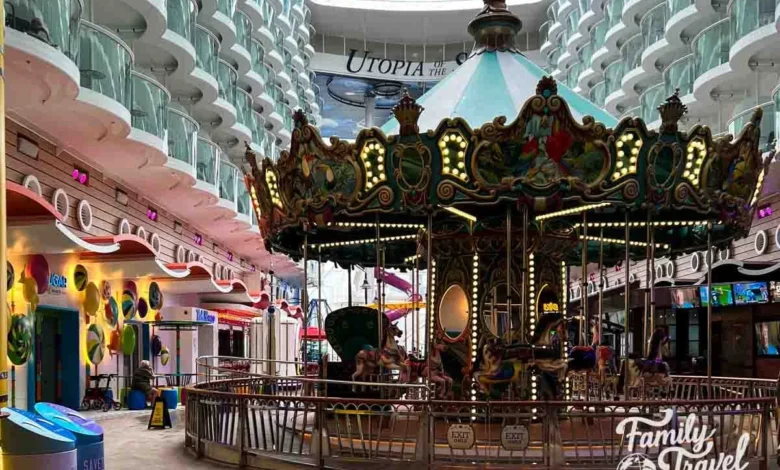
The defining characteristic of an Oasis Class ship is its division into seven distinct "neighborhoods," a design strategy intended to disperse crowds and create specialized zones for different demographics. These neighborhoods include the Royal Promenade, a multi-deck indoor shopping and entertainment boulevard; Central Park, a tranquil outdoor sanctuary featuring thousands of living plants and upscale specialty dining; and the Boardwalk, a nostalgic nod to classic seaside piers complete with a hand-carved wooden carousel.
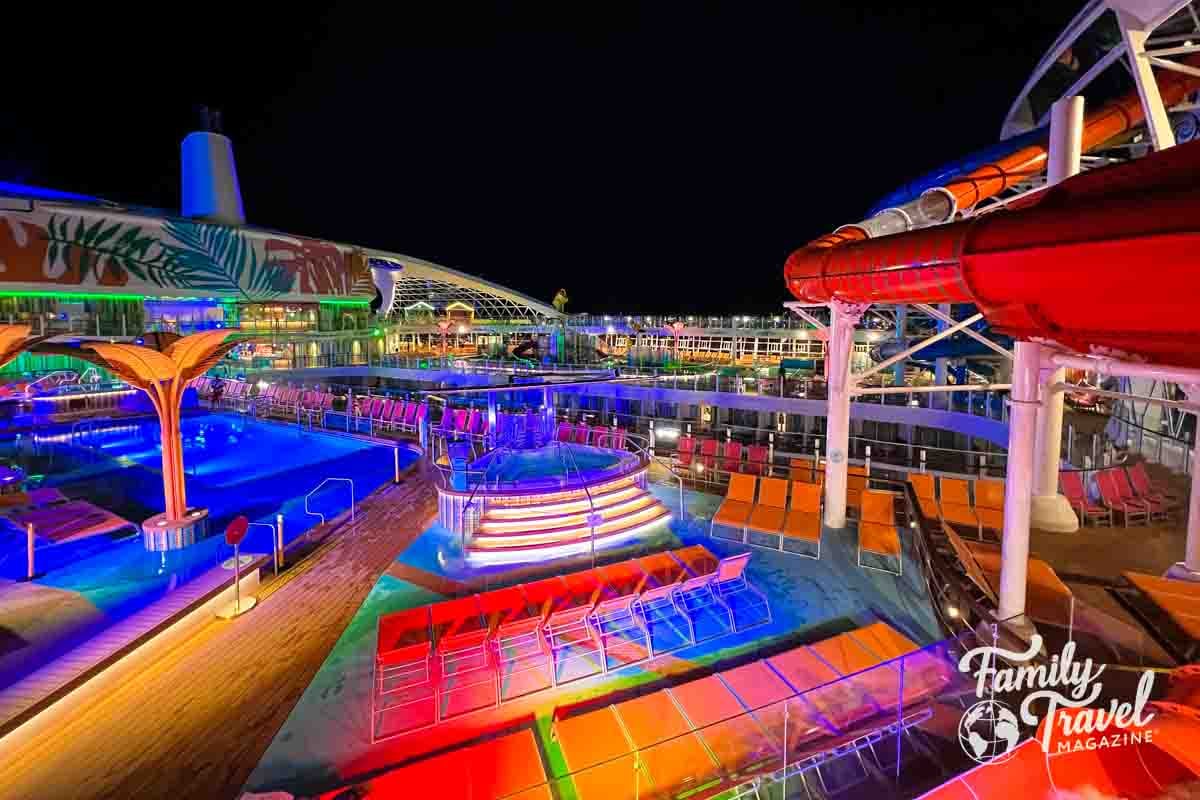
Additional zones include the Pool and Sports Zone, the Vitality Spa and Fitness Center, the Youth Zone dedicated to children and teenagers, and the Entertainment Place, which houses the vessel’s primary performance venues. This segmented layout addresses one of the primary historical criticisms of megaships: the sensation of being trapped in a crowded, homogeneous environment. By breaking the massive interior volume into distinct atmospheric zones, passengers can transition from the high-energy environment of the pool deck to the quiet ambiance of an outdoor garden within a matter of minutes. Furthermore, the inclusion of inward-facing balcony staterooms overlooking Central Park or the Boardwalk offers guests alternative views to traditional ocean-facing rooms, altering the real estate dynamics onboard.
Culinary Diversity and Dining Logistics

Managing food and beverage operations for a vessel that can carry upwards of 6,000 to 7,000 passengers at maximum capacity requires complex logistical planning. Oasis Class ships typically feature more than 20 dining options, bridging the gap between complimentary mass-catering facilities and fee-based specialty restaurants.
The culinary ecosystem is anchored by the multi-level Main Dining Room and the expansive Windjammer Marketplace buffet, which serve as the primary venues for high-volume service. To alleviate bottlenecks and cater to changing consumer preferences, Royal Caribbean has integrated numerous casual eateries across the various neighborhoods. Venues such as Park Café, Sorrento’s Pizza, and the Boardwalk Dog House offer quick-service options included in the baseline cruise fare.
Concurrently, specialty restaurants—requiring reservations and an additional cover charge or a la carte pricing—target guests seeking elevated culinary experiences. These venues often include Chops Grille (steakhouses), Giovanni’s Italian Kitchen, Izumi (sushi and hibachi), and Hooked Seafood. Cruise industry analysts note that ancillary spending on specialty dining and beverage packages has become a critical revenue driver for major cruise lines, making the diverse culinary footprint of the Oasis Class an essential economic component for the operator.

Entertainment Infrastructure and Technological Integration
The entertainment infrastructure aboard Oasis Class ships rivals that of land-based resort destinations. Performance venues are decentralized across the vessel to prevent scheduling conflicts and capacity issues. The Royal Theater hosts large-scale, Broadway-style musical productions, while Studio B serves as an indoor ice-skating rink featuring professional ice shows. Perhaps most distinctive is the AquaTheater, an outdoor deep-water acrobatic pool located at the stern of the ship, which hosts high-diving, synchronized swimming, and aerial performances against the backdrop of the open ocean.
Activity-based entertainment includes the Ultimate Abyss, a pair of dry slide tunnels plunging ten stories from the sports deck down to the Boardwalk, alongside ziplines, rock-climbing walls, escape rooms, and laser tag arenas. Because demand for these high-profile shows and activities regularly exceeds capacity, Royal Caribbean utilizes its proprietary mobile application to manage reservations. Passengers are strongly encouraged to secure show bookings months in advance or immediately upon boarding to avoid sold-out performances.

Economic, Operational, and Environmental Implications
Operating vessels of this magnitude involves significant economic and environmental considerations. The construction cost of a single Oasis Class ship exceeds $1.3 billion, requiring high occupancy rates and diversified revenue streams to achieve profitability over its operational lifespan. These ships generally operate at or near full capacity, driven by strong family demand during school holidays and multi-generational family reunions year-round.
From an environmental perspective, the maritime industry faces mounting pressure to reduce its carbon footprint. While earlier Oasis Class ships run on conventional marine gas oil and heavy fuel oil, newer additions like Utopia of the Seas incorporate more advanced energy-efficient technologies, such as shore power capabilities, waste heat recovery systems, and optimized hull designs to reduce hydrodynamic drag. Royal Caribbean Group has committed to introducing net-zero cruise ships by 2035, prompting ongoing retrofits and technological investments across the existing fleet.

Industry Outlook and Consumer Considerations
For travelers weighing a cruise vacation, the primary deterrent associated with the Oasis Class is scale. First-time cruisers frequently express concern that a ship carrying over 6,000 guests will feel overwhelmingly large or impersonal. Industry experts and frequent passengers generally observe that while the ship’s public thoroughfares can become congested during peak transit times—such as embarkation day or immediately following major shows—the neighborhood concept successfully diffuses passenger density during the majority of the voyage.
For those hesitant to commit to a traditional seven-day itinerary on a mega-ship, shorter regional deployments—such as the three- and four-night Bahamas itineraries operated by Utopia of the Seas out of Port Canaveral—offer a lower-risk introduction to the class. As global cruise demand continues to expand post-pandemic, the Oasis Class remains a benchmark for mega-resort cruising, blending architectural innovation, extensive recreational infrastructure, and large-scale operational logistics into a single floating ecosystem.