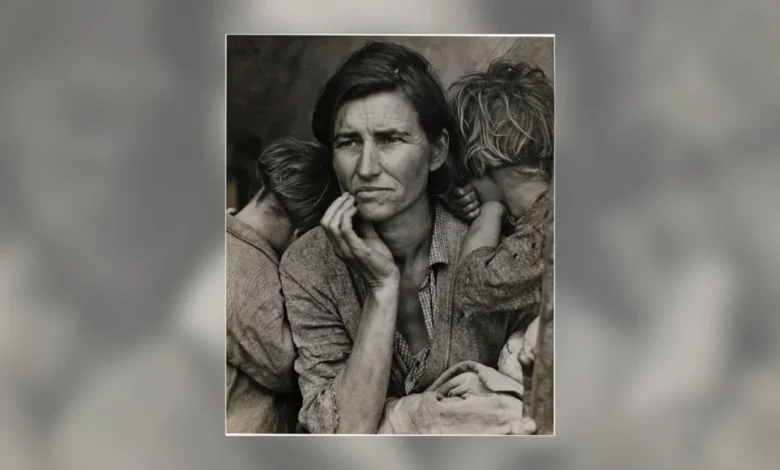
The Sotheby’s October prints and photographic auction has unveiled a collection of rare historical and contemporary works, with two standout lots capturing the attention of the global art market. Among the most significant pieces is an exceptionally early silver gelatin print of Dorothea Lange’s Migrant Mother, a defining image of the Great Depression that serves as a cornerstone of 20th-century American documentary photography. Alongside this historical masterpiece, the auction features a large-scale, limited-edition work by Japanese contemporary artist Hiroshi Sugimoto, Radio City Music Hall, New York City, from his acclaimed Theaters series. These offerings represent a rare convergence of photojournalistic history and contemporary fine art, with estimated valuations reflecting their scarcity and provenance.
The Historical Significance of Migrant Mother
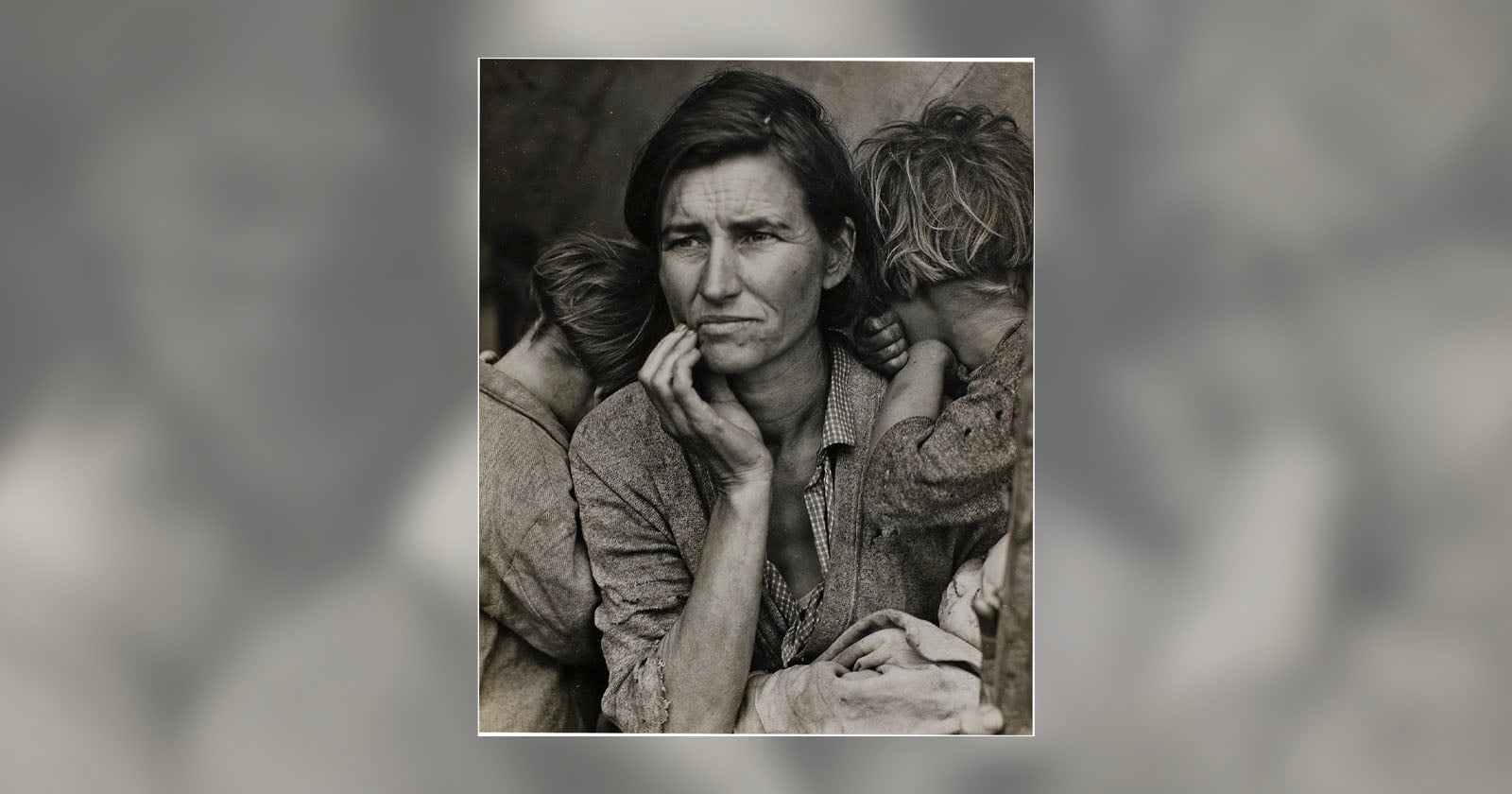
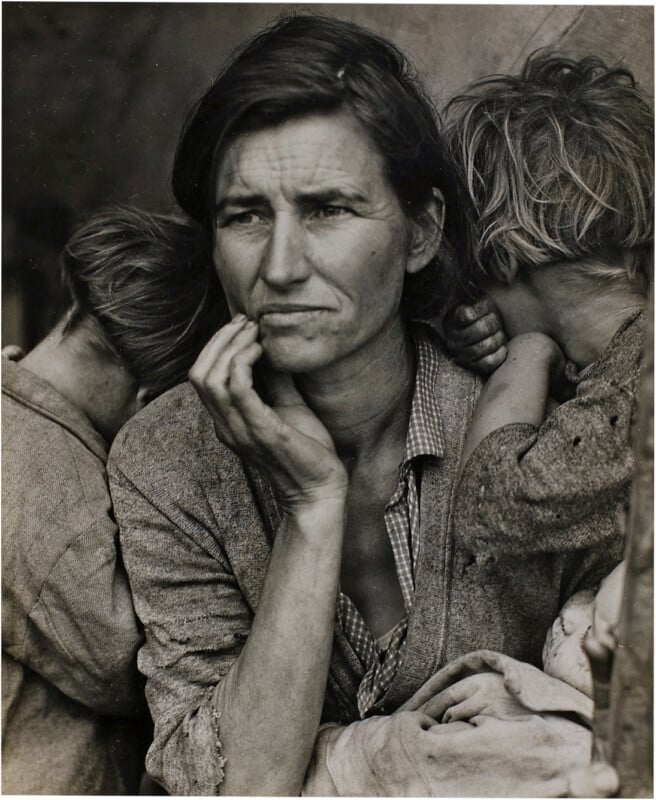
The photograph depicting Florence Owens Thompson and her children in Nipomo, California, has long been recognized as a definitive symbol of the American spirit during the 1930s. Dorothea Lange, then working for the Resettlement Administration—a federal agency tasked with providing economic relief to rural populations—captured the image in March 1936. The print currently listed at Sotheby’s is distinguished by its historical proximity to the original negative, having been printed between 1936 and 1937.
What elevates this specific print beyond standard archival copies is the presence of the Resettlement Administration’s official credit stamp and a visible thumb in the lower-right corner of the frame. This detail, which was later cropped out of the versions published in national newspapers and distributed for government records, offers collectors a tangible link to the raw, unedited moment of production. The estimated value of $100,000 to $150,000 underscores the premium collectors place on early prints that capture the photographer’s initial intent before subsequent editorial intervention.
A Chronology of a Depression-Era Icon
The creation of Migrant Mother was not a calculated studio production but an act of journalistic intuition. In March 1936, Lange was nearing the end of a month-long excursion documenting the hardships of agricultural workers in California. While driving home to Berkeley, she passed a sign for a camp of stranded pea pickers in Nipomo. Despite an initial instinct to continue driving, she reversed her course, entered the camp, and located the family of Florence Owens Thompson.
Within days of the encounter, the images were transmitted to the San Francisco News. While the initial article on March 10 did not feature the most famous portrait, the subsequent day’s edition, titled What Does the "New Deal" Mean to This Mother and Her Child?, featured the iconic shot. The public reaction was immediate and profound, helping to catalyze federal aid for the starving workers at the camp. This historical context cements the image not merely as a photograph, but as a document of social reform.
Hiroshi Sugimoto and the Evolution of the Theaters Series
While Lange’s work represents the history of the medium, the auction’s second highlight, Hiroshi Sugimoto’s Radio City Music Hall, New York City, represents the evolution of technical precision in contemporary photography. Sugimoto is widely celebrated for his Theaters series, in which he uses a large-format camera to record an entire film screening in a single long exposure.
The light emanating from the movie screen serves as the sole source of illumination, filling the theater for the duration of the film. The result is a luminous, ghostly interior where the architecture of the venue becomes the primary subject, while the audience—their movements blurred by the duration of the exposure—vanishes, leaving behind only a sense of atmosphere. The piece offered at Sotheby’s is particularly notable for its scale, measuring 47 by 58 3/4 inches, and its status as print number one in an edition of five. With an estimated value of $200,000 to $300,000, it reflects the high demand for Sugimoto’s large-scale works, which have become staples in museum collections worldwide.

Market Implications and Provenance
The art market for 20th-century photography has seen a marked shift toward valuing "early" or "vintage" prints. In the context of the current Sotheby’s auction, the price estimate for the Lange print serves as a barometer for the broader photography market. Vintage prints—those produced close to the time of the negative—are increasingly viewed as the authentic manifestation of a photographer’s original vision.
The fact that the Migrant Mother print is appearing at auction for the first time is a significant development for provenance researchers. The art world often tracks the movement of such iconic works, and the sudden emergence of a high-quality, early-printing specimen can influence future valuation models for other prints in the series. By retaining the uncropped elements of the original composition, the work acts as a primary source document for historians studying how Lange’s images were edited and disseminated by the government during the New Deal era.
Analysis of Institutional and Private Demand
The inclusion of these works in the October auction signals a robust demand from both institutional archives and private collectors. Institutions like the Museum of Modern Art (MoMA) and the Getty Museum have historically sought out such rare prints to complete their collections of American documentary history. Simultaneously, private collectors are increasingly diversifying their portfolios with works that hold high cultural recognition.
The juxtaposition of Lange’s documentary grit with Sugimoto’s ethereal architectural studies provides a comprehensive view of the camera’s capabilities. Lange used the camera to reveal uncomfortable truths about the human condition, while Sugimoto uses it to manipulate time and light, turning an architectural space into a meditative void. The auction environment at Sotheby’s effectively frames these two approaches as equally vital to the canon of photographic history.
The Broader Impact on Photography Collecting
As the auction moves forward, observers will be watching to see if the Migrant Mother print meets or exceeds its high estimate of $150,000. Historically, images of such immense cultural weight are subject to "cultural premium" pricing. Because Migrant Mother is widely considered one of the two most recognizable portraits in history—sharing that distinction with Steve McCurry’s Afghan Girl—the demand is often driven by a desire to own a piece of universal visual literacy.
Furthermore, the auction serves as a reminder of the fragility of photographic history. Many of these prints were originally produced as government propaganda or utilitarian news images, not intended to survive a century. The survival of this print, preserved with its original credit stamp, is an anomaly. Collectors are not merely buying a photograph; they are acquiring a physical artifact that has survived the transition from the Great Depression to the digital age.
Conclusion: A Legacy in Light and Shadow
The Sotheby’s October prints and photographic auction offers a rare opportunity to examine the breadth of the photographic medium. Whether through the lens of Dorothea Lange’s humanitarian documentation or Hiroshi Sugimoto’s conceptual explorations, the works on offer highlight the unique ability of the camera to bridge the gap between historical record and fine art. As the auction concludes, these images will likely find new homes, continuing their journey as objects of both aesthetic beauty and immense historical importance. The high valuations placed on these pieces serve as a testament to the enduring power of photography in an era where the medium continues to redefine its relationship with reality, history, and memory.