Auroville Grapples with Foundational Ideals Amidst Development Plans and Governance Disputes

Journalist and photographer Nicola Zolin recently journeyed to Auroville, the acclaimed experimental international township in southeastern India, established in the late 1960s. His visit coincides with a period of profound introspection for the community, questioning whether the utopian dream it was founded upon can withstand the pressures of modern development and governance shifts.

Zolin’s arrival on New Year’s Eve was met with a scene emblematic of Auroville’s spiritual core: hundreds of candles illuminating concentric circles of meditating figures. The fervent embrace of an old friend, a resident of the spiritual enclave, underscored the deep-seated warmth and idealism that still permeates the community. Yet, even amidst the celebratory bonfires on a wild stretch of beach near Puducherry, where young travelers from diverse backgrounds shared tales of India’s mystical allure, a jarring note was struck. A young man, cross-legged by the fire, declared, "This place is actually falling apart." The pronouncement, delivered with a stark contrast to the surrounding enthusiasm, exposed a simmering tension beneath Auroville’s serene surface – a tension between the pursuit of utopia and the realities of its present challenges.
The Genesis of a Dream: A Universal Township Emerges
Auroville, spanning approximately 7.7 square miles (20 square kilometers) of what was once barren land, was formally inaugurated on February 28, 1968, by Mirra Alfassa, widely known as ‘the Mother.’ A French-born spiritual teacher and collaborator of Sri Aurobindo, one of the 20th century’s most influential Indian philosophers, the Mother envisioned an unprecedented experiment: a universal township where humanity could evolve beyond the divisions of borders, religions, private ownership, and nationalism. The symbolic gesture of pouring soil from 124 nations and 23 Indian states into a ceremonial urn at the inauguration epitomized this vision of global unity.
The philosophical bedrock of Auroville was rooted in the teachings of Sri Aurobindo and the Mother, who posited that humans possessed the capacity to transcend greed, ego, and societal divisions. The city itself was conceived not merely as a settlement, but as a "laboratory of consciousness" – a living experiment dedicated to the realization of human unity. Rather than a futuristic metropolis, what emerged was an eco-community characterized by sprawling forests, experimental architectural forms, meditation spaces, workshops, and farms connected by dusty pathways. Crucially, all land and assets within Auroville are held by a Government-appointed body, the Auroville Foundation, and are considered collective property, challenging the very notion of private ownership. This radical economic and social model aimed to prioritize "individual worth" over "material wealth and social standing," as articulated by the Mother at its founding.
A Living Experiment: Ideals and Early Challenges
Frederick Schulze Buxloh, one of Auroville’s last surviving pioneers, offers a poignant glimpse into the township’s formative years. Arriving in Puducherry in 1959, a restless young German drawn by the philosophical depths of Hermann Hesse and Arthur Schopenhauer, Buxloh encountered the Mother at the Sri Aurobindo Ashram. He recalls a transformative moment: "When she looked into my eyes, everything collapsed. I thought I feared nothing. I was arrogant. Then suddenly all the masks disappeared." This profound personal experience catalyzed his commitment to the Auroville project.

Buxloh became instrumental in its physical manifestation, building Auroville’s first house. He describes the early settlers as "idealistic wanderers, hippies, and spiritual seekers who arrived with little money and almost no practical skills. But we had fire inside us." They faced the formidable task of transforming a dry, almost lunar landscape into a vibrant, self-sustaining community. The pioneers’ collective spirit and dedication to manual labor, echoing the Mother’s June 13, 1970, dictum that "Work, even manual work, is something indispensable for the inner discovery," were central to this monumental undertaking.
Today, Auroville hosts approximately 3,500 residents from hundreds of different nations, a diverse population that includes individuals from over 50 countries. While this represents a vibrant international microcosm, it falls significantly short of the 50,000 residents envisioned in the original master plan drafted by French architect Roger Anger. This discrepancy highlights the long-standing tension between the ambitious scale of the founding vision and the organic, often slower, pace of its development.

The Green Heart of Auroville: Ecological Transformation
Central to Auroville’s identity is its remarkable ecological transformation. In the early 1970s, residents embarked on an ambitious reforestation project, cultivating what is now known as the Green Belt – a vast forest area surrounding the township. Natasha Storey, a resident of Auroville’s ‘Evergreen’ community, attests to this profound change: "At the beginning, people planted hundreds of trees every day. Water was scarce, so we built rainwater harvesting tanks, earthen dams, and groundwater recharge systems. Seeing water return to the wells felt like witnessing a process of healing. We live with the forest, not separated from it." This environmental stewardship became a cornerstone of Auroville’s practical application of its ideals, demonstrating a harmonious relationship between humanity and nature.
At the geographic and spiritual heart of Auroville stands the Matrimandir, a colossal golden sphere surrounded by twelve themed gardens, each dedicated to an ideal such as peace, harmony, or light. This architectural marvel houses a serene white marble meditation center with a crystal globe suspended at its core. The township’s design radiates outwards from the Matrimandir in concentric zones – residential, cultural, industrial, and international – further enveloped by the meticulously cultivated Green Belt. This intricate design reflects the aspiration for an integrated, holistic living environment. Construction of the Matrimandir began in 1971 and continued for decades, a testament to the community’s perseverance and long-term vision.

A Crisis of Vision: The Radial Road Controversy
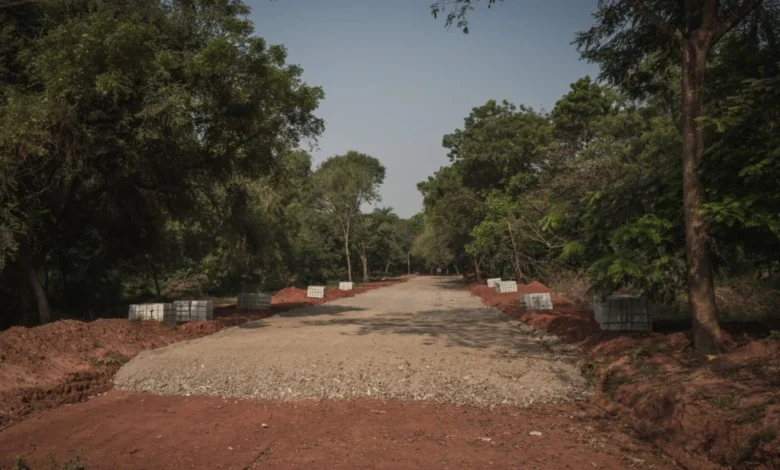
The long-held vision and delicate ecological balance of Auroville were dramatically disrupted in December 2021. Bulldozers forcibly entered designated forested areas, initiating construction on a new radial road. This development was intended to expand the city in line with the original 50,000-resident master plan, but it directly clashed with the Green Belt’s environmental preservation efforts and the community’s established decision-making processes.
Natasha Storey vividly recounts the confrontation: "I stood in front of the bulldozers asking that the decisions of the residents’ assembly be respected. But the process had clearly been bypassed." The demolitions continued, revealing a top-down directive. The greenlight for the construction had come from Dr. Jayanti Ravi, a public servant who had been appointed as the new Secretary to the Governing Board of the Auroville Foundation earlier that year. This action ignited a significant schism within Auroville, pitting supporters of rapid development, who argued for adherence to the Mother’s original urban plan, against those who prioritized ecological preservation and participatory governance.

Governance and Discontent: Erosion of Autonomy
The Auroville Foundation, established as an autonomous body corporate by an Act of Parliament in 1988, is designed to be governed by three interdependent entities: the Residents’ Assembly (comprising all residents aged 18 and above), the Governing Board (appointed by the Central Government of India for a four-year term), and the International Advisory Council (eminent scholars and elders from across the globe, also appointed by the Indian Government). The intention behind this structure was to balance local autonomy with governmental oversight, ensuring the project’s continuity and adherence to its founding charter.
However, the approval of the radial road construction by Dr. Ravi, seemingly bypassing the Residents’ Assembly, signaled a significant centralization of power. This move sparked widespread concern among residents who felt their well-established decision-making bodies were being sidelined. Inside the offices of the Auroville Foundation, the atmosphere grew tense. An anonymous European official, visibly unsettled, whispered to Zolin, "We don’t have the right to talk about these matters. We can’t say anything against the Foundation." This statement underscores a climate of fear and restricted communication, a stark departure from the open dialogue expected in a community founded on unity and conscious evolution.

Further reports from residents detail increasing control over internal communications, including unexplained changes to email accounts and the stripping of administrative access. Perhaps most critically, there are accounts of the Auroville Foundation exerting influence over the visa application process. While India’s immigration authorities issue a special visa category for those wishing to live or volunteer in Auroville, it requires a recommendation letter from the Foundation’s secretary. Alarmingly, even Frederick Schulze Buxloh, a foundational pioneer and a symbol of Auroville’s enduring spirit, has reportedly had his visa renewal denied. These actions, if substantiated, represent a significant erosion of resident autonomy and raise questions about the Foundation’s role in shaping the community’s demographic and ideological future.
Voices from Within: Division and Dialogue
The internal debates and divisions within Auroville are reflected in its monthly newspaper, Auroville Today, where appeals for reconciliation coexist with warnings against polarization. Supporters of the expansion argue that the developments merely fulfill the Mother’s original urban vision for a community of 50,000 residents, viewing the radial road as essential infrastructure for growth. They contend that adhering to the master plan is a matter of fidelity to the founding ideals, ensuring Auroville can accommodate a larger population and continue its experiment on a grander scale.

Conversely, many residents and environmentalists argue that unchecked expansion, particularly at the expense of the painstakingly cultivated Green Belt, betrays the ecological principles that have become integral to Auroville’s identity. They emphasize the importance of sustainable development and participatory decision-making, asserting that the spirit of Auroville lies not just in its physical form, but in its processes and its commitment to harmonious living. The conflict, therefore, is not simply about a road; it is a profound philosophical struggle over the very interpretation and future direction of Auroville’s founding vision.
The Future of Utopia: Evolution or Compromise?
Amidst these profound challenges, Frederick Schulze Buxloh, with the wisdom of decades spent in Auroville, offers a perspective of resilience. "Every crisis can be useful," he muses. "These are precisely the moments that accelerate evolution. We learned not to possess anything and to understand a form of love that is not possession but unity. Here I learned to let everything go." His words suggest that the current turmoil, while painful, could be a catalyst for deeper understanding and adaptation.

Leafing through the archival photobook AUROVILLE 1968-2018, Buxloh reflects further: "Today I see Auroville differently. Maybe the time has come to carry this experience beyond Auroville itself. Many other utopian places like this one are emerging all around the world. The experience of what we have done here will never be lost." This sentiment points to a potential evolution of Auroville’s influence, from a contained experiment to a dispersed model, inspiring similar communities globally.
Nicola Zolin’s experience in Auroville resonates with this broader implication. He acknowledges the township as a powerful symbol of how a new humanity could live together, demonstrating the possibility of collective endeavor and ecological harmony. Yet, he also recognizes that the current situation highlights the inherent difficulties in nurturing such an ambitious vision, particularly when faced with external pressures and internal disagreements. Despite the evident struggles, Zolin observes a growing number of individuals worldwide finding the courage to align their lives with their beliefs, creating smaller, intentional projects that serve as "foyers of an emerging world."

Auroville, therefore, stands at a critical juncture. Its journey from a philosophical ideal to a living community, and now to a site of intense debate over its future, offers crucial lessons for intentional communities globally. The questions it grapples with – how to balance growth with sustainability, how to maintain autonomy within a larger governance structure, and how to evolve a founding vision while staying true to its core principles – are universal. The outcome of Auroville’s current crisis will undoubtedly shape not only its own destiny but also contribute to the ongoing global dialogue about the viability and challenges of creating a more united and conscious future.