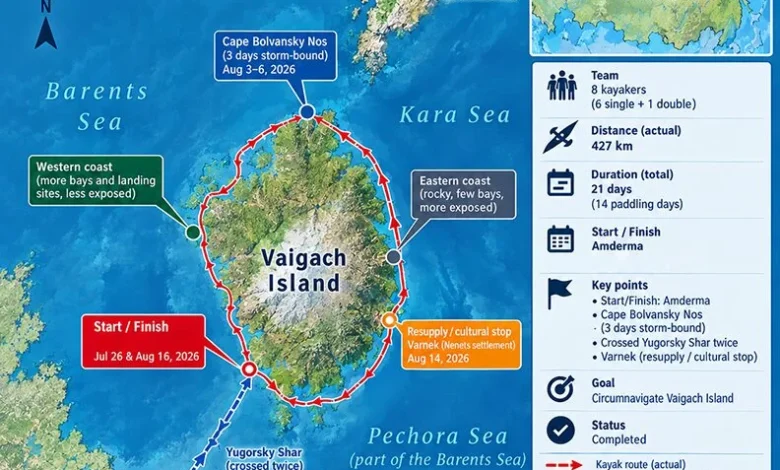
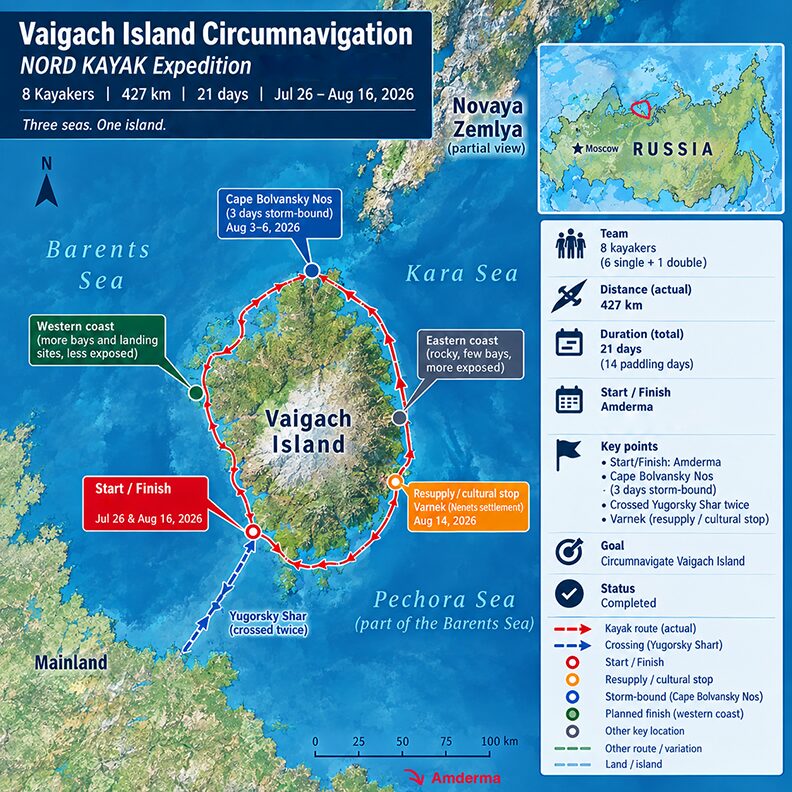
The expedition, which spanned from late July to late August, involved a demanding 427-kilometer journey through the frigid and volatile waters of the Barents, Kara, and Pechora Seas. Led by 41-year-old Sergei Moyseenko, founder of the specialized outfitting firm Nord Kayak, the team executed the mission with a fleet of six single kayaks and one double, showcasing a high degree of technical skill and endurance. The crew, hailing from diverse urban centers including Moscow, St. Petersburg, Murmansk, and Sortavala, navigated the island’s jagged coastline, overcoming unpredictable weather patterns and the inherent isolation of the Russian High Arctic.
Logistical Challenges and the Choice of Vaigach
The decision to target Vaigach Island—a landmass approximately 100 kilometers long and 45 kilometers wide—was a strategic departure from the team’s original, more ambitious objective. According to team member Evgeny Shmyrin, who documented the journey via periodic updates, the group initially aspired to circumnavigate Novaya Zemlya. However, the logistical, financial, and regulatory barriers proved insurmountable.
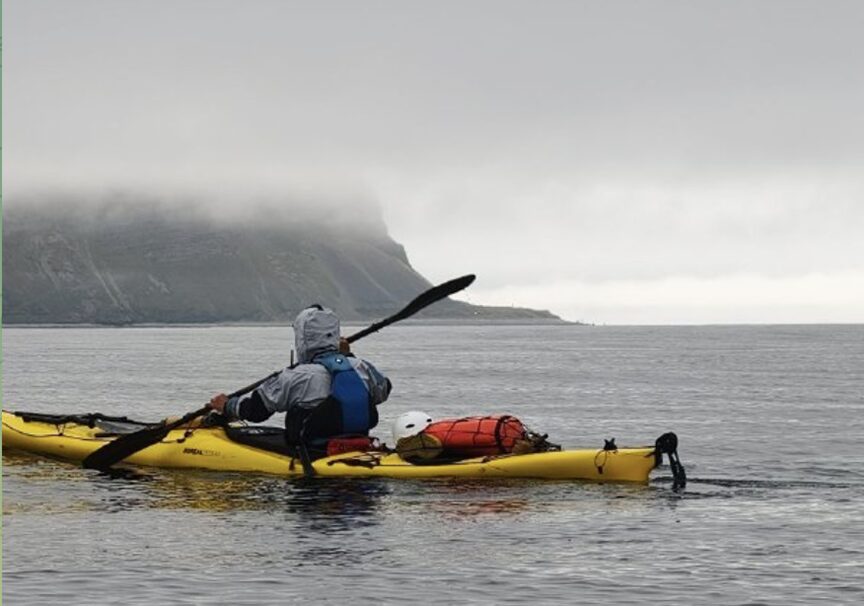
Novaya Zemlya, characterized by its massive glaciers and stringent military oversight, requires specialized permits and high-cost support, such as helicopter or yacht chartering, to navigate safely. In contrast, Vaigach, located approximately 50 kilometers south of the Novaya Zemlya archipelago, offered a more accessible, albeit still perilous, Arctic experience. Crucially, Vaigach lacks the dense military restrictions of its northern neighbor, and while polar bear sightings are a persistent concern in the region, the island presents a lower risk profile compared to the high-density habitats found on the larger Arctic islands. By choosing Vaigach, the team managed to conduct a self-supported expedition that tested their endurance without the need for complex, multi-national governmental clearance.
Chronology of the Expedition
The expedition’s timeline was dictated by the unrelenting climate of the Arctic circle. The group launched on July 27 from the Russian mainland, crossing the Yugorsky Strait to reach the southern shores of Vaigach.
The circumnavigation was conducted in a counterclockwise direction. This route was chosen to tackle the island’s eastern coast—widely considered the most rugged and inaccessible portion—first, while the team’s morale and physical stamina were at their peak. The eastern shore offered limited landing spots and minimal protection from the elements, forcing the paddlers to remain constantly vigilant against the rising surf.
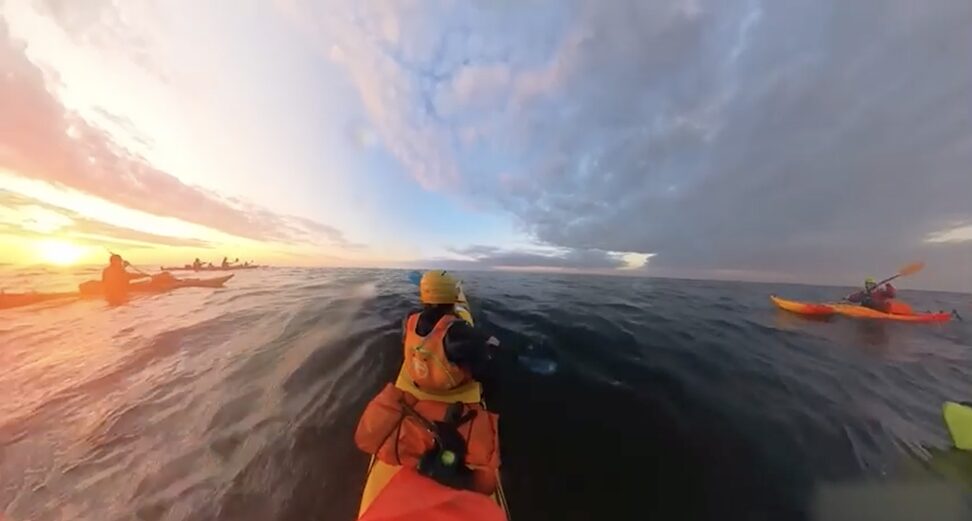
The group was plagued by adverse weather throughout the three-week journey, spending seven days completely stormbound. Their daily routine was entirely governed by the interplay between tidal currents and prevailing wind speeds. Observations revealed that wind intensity typically spiked during the early morning hours, between 3:00 AM and 6:00 AM. To mitigate the risk of being overturned or stalled by these gusts, the team adopted an unconventional schedule, frequently launching in the late afternoon and paddling well into the night. This approach allowed them to capitalize on the calmer twilight and evening air, covering as much as 54 kilometers on their most productive day.
The expedition reached a critical juncture at Cape Bolvansky Nos, the island’s northernmost point and home to a remote weather station. High winds forced the team to shelter for three days. It was here that the reality of the Arctic predator presence became clear; while the team did not encounter live bears, they discovered tracks confirming that the animals had been in the vicinity as recently as two weeks prior.
By August 16, the circumnavigation of the island was officially completed. The team spent the final days of their journey crossing the Yugorsky Strait once more and paddling southeast toward the town of Amderma, where they arrived on August 20 to conclude their mission.
Environmental and Navigational Context
The expedition crossed three distinct bodies of water, each presenting unique challenges. The Kara Sea, in particular, is notorious for its harsh environment. With water temperatures hovering around 6°C, any immersion would present an immediate risk of hypothermia, even with specialized dry-suit equipment. Furthermore, the Kara Sea is prone to massive ice drifts; strong northeasterly winds can push ice floes against the coastline, effectively blocking escape routes for small craft like sea kayaks.
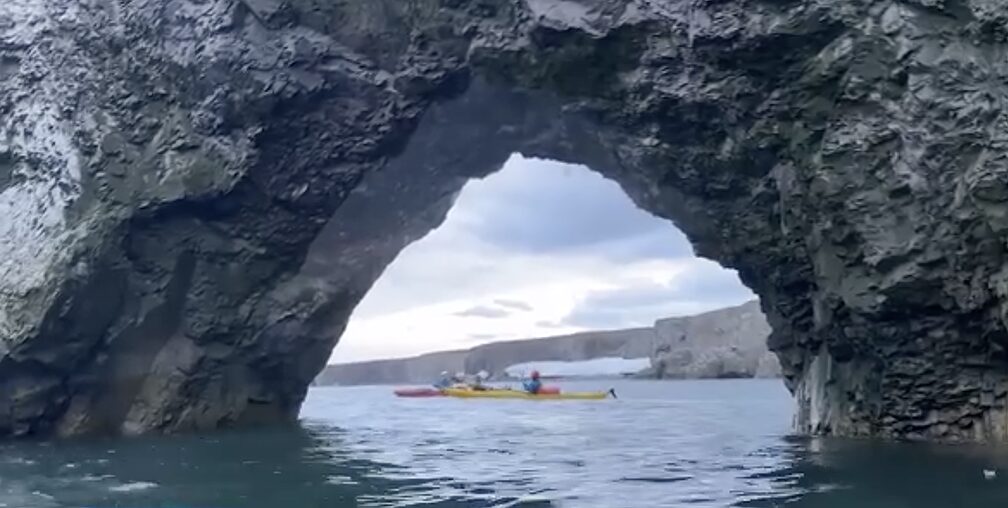
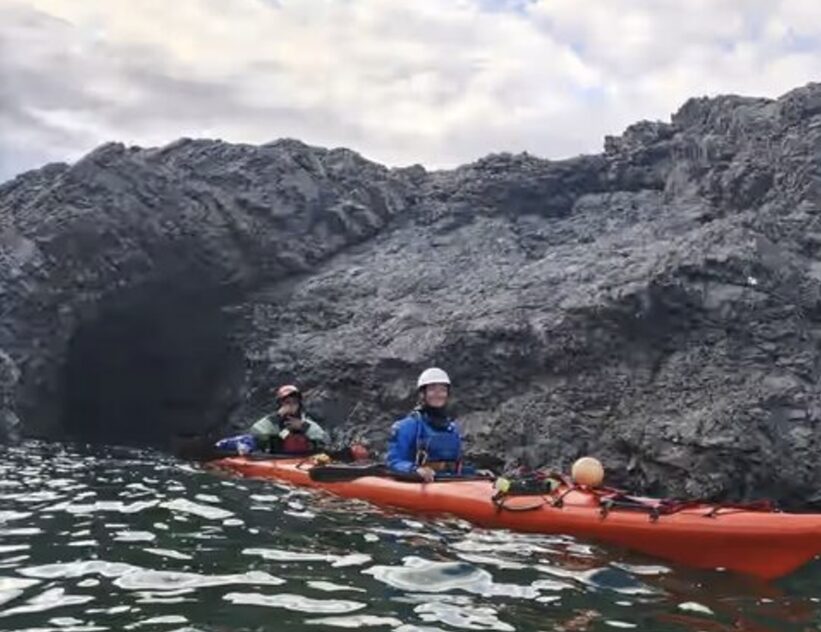
The contrast between the eastern and western coasts provided a lesson in coastal geography. The east, defined by its steep, rocky profile, lacked the natural harbors required for emergency landing. The west coast, conversely, featured a lower, more indented shoreline. While this meant higher surf, the presence of sheltered bays provided the team with necessary, though infrequent, sanctuary from the weather.
Social Dynamics in the High Arctic
A notable human element of the expedition was the team’s encounter with a local hermit named Vasily. Living in isolation on the west coast, Vasily had remained cut off from external human contact since May. His presence underscored the extreme isolation of the region, where the only formal settlement, Varnek, is home to a small population of approximately 70 residents, most of whom are Nenets reindeer herders. The interaction provided the team with a rare, firsthand account of the challenges associated with subsistence living in one of the world’s least hospitable environments.
Implications of the Expedition
The successful completion of this 427km voyage serves as a case study for future Arctic small-craft expeditions. It demonstrates that with the right combination of technical expertise, physical fitness, and tactical flexibility, teams can execute complex maritime missions without the massive support infrastructure traditionally required for polar travel.
However, the expedition also highlights the inherent volatility of the region. The necessity of staying "stormbound" for one-third of the trip serves as a reminder that the Arctic remains an environment that dictates terms to humans, rather than the reverse. The reliance on the team’s ability to "night-paddle" underscores the necessity of high-latitude navigation skills and the ability to operate effectively in low-light conditions.
From an environmental standpoint, the voyage provides an updated look at the accessibility of the region. As Arctic ice cover continues to shift due to broader climatic trends, the ease of access to islands like Vaigach may increase, potentially leading to more interest from adventure tourism. However, the lack of infrastructure—such as the limited shelter and the extreme distance from emergency services—means that the region remains fundamentally dangerous for those who lack formal training and deep experience in cold-water navigation.
Conclusion
The Nord Kayak expedition has not only claimed the title of the first circumnavigation of Vaigach Island but has also provided a blueprint for future explorers. By balancing the need for scientific caution with the drive for personal achievement, the team of eight has documented a corner of the world that remains largely off the radar of the mainstream adventure community. As the group loaded their kayaks onto a barge in Amderma, they left behind a legacy of endurance that will likely inspire subsequent generations of kayakers to look toward the Russian Arctic with both respect and a calculated sense of ambition. The mission stands as a testament to the fact that even in the modern age of satellite tracking and high-tech equipment, the spirit of exploratory, self-powered travel remains a cornerstone of the human experience in the world’s most extreme environments.