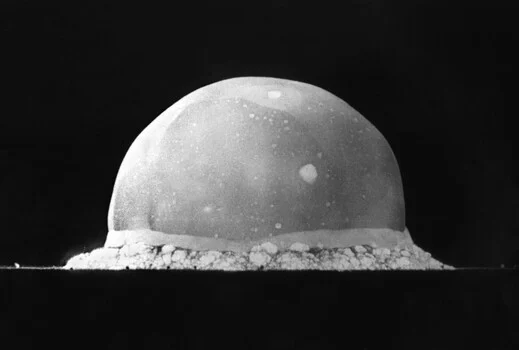
In August 1945, a routine shipment of packaging board manufactured at a mill along the Wabash River yielded an unexpected and alarming discovery. Photographic X-ray film stacked against the newly produced strawboard developed mysterious dark spots after sitting in storage for roughly two weeks. Julian H. Webb, a physicist working in the research laboratories of Eastman Kodak in Rochester, New York, set out to investigate the anomaly. Working backward from the damaged emulsion, Webb traced the contamination to a catastrophic radioactive source located nearly 1,000 miles away in the New Mexico desert. The findings, though understood by corporate and government scientists within months, remained unpublished in open scientific literature for four years, setting a precedent for the intersection of industrial manufacturing, national security, and public health transparency.
The inherent sensitivity of photographic emulsion to radiation forms the cornerstone of this historical event. Silver halide crystals function as passive detectors that respond uniformly to visible light, X-rays, and beta particles emitted by decaying atomic isotopes. When sensitized film rests in proximity to radioactive material, it records the exposure as fogging or distinct dark spots without the intervention of a lens. This exact physical principle enabled Henri Becquerel to discover radioactivity in 1896 using uranium salts and wrapped photographic plates. For commercial film manufacturers, however, this sensitivity presented a severe vulnerability that required constant vigilance, particularly during the industrial disruptions of the Second World War.
During the wartime paper salvage program, recycled paper stock from industrial facilities where workers painted radium clock dials occasionally mixed into general paper supplies. Trace specks of radium paint routinely contaminated commercial packaging, quietly ruining sensitive photographic inventory stored in warehouses across the United States. To mitigate this risk, Kodak established a specialized supply chain partnership with a paper mill in Indiana. This facility was instructed to produce strawboard—a stiff, inexpensive paperboard pressed from cereal straw—utilizing strictly monitored raw materials. The strawboard served as an interleaving protective stiffener between individual sheets of X-ray film. Because Kodak maintained a tightly controlled baseline for its packaging materials, any deviation in quality immediately signaled an external environmental factor.
The Chronology of Discovery and Scientific Investigation
The anomaly materialized in August 1945, when 14-by-17-inch sheets of X-ray film emerged from development bearing between ten and several hundred small dark spots. The radiation had possessed sufficient energy to punch directly through multiple layers of film and cardboard. Julian Webb dismantled the problem systematically. He quickly ruled out defects within the photographic emulsion itself, narrowing the fault down to a specific production run of strawboard manufactured on August 6, 1945, at a mill in Vincennes, Indiana.
Subsequent radiation surveys eliminated radium and natural uranium as primary suspects. The contaminating agent exhibited strong beta radiation, measurable gamma emissions, and a complete absence of alpha particles. Webb measured a maximum beta energy of approximately 0.6 mega-electron-volts (MeV) alongside a decay period of roughly 30 days. Limited radiochemical analysis further indicated that the material belonged to the rare earth chemical series. These specific physical parameters strongly pointed toward cerium-141, a prominent nuclear fission product with a half-life of 32.5 days. Because natural agricultural processes in Indiana could never generate cerium-141, Webb recognized that the isotope was the direct byproduct of a nuclear reactor or an atomic detonation.
Confirmation arrived shortly afterward when a second contaminated batch of strawboard surfaced at a different mill located in Tama, Iowa. Operating hundreds of miles away within an entirely separate watershed, this facility processed straw that had been stored safely indoors, ruling out the harvested crops as the vector of contamination. Investigators ultimately isolated the process water as the common denominator. Both Midwestern mills drew their water from river systems that had experienced heavy local precipitation. Radioactive fission products, deposited into the upper atmosphere by the first successful atomic bomb test, had been scavenged by rainstorms, washed into local river networks, filtered out during pulp processing, and permanently pressed into the industrial packaging materials.
Webb meticulously documented these findings and submitted a landmark paper to the Physical Review, which published it in 1949 under the title "The Fogging of Photographic Film by Radioactive Contaminants in Cardboard Packaging Materials." In the text, Webb explicitly identified the origin of the isotope, writing that the contamination consisted of wind-borne radioactive fission products derived from the Trinity atom-bomb detonation in New Mexico on July 16, 1945. Archival evidence reveals that the broader scientific and defense apparatus was aware of these measurements long before publication; a Los Alamos consultant had written to Webb as early as 1947 requesting detailed data regarding the contamination metrics.
Corporate Adaptation and the Atomic Energy Commission Partnership
Contrary to popular misconceptions, Kodak did not inadvertently discover the existence of the Manhattan Project through its ruined film. The Trinity detonation on July 16, 1945, had been initially explained to the public as an ammunition magazine explosion in New Mexico, but the true nature of the weapon became global news following the atomic bombing of Hiroshima on August 6, 1945. Kodak’s discovery was not the existence of the bomb itself, but rather the astonishing reach of its fallout. A single 21-kiloton device detonated in the desert had lofted measurable quantities of fission products into the jet stream, depositing them across the American Midwest in concentrations high enough to contaminate commercial manufacturing supply chains 1,000 miles downwind.
The industrial implications forced rapid operational changes within the company. Kodak installed advanced air-filtration and radiation-sampling equipment into the ventilation intakes of its manufacturing facilities, effectively transforming a commercial photographic enterprise into a private radiological monitoring station designed purely to safeguard its product inventory.
As the federal government expanded its nuclear weapons testing program to the Nevada Test Site, the scale of potential contamination increased dramatically. Following the Able shot of Operation Ranger on January 27, 1951—a one-kiloton air-dropped device detonated over Frenchman Flat—radioactive snow fell on Rochester, New York, driving Geiger counter readings at Kodak’s facilities to 25 times normal background levels.
Recognizing the ongoing threat to industrial operations, Kodak formally engaged the Atomic Energy Commission (AEC). The federal agency agreed to provide private industry with advance notice of upcoming nuclear detonations, including detailed forecasts predicting the expected geographic distribution of radioactive fallout. This cooperative agreement ensured that photographic manufacturers could secure vulnerable inventory in warehouses and transit hubs ahead of incoming radiation plumes.
Public Health Implications and the 1997 Congressional Hearings
Decades later, the stark disparity between corporate protection and public communication became the focal point of intense congressional scrutiny. The long-term health consequences of atmospheric nuclear testing came to light following a comprehensive 15-year dose reconstruction study conducted by the National Cancer Institute (NCI). Mandated by Congress in 1982 and published in August 1997, the study calculated population radiation doses county by county across the United States, focusing heavily on iodine-131—a short-lived fission product that settles onto agricultural pastures, enters the food supply through dairy consumption, and concentrates within the human thyroid gland.
During an October 1, 1997, hearing before a Senate Appropriations subcommittee, lawmakers confronted federal officials regarding the historical distribution of fallout data. Senator Tom Harkin of Iowa highlighted the historical precedent set by the Kodak-AEC agreement. Testimony entered into the official hearing record confirmed that while the federal government actively supplied predictive contamination maps and advance warnings to the photographic industry to protect commercial goods, no corresponding warnings or safety advisories were issued to dairy farmers, parents, or school children consuming milk produced in the direct path of the fallout plumes.
Epidemiological estimates presented during the hearings suggested that nationwide atmospheric testing may have resulted in between 11,300 and 212,000 excess lifetime cases of thyroid cancer, with a central estimate of approximately 49,000 cases. While the AEC maintained throughout the testing era that public health hazards were negligible, the lack of proactive public notification contrasted sharply with the rigorous protective measures afforded to industrial manufacturers.
Modern Technological Legacy and Enduring Sensitivity
The foundational physics that disrupted industrial manufacturing in 1945 continue to influence modern technology and security protocols. The high sensitivity of silver halide emulsion remains vital in specialized scientific fields, while personal radiation dosimeters routinely utilize film badges to measure occupational exposure. Furthermore, the global proliferation of atmospheric nuclear testing permanently altered the baseline composition of the Earth’s industrial materials; instruments requiring ultra-low background radiation must be constructed from "low-background steel" salvaged from naval vessels sunk prior to 1945 to avoid interference from airborne radioisotopes.
In contemporary aviation, the relationship between radiation detection and photographic materials persists. The deployment of advanced computed tomography (CT) scanners by security agencies for carry-on baggage screening poses a direct threat to undeveloped photographic film. Major manufacturers, including Kodak Alaris and Ilford, explicitly warn that modern CT security equipment can severely fog or ruin unprocessed film regardless of film speed, prompting official travel guidance recommending manual hand inspections at airport security checkpoints.
Ultimately, Julian Webb’s investigation into a batch of contaminated strawboard revealed that the environmental footprint of the atomic age extended far beyond the immediate blast zones of New Mexico and Nevada. The accidental discovery demonstrated that sensitive industrial instrumentation, long before the advent of digital sensors, could faithfully record and preserve the invisible environmental consequences of nuclear history.