Ghosts of the Steppe: How Modern Infrastructure Threatens Kazakhstan’s Ancient Saiga Antelopes

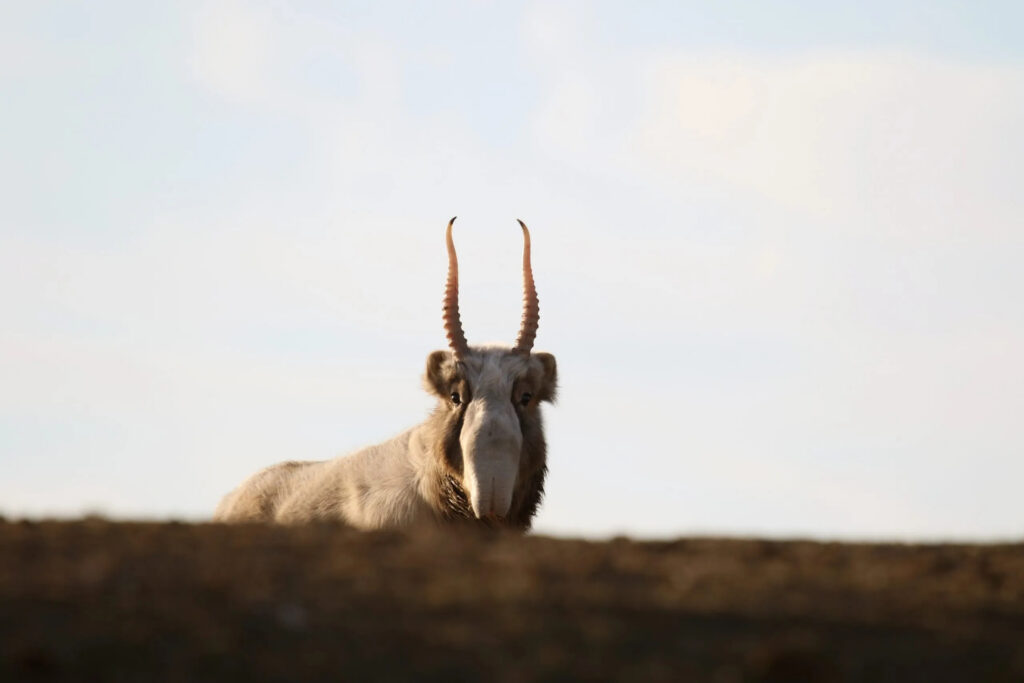
The wheels of the four-wheel-drive vehicle fight for traction, skidding off the paved artery and onto a treacherous network of mud paths. Outside, the vast, unforgiving expanse of the Eurasian steppe stretches toward an endless horizon. Flanking the two-track trail are parallel animal paths—interlaced ribbons of earth forged by hoof and time. In the distance, a low-slung, ghost-like train of shapes materializes against the howling Siberian wind. Through binoculars, hundreds of saiga antelopes come into sharp focus. Piercing the frigid air with their distinct, ringed horns and inhaling through elongated, trunk-like snouts, they sprint across the desolate plain.
For conservationists from the Association for the Conservation of Biodiversity of Kazakhstan (ACBK), this annual gathering is both a spectacle of resilience and a matter of urgent fieldwork. The saiga antelope—a survivor of the Pleistocene epoch that once shared the earth with woolly mammoths and saber-toothed cats—now faces a modern existential crisis. As railways, paved highways, and border fences carve up Central Asia, these ancient nomads are finding their historic migratory routes increasingly obstructed, threatening a lineage that predates recorded human history.
The Evolutionary Marvel of the Steppe
Saiga antelopes are living fossils. Having weathered severe climate shifts and outlived the megafauna of the last ice age, the species is uniquely adapted to the harsh realities of the Central Asian semidesert. Their defining physical feature—the bulbous, flexible snout—serves a vital biological purpose. During the blistering summers, it filters out microscopic dust particles kicked up across the arid plains; in the bitter winters, it functions as a natural heat exchanger, warming sub-zero air before it reaches the animal’s lungs.
This adaptability extends to their social behavior. Every autumn, saigas congregate for the rutting season, embarking on massive migrations that span hundreds of miles. Males engage in fierce headbutting battles to display their physical prowess, relying heavily on the prominence of their large noses—a universal sign of virility among the herds—to attract mates. Historically, these mass movements formed the backbone of Central Asia’s ecosystem, creating ecological corridors across what is now Kazakhstan, Uzbekistan, and Mongolia.
For centuries, early human travelers and nomadic caravans relied on the saigas as navigational guides across a largely featureless landscape. These ancestral human migration paths eventually crystallized into the Silk Road, turning the fertile banks of the Ural River—where Europe meets Asia—into a bustling transcontinental crossroads.
The Twentieth-Century Bottleneck and Modern Threats
While nomadic human populations flourished for millennia, geopolitical shifts in the twentieth century fundamentally altered the geography of the region. The rise of the Soviet Union brought mandatory sedentarization policies, forcing nomadic communities into fixed agricultural plots and effectively halting a lifestyle defined by perpetual motion. As human infrastructure expanded, the landscape was systematically partitioned.
Today, the saigas’ ancient migration routes are intersected by linear barriers: high-speed railways, heavily trafficked highways, and international border fences. These developments have fractured once-contiguous populations into isolated, vulnerable groups.
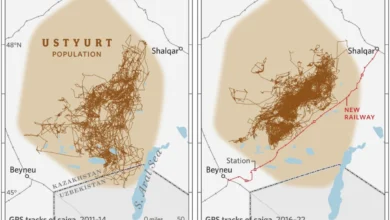
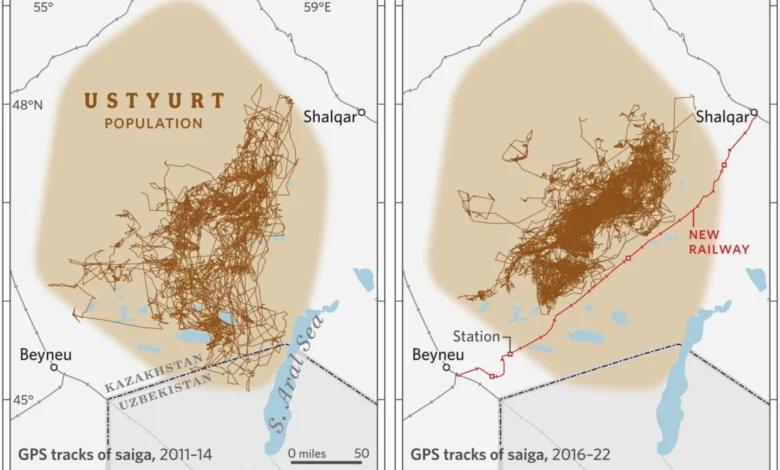
A striking example of this fragmentation occurred in 2014, when the construction of a new railway line in western Kazakhstan abruptly cut off a vital migratory path leading deep into Uzbekistan. Historical GPS-collared tracking data analyzed by ACBK researchers revealed a stark before-and-after contrast. Prior to construction, herds moved fluidly across the border with the changing seasons. Afterward, tracking data showed animals spinning despondently on the northern side of the tracks, unable to cross, while traditional feeding and watering grounds to the south withered away out of reach.
This disruption causes more than just physical blockages; it erodes the collective memory of the herd. Saiga calves acquire spatial knowledge—routes to water, shelter, and seasonal pastures—not through instinct alone, but by following older, experienced females. When infrastructure severs these pathways, the behavioral transmission of migratory knowledge is lost, a phenomenon science writers and conservationists compare to the erasure of a language.
Collaborative Conservation and Innovative Mitigation
Recognizing the severity of the threat, conservation organizations and regional governments have initiated targeted mitigation efforts to restore connectivity across the Eurasian steppe. ACBK, in close partnership with the Kazakh government, has spearheaded the establishment of new wildlife sanctuaries informed by precise GPS tracking data.
To bridge the physical divide created by industrial development, the coalition has engineered saiga-friendly crossing points along railway lines. These structures feature gently sloping dirt ramps that match the height of the tracks, creating the illusion of a natural land bridge. To prevent catastrophic collisions, heavy cattle-guard fencing is positioned at a distance, ensuring trains and ungulates do not intersect unexpectedly.
International cooperation has also yielded tangible results. ACBK successfully collaborated with the Uzbek government to modify rigid barbed-wire border fences. By replacing solid barriers with X-shaped barricades, authorities have maintained vehicle security while leaving precisely calibrated gaps that allow saiga herds to pass freely.
Broader Implications for Central Asian Ecosystems
The plight of the saiga antelope serves as a broader bellwether for landscape-level conservation in Central Asia. As developing nations seek economic expansion through expanded transportation networks, the fragmentation of natural habitats poses a growing threat to migratory species globally.
Biologists emphasize that preserving the steppe requires shifting from reactive species management to proactive landscape planning. If infrastructure projects continue to disregard historical wildlife corridors, iconic migratory species face functional extinction, reduced genetic diversity, and heightened vulnerability to localized disease outbreaks—such as the devastating pasteurellosis bacterial events that decimated massive portions of the saiga population in past decades.
Despite these mounting pressures, the resilient spirit of the saiga endures. Out on the frozen crust of the winter steppe, as thousands of antelopes kick up fresh snow crystals in a display of primal freedom, conservationists find cautious optimism. By dismantling barriers, honoring historical migration routes, and integrating wildlife needs into regional development frameworks, researchers hope to secure a future where the ghosts of the steppe can roam unhindered once more.