Following the Tracks of the Ancients: The Battle to Preserve Kazakhstan’s Migratory Saiga Antelope

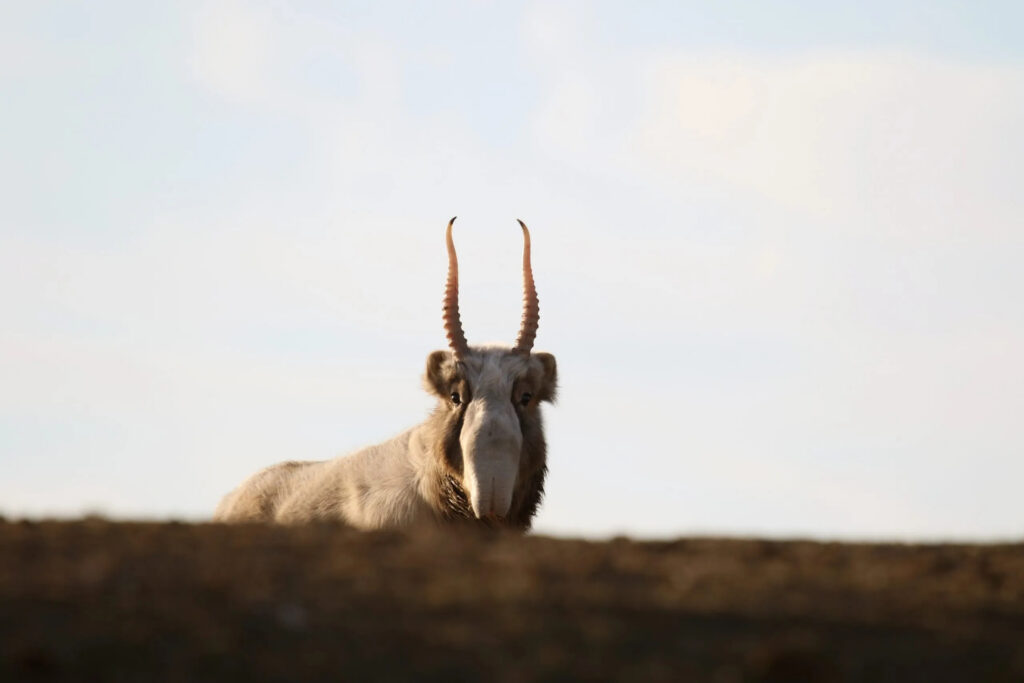
The modern landscape of the Eurasian steppe is increasingly defined by fragmentation, yet deep within the remote expanses of western Kazakhstan, a relic of the Pleistocene epoch continues its ancient journey. As vehicles traverse the muddy, unpaved tracks maintained only by seasonal tire ruts, travelers are occasionally met with an extraordinary sight: hundreds of saiga antelope piercing the frigid air with their distinctive ringed horns, sprinting across the desolate horizon.
For conservationists tracking these resilient ungulates, the journey offers a window into a rapidly vanishing world. Researchers from the Association for the Conservation of Biodiversity of Kazakhstan (ACBK) routinely embark on field audits to monitor herd movements, timing their expeditions to coincide with the critical annual rutting season. However, as infrastructure development accelerates across Central Asia, these prehistoric nomads face unprecedented existential threats that challenge both their survival and the ecological integrity of the steppe.
Historical Context and Evolutionary Resilience
The saiga antelope (Saiga tatarica) is an evolutionary marvel, having coexisted with woolly mammoths, saber-toothed cats, and giant deer with 12-foot antlers during the late Pleistocene. While its megafauna contemporaries vanished thousands of years ago, the saiga survived due to its specialized physiological adaptations.
Most notably, the animal’s distinctively enlarged, floppy nose serves a dual purpose: it filters out harsh dust during the arid summer months and warms frigid, sub-zero air before it reaches the lungs during brutal Siberian winters. Historically, these nomadic herds acted as vital navigational guides for early human caravans traversing the unforgiving Central Asian plains. These seasonal transit corridors eventually paved the way for portions of the legendary Silk Road, transforming the fertile banks of the Ural River—the natural boundary between Europe and Asia—into a bustling transcontinental crossroads.
Despite enduring millennia of climatic shifts, the saiga’s trajectory shifted dramatically during the 20th century. The rise of the Soviet Union brought mandatory sedentarization policies, forcing traditional nomadic human populations to abandon perpetual motion in favor of state-mandated agriculture. While human societies largely transitioned to sedentary, urban lifestyles, the saigas maintained their ancient migratory imperatives, setting the stage for inevitable conflicts with modern infrastructure.
Chronology of Modern Threats to Migration
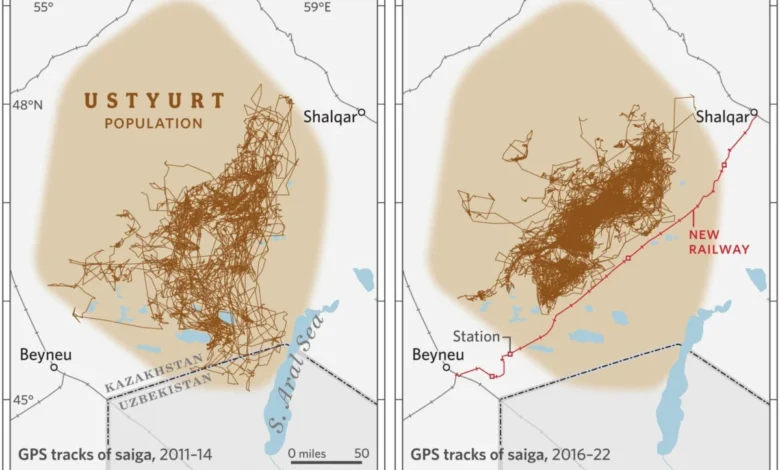
The traditional migratory routes of the saiga historically spanned hundreds of miles, stretching from the Caucasus Mountains to the borders of Mongolia. However, post-Soviet industrialization and rapid economic development introduced a labyrinth of linear infrastructure—including rattling railways, fenced borders, and roaring highways—that systematically fractured the Eurasian steppe.
The impact of these barriers is well-documented by conservation telemetry. Prior to the construction of a major rail line in 2014, GPS-collared saiga populations routinely trekked deep into neighboring Uzbekistan during seasonal migrations. Post-construction monitoring data revealed a stark behavioral shift: individual animals, blocked by physical barriers and security fences, became disoriented on the northern side of the tracks while vital seasonal grazing lands and water sources withered to the south.
This anthropogenic fragmentation leads to what researchers describe as a collapse in spatial knowledge. Much like human populations forced into stationary living lose connection to ancestral navigation, young saigas learn safe migration routes through active observation and participation in herd movements. When herds are segregated by industrial barriers, entire stretches of ecological memory are effectively erased.
Conservation Initiatives and Cross-Border Collaboration
Recognizing the severity of the crisis, organizations such as ACBK have partnered with the government of Kazakhstan and international entities to mitigate the impacts of infrastructure development. Conservation strategies increasingly focus on restoring landscape connectivity through targeted engineering solutions.
Among the primary initiatives is the construction of specialized saiga-friendly crossing points along railway lines. These structures feature gently sloping dirt ramps designed to match the elevation of the tracks, creating the illusion of a natural gap in the barrier. To prevent fatal collisions, strategic cattle-guard fences are positioned at a distance from the crossings, guiding the animals safely across the infrastructure corridors.
Furthermore, conservationists have collaborated with neighboring authorities, such as the government of Uzbekistan, to modify outdated border infrastructure. Traditional barbed-wire security walls have begun to give way to X-shaped barricades that effectively deter unauthorized vehicular traffic while leaving precisely enough clearance for saigas to move freely between historical ranges. These interventions are critical for rebuilding herd trust and encouraging the re-establishment of traditional migration patterns.
Implications for Ecosystem Stability
The preservation of the saiga antelope extends far beyond species-level conservation; it is fundamentally tied to the ecological health of the Eurasian semidesert biome. As keystone ungulates, saigas play a crucial role in nutrient cycling, seed dispersal, and maintaining the structural composition of the steppe vegetation through their massive, trampling hooves.
Environmental analysts emphasize that the steady encroachment of roads, railways, and agricultural plots threatens to turn vast wilderness areas into isolated ecological islands. Without coordinated transboundary management and proactive infrastructure planning, the saiga risks functional extinction as a true migrant, relegated to fragmented pockets unable to sustain genetically diverse populations.
Despite these mounting pressures, the annual rutting season continues to showcase the resilience of the species. As thousands of saigas traverse the snow-covered plains, their movements serve as a stark reminder of a deeper ecological heritage. For researchers and conservationists navigating the unpredictable weather and stark realities of the field, safeguarding these pathways remains an urgent imperative to ensure that the ancient rhythm of the steppe is not lost to history.