The autonomous community of Aragón in northern Spain represents a complex intersection of historical preservation, agricultural heritage, and modern tourism development. Bounded by the imposing peaks of the Pyrenees to the north and sharing a porous cultural border with France, the region centers on its vibrant capital, Zaragoza. As Spain’s fourth-largest municipality, housing a population of approximately 700,000 residents, Zaragoza functions as a vital economic and cultural bridge between major Iberian powerhouses like Madrid and Barcelona, accessible via high-speed rail networks.
Recent travel initiatives sponsored by Aragón Tourism have sought to cast a broader international spotlight on the province’s diverse assets. From ancient Roman infrastructure and medieval Mudéjar architecture to the burgeoning global recognition of indigenous viticulture, the region offers a distinct alternative to the heavily trafficked coastal corridors of southern and eastern Spain.

Main Facts and Architectural Heritage
Zaragoza’s urban layout presents a stratified timeline of Mediterranean and European history. The municipal core is distinguished by the coexistence of Roman ruins, Islamic-era palaces, Gothic fortifications, and Baroque religious structures within a compact pedestrian footprint.
At the center of this architectural convergence lies the Plaza del Pilar, anchored by two prominent ecclesiastical monuments: the Cathedral-Basilica of Our Lady of El Pilar and the Cathedral of the Savior, commonly known as La Seo. The Basilica del Pilar, a massive Baroque structure defined by its eleven tiled domes and four corner towers, dominates the skyline of the Ebro River valley. Adjacent to it, La Seo stands as a testament to religious transition, constructed atop the foundations of the former Moorish Great Mosque of Saraqusta. Its exterior showcases intricate Mudéjar brickwork—a style recognized by UNESCO for its synthesis of Christian and Islamic design traditions—while its interior reveals centuries of shifting masonry techniques and structural adaptations.

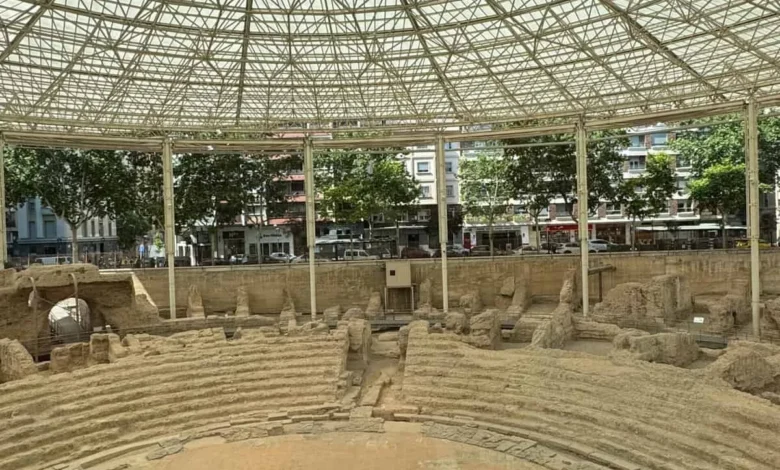
Beyond its religious edifices, the city preserves significant secular antiquity. The Roman Theatre Museum houses the excavated remains of the Caesaraugusta theater, one of the largest constructed in Roman Hispania. Originally seating thousands for civic assemblies and dramatic performances, the site features advanced archaeological preservation beneath a protective architectural canopy, safeguarding fragile masonry from regional climate extremes. Complementing this is the Aljafería Palace, an 11th-century fortified Islamic palace featuring elaborate arches, ornate plasterwork, and sprawling courtyards. Originally constructed under the Banu Hud dynasty, the palace later served as a residence for the Catholic Monarchs and currently houses a permanent exhibition of works by Francisco Goya, Aragón’s most celebrated historical artist.
Chronology of the Aragonese Expedition
The systematic exploration of the region follows a logical geographic progression from the urban center of Zaragoza northward into the rugged terrain of the Pyrenean foothills.

The journey commences in early summer within Zaragoza’s historic quarter, focusing on the immediate density of the municipal core. Initial days are dedicated to archival and culinary institutions, including the historic Fantoba chocolate confectionery—operating with traditions predating many contemporary European equivalents—and specialized purveyors of salt cod, reflecting historical preservation supply chains.
The itinerary subsequently shifts from the capital to the surrounding agricultural and viticultural zones of Campo de Borja, Cariñena, and Calatayud. A key milestone in this progression is the historic Veruela Monastery. Founded in the 12th century, the Cistercian complex experienced periods of monastic abandonment, state seizure, and subsequent restoration before evolving into a modern cultural venue.
Further north, the expedition enters the province of Huesca, incorporating historical fortifications such as Loarre Castle—widely regarded as one of Europe’s finest examples of Romanesque military architecture—and natural landmarks including the Mallos de Riglos and Ordesa National Park. The final phases of the route involve technical outdoor excursions in Alquézar, balancing high-altitude canyoning with the study of rural depopulation patterns in surrounding abandoned settlements.

Supporting Data and Regional Demographics
Economic and demographic indicators across Aragón highlight distinct socio-economic challenges, particularly concerning rural migration and environmental pressures. While Zaragoza maintains a stable urban population of approximately 700,000, rural municipalities in Huesca and Teruel have experienced sustained depopulation over the latter half of the 20th century.
Data compiled by regional planning authorities indicate that the province of Aragón contains over 130,000 abandoned structural units, encompassing former farmsteads, rural residences, and agricultural outbuildings largely deserted during the rural exodus of the 1950s and 1960s. This widespread depopulation presents both preservation challenges for local municipal governments and potential opportunities for rural revitalization initiatives, such as heritage tourism, adventure sports development, and localized agricultural enterprises.

Simultaneously, environmental metrics underscore contemporary climatic pressures in the Ebro River basin. Drought conditions and below-average precipitation levels have resulted in significantly reduced water flow along the Ebro River, impacting regional aquatic ecosystems and limiting recreational navigation within urban centers like Zaragoza.
Viticultural Renaissance and the Garnacha Economy
Agriculture, specifically viticulture, remains a cornerstone of the regional economy. Aragón has positioned itself as a global epicenter for the Garnacha (Grenache) grape variety. Local winemaking associations across the protected designations of origin (DO) of Campo de Borja, Cariñena, and Calatayud have capitalized on international consumer demand for authentic, terroir-driven wines.

The regional promotion of Garnacha extends beyond traditional wine production into culinary arts and education. Cooking academies in Zaragoza, such as La Zarola, integrate regional varietals directly into gastronomic curricula, pairing indigenous wines with traditional local proteins like Duroc pork cheeks and agricultural products including regional almonds and stone fruits. This integration serves to reinforce the farm-to-table economic model promoted by local tourism boards, bridging the gap between primary agricultural production and the service sector.
Broader Impact and Implications
The strategic promotion of Zaragoza and the broader Aragón province by regional authorities reflects a broader European trend toward decentralizing tourism away from saturated coastal destinations and major metropolitan hubs. By leveraging distinct historical narratives—spanning Roman antiquity, Islamic engineering, and monastic preservation—the region aims to attract culturally and environmentally conscious travelers.

However, the long-term sustainability of these initiatives depends heavily on addressing systemic regional issues. The management of architectural heritage in depopulated rural zones requires coordinated public-private investment to prevent further structural degradation of historical assets. Additionally, evolving climate conditions within the Ebro River basin necessitate adaptive resource management strategies to safeguard both agricultural yields, particularly in viticulture, and municipal water supplies.
Ultimately, the development of Aragón as an integrated cultural and ecological destination demonstrates how regional tourism frameworks can diversify national economic portfolios while preserving complex layers of European heritage for future generations.