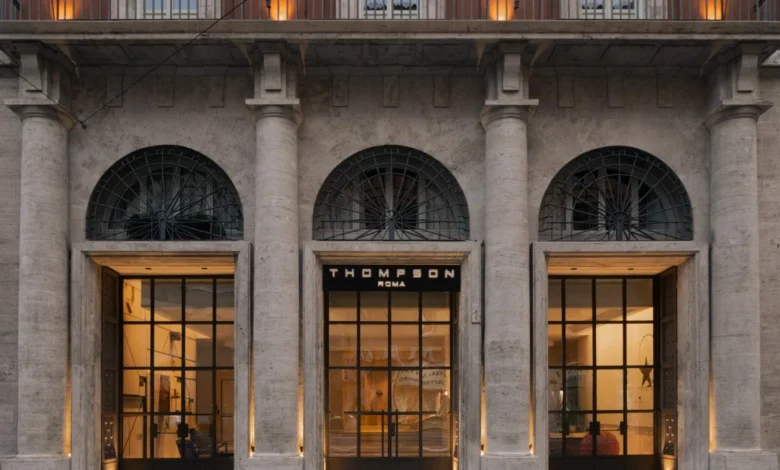
The grand opening of the Thompson Rome represents a significant milestone in the ongoing evolution of Italy’s luxury hospitality sector, as the Hyatt-affiliated brand establishes its first footprint in the Italian capital. Situated within a meticulously restored 1940s architectural landmark, the property serves as a bridge between the rationalist aesthetic of the mid-20th century and the demands of the modern, design-conscious traveler. This development not only underscores the aggressive expansion of the Thompson Hotels portfolio across Europe but also highlights the increasing trend of repurposing historical urban structures into high-end, art-centric boutique accommodations.

Historical Context and Architectural Significance
The building housing the Thompson Rome is a testament to the architectural rigor of the post-war era. During the 1940s, Rome underwent a period of stylistic transition, moving away from the heavy monumentalism of the preceding decade toward a more streamlined, functionalist approach. The structure, originally designed for administrative use, features clean lines, expansive windows, and a spatial configuration that prioritizes natural light—elements that were largely overlooked in older, more traditional Roman palazzos.
The restoration process, which concluded in late 2026, required a delicate balance between preserving the integrity of the original mid-century masonry and integrating the modern mechanical, electrical, and plumbing systems necessary for a five-star hotel. Architects and preservationists worked in tandem to ensure that the exterior facade remained true to its historical record, while the interior was entirely reimagined to meet the contemporary standards of Hyatt’s luxury tier. The result is an environment where the grit and history of the 1940s meet the polished, curated aesthetic of modern interior design.

A Chronology of the Project
The journey to the Thompson Rome’s debut was marked by several years of planning and construction. The project was first conceptualized in 2022, following a period of post-pandemic recovery in the luxury travel market, which saw a surge in demand for "experiential" stays in primary European capitals.
- Early 2023: Acquisition of the site and initial feasibility studies conducted by developers.
- Late 2023: Approval from local Roman planning authorities regarding the exterior restoration of the heritage-listed structure.
- Q2 2024: Commencement of structural reinforcements and interior demolition, focusing on the removal of non-original partitions to create an open-concept lobby and common areas.
- Q1 2025: Finalization of the interior design concept, which centers on Italian craftsmanship, local contemporary art, and bespoke furniture.
- Mid-2026: Soft opening and staff training phases aimed at aligning service standards with the global Thompson brand identity.
- October 26, 2026: Official public launch and opening of the property.
Design Philosophy and Art Integration
At the heart of the Thompson Rome is a commitment to the arts. Unlike conventional luxury hotels that rely on generic decorative elements, the Thompson Rome features a rotating collection of works by contemporary Italian artists. This strategy is intended to ground the guest experience in the local culture rather than providing a sanitized, international-standard luxury experience.

The interior palette utilizes warm, muted tones that complement the historical stone and marble finishes of the original architecture. Custom-designed lighting fixtures, inspired by 1940s industrial design but updated with LED technology, provide a soft, ambient glow that accentuates the architectural volume of the guest suites. By prioritizing local materials—such as Travertine stone and Italian leathers—the developers have successfully created an environment that feels intrinsically Roman while functioning as a modern sanctuary.
Strategic Market Positioning
The entry of the Thompson brand into the Roman market is a calculated strategic move by Hyatt. Rome, a city traditionally dominated by historic grand hotels like the Hotel de Russie or the Hassler, has seen a rise in the "lifestyle hotel" category. These properties cater to a younger, affluent demographic that values design, tech-forward amenities, and localized culinary experiences over the traditional, often formal, service models of the past.

According to market analysis data from the hospitality sector, the demand for lifestyle luxury in Rome has increased by approximately 18% over the last three years. This shift is driven by the emergence of "bleisure" travel—where business and leisure intersect—and a desire for hotels that double as social hubs. By placing the Thompson Rome in a central location, Hyatt is positioning itself to capture both the high-end tourist market and the growing segment of creative professionals visiting the city for extended stays.
Culinary and Social Programming
A critical component of the Thompson Rome’s business model is its food and beverage program. Recognizing that guests are increasingly looking for dining experiences that draw a local crowd, the hotel has launched a signature restaurant that emphasizes seasonal, farm-to-table Roman cuisine.

Industry experts note that the success of modern lifestyle hotels is largely dependent on the vibrancy of their public spaces. The rooftop terrace and the lobby lounge at the Thompson Rome are designed to serve as "the city’s living room," a space where visitors and local Romans can mingle. This approach minimizes the "tourist bubble" effect and embeds the hotel more deeply into the city’s social fabric.
Official Perspectives and Industry Reactions
While specific statements from executive leadership at Hyatt have been focused on the brand’s global growth strategy, internal documentation suggests that the Rome project is considered a "flagship model" for future European expansions. The successful execution of the restoration is viewed by industry analysts as a benchmark for how international brands can navigate the complex regulatory environments of heritage-rich cities like Rome.

"The challenge with a city like Rome is avoiding the pastiche," says a hospitality consultant familiar with the project. "You cannot simply replicate a 1940s aesthetic without understanding the specific, brutalist-leaning elegance that defined that period in Italy. The Thompson has managed to capture a sense of place that feels authentic rather than curated for a catalog."
Broader Implications for the Roman Luxury Market
The opening of the Thompson Rome serves as a harbinger for further investment in the city’s underutilized mid-century real estate. As space becomes increasingly scarce in the historic center, developers are turning their attention to the 1940s and 1950s buildings that were previously ignored by developers obsessed with the Renaissance or Baroque eras.

This trend is not without its controversies. Some preservationists argue that the modernization of these structures threatens to erase the specific social history of the buildings, which were often built during the fascist or early post-war eras. However, the commercial reality is that these properties offer the structural integrity and floor-plate size required for modern hotel operations, which older, more fragmented buildings cannot easily accommodate.
Furthermore, the impact of the Thompson Rome on the local economy is expected to be positive. Beyond the direct job creation and tax revenue, the project serves as an anchor for the surrounding neighborhood, potentially stimulating investment in local retail and service industries.

Conclusion: A New Standard for Urban Hospitality
The Thompson Rome represents a synthesis of historical preservation, modern design, and strategic market positioning. By opting for a landmark 1940s building, the hotel offers a unique narrative that distinguishes it from its competitors. As the hospitality industry continues to move toward experiences that feel specific to their geography, the Thompson Rome stands as a case study in how global brands can adapt to local constraints while maintaining a high standard of luxury.
Whether the property will successfully sustain its appeal in a highly competitive market remains to be seen, but its arrival marks a notable chapter in the ongoing transformation of the Eternal City’s luxury landscape. As guests begin to experience the property, the focus will shift to how well the service, programming, and culinary offerings hold up against the intense scrutiny of Rome’s sophisticated visitor base. For now, the Thompson Rome is a polished addition to a city that is constantly redefining its relationship with its own history.