The Rocks, Sydney’s historic foundation district, continues to serve as a primary focal point for both domestic and international visitors seeking a synthesis of early Australian colonial history and contemporary urban culture. Nestled on the southern shores of Sydney Harbour, this precinct represents the birthplace of European settlement in Australia. Established following the arrival of the First Fleet under the command of Governor Arthur Phillip in January 1788, the area has undergone extensive transformations—shifting from a gritty working-class maritime hub and convict quarters to a protected heritage precinct and vibrant lifestyle destination.

Urban planners, historians, and tourism boards frequently analyze The Rocks as a masterclass in urban conservation. Unlike many historic districts globally that succumbed to total demolition during mid-century modernization waves, The Rocks survived targeted clearance proposals in the 1970s following robust community activism and heritage preservation campaigns. Today, the district is managed primarily by Placemaking NSW, ensuring that its distinct architectural fabric—comprising the largest concentration of 19th-century sandstone buildings in Australia—remains intact while accommodating modern commercial enterprises.
Historical Chronology and Evolution of the District

The indigenous custodians of the land comprising modern-day Sydney Harbour, including The Rocks, are the Gadigal people of the Eora Nation, who utilized the foreshore for fishing, gathering, and cultural ceremonies for tens of thousands of years prior to European colonization. The arrival of the British fleet in 1788 abruptly altered the landscape. Convicts, marines, and administrators rapidly constructed temporary shelters, government stores, and rudimentary housing along the rugged terrain flanking Sydney Cove, giving rise to the informal moniker "The Rocks."
Throughout the 19th century, the precinct developed a notorious reputation as a rough maritime enclave. Waterfront laborers, sailors, and criminal networks populated the narrow, winding alleys, establishing a dense network of boarding houses and drinking establishments. By the turn of the 20th century, overcrowding and poor sanitation prompted fears of disease outbreaks, culminating in a government-mandated quarantine and subsequent resumption of properties following an outbreak of the bubonic plague in 1900. Large portions of the area were subsequently redeveloped or left dormant, paving the way for the construction of the Sydney Harbour Bridge between 1923 and 1932, which physically cleaved through parts of the historic neighborhood.

In the latter half of the 20th century, government proposals to demolish Victorian-era terraced housing to make way for high-rise commercial towers triggered fierce public opposition. Known colloquially as the "Green Bans"—enforced by militant trade unions in collaboration with local residents—these protests halted destructive development schemes and preserved the precinct’s architectural integrity. The historical awakening culminated ahead of the Sydney Bicentenary in 1988, transforming The Rocks into a protected heritage zone recognized globally for its unique colonial streetscapes.
Cultural Attractions and Architectural Landmarks

Modern visitors exploring The Rocks encounter a dense concentration of cultural institutions, museums, and galleries that chronicle the precinct’s complex history.
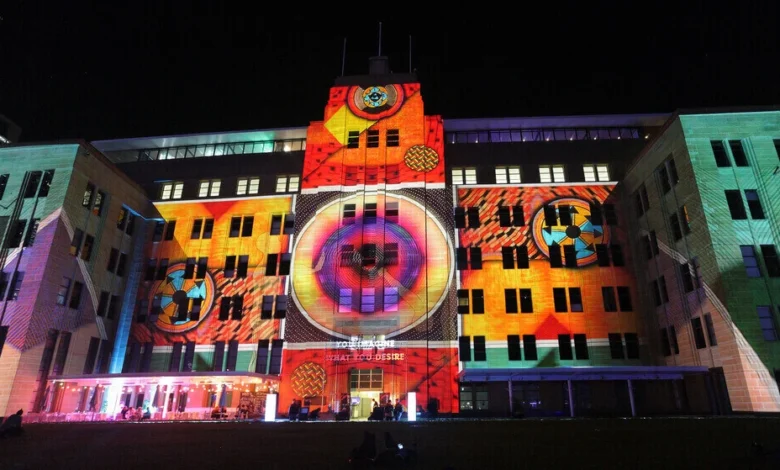
The Museum of Contemporary Art Australia (MCA), situated prominently at Circular Quay within a striking Art Deco former maritime services building, serves as the country’s premier institution dedicated exclusively to exhibiting, collecting, and interpreting contemporary art. Featuring a rotating calendar of major international exhibitions alongside extensive showcases of Aboriginal and Torres Strait Islander art, the MCA acts as a cultural bridge between the historic architecture of The Rocks and the modern skyline of the Sydney Central Business District (CBD).

Adjacent to the gallery spaces, the Rocks Discovery Museum, housed within a restored 1850s sandstone warehouse, provides a comprehensive educational overview of the area’s chronological development. Utilizing interactive displays, archaeological artifacts recovered from local digs, and multi-media presentations, the museum details the lives of early colonial settlers, convicts, and merchants, alongside significant representations of indigenous heritage.
Streetscapes, Heritage Precincts, and Guided Explorations

Walking through The Rocks offers a tangible timeline of Sydney’s architectural evolution. Cobblestone laneways, including Argyle Street and Nurses Walk, wind past meticulously preserved colonial-era structures. Among these stands Cadman’s Cottage, constructed in 1816 under the direction of Governor Lachlan Macquarie. As the oldest surviving residential building in central Sydney, it originally served as a government water transport base before fulfilling various roles over two centuries.
Further enriching the heritage trail is Susannah’s Place, a row of four terrace houses built in 1844. Operated by Sydney Living Museums, the site has been preserved with minimal structural intervention, capturing the domestic realities of working-class families who inhabited the rooms across four distinct historical eras spanning from the mid-19th century to the late 20th century.

For visitors seeking structured insights, professional 90-minute walking tours operate daily throughout the precinct. Led by expert guides, these tours traverse hidden alleyways, Campbell’s Cove, and historical vantage points, contextualizing historical events such as the 19th-century rum trade, plague outbreaks, and urban preservation battles.
Commerce, Markets, and Gastronomic Landscape

Beyond its historical footprint, The Rocks operates as a bustling commercial and culinary hub. The Rocks Markets, held every Saturday and Sunday, represent a long-standing Sydney institution. Established decades ago to support local artisans, the markets now feature over 200 open-air stalls showcasing independent fashion designers, locally crafted homewares, fine jewelry, and original photography, operating beneath the canopy of the Sydney Harbour Bridge approach.
The culinary and nightlife scene within The Rocks reflects a deliberate blending of colonial heritage and modern gastronomy. The district is home to several of Australia’s oldest continuously licensed pubs. Establishments such as the Fortune of War, established in 1828 on George Street, and the Lord Nelson Brewery Hotel, known for pioneering microbrewing in Sydney since 1986, provide traditional pub fare alongside contemporary craft beer selections.

Other notable venues include the Orient Hotel and The Mercantile Hotel, the latter celebrated for its enduring Irish musical heritage and community atmosphere. For elevated dining and panoramic harbor vistas, the rooftop bars of the Glenmore Hotel and heritage dining rooms offer unobstructed views of Circular Quay, the Sydney Opera House, and the Sydney Harbour Bridge.
Integration with Broader Sydney Tourism Infrastructure

The strategic geographic positioning of The Rocks makes it an indispensable transit and tourism node. Situated immediately adjacent to Circular Quay—Sydney’s primary ferry, train, and bus interchange—the precinct facilitates seamless connectivity to broader metropolitan attractions, including Taronga Zoo, Manly Beach, and Watsons Bay.
Furthermore, the area serves as a primary access point for iconic infrastructure, including the Sydney Harbour Bridge. Visitors frequently undertake the BridgeClimb experience, a guided ascent scaling the outer arch of the "Coathanger" 134 meters above sea level, providing panoramic views of the coastal basin. Alternatively, pedestrians utilize the bridge’s eastern walkway or visit the Pylon Lookout Museum to examine the engineering feats behind its 1932 completion.

During the winter months, The Rocks and Circular Quay experience a significant surge in visitor volume as the host locations for Vivid Sydney, an annual festival of light, music, and ideas. The event transforms historical sandstone facades, the MCA, and the Sydney Opera House into dynamic canvases for large-scale light projections and immersive digital art installations, reinforcing the precinct’s status as a dynamic intersection of past preservation and future-facing creativity.