The Geological Enigma of Crowley Lake: Unveiling California’s Hidden Volcanic Spires

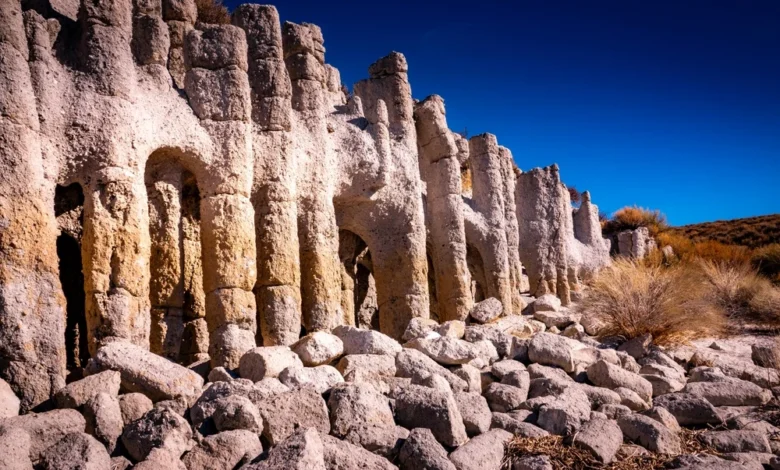
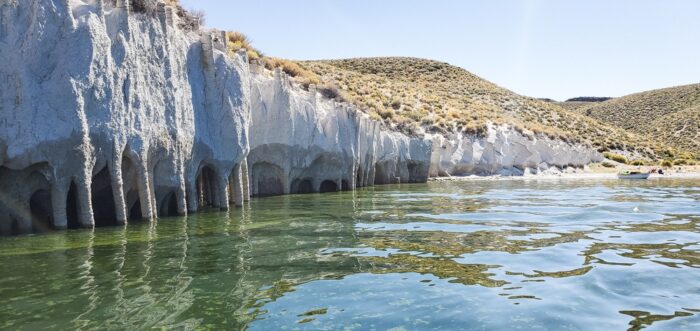
Tucked away along the secluded, windswept shores of Crowley Lake in California’s Mono County, a surreal architectural landscape emerges from the earth. While the reservoir is primarily known for its world-class trout fishing and tranquil kayaking, a recent surge in public interest has turned the spotlight toward the shoreline’s weathered cliffs. Here, hundreds of towering, spiral-shaped stone pillars stand in uniform rows, creating an aesthetic that mirrors the intricate, arched masonry of Moorish cathedrals or ancient Mediterranean ruins. Despite their uncanny resemblance to human-engineered structures, these formations are entirely natural—the product of a violent, primordial history that dates back hundreds of thousands of years.
A Legacy Born of Fire: The Long Valley Caldera
The story of the Crowley Lake columns begins not with human builders, but with one of the most cataclysmic geological events in North American history. The lake sits within the Long Valley Caldera, a massive depression measuring 32 kilometers in length and 18 kilometers in width. Approximately 760,000 years ago, this site was the epicenter of a supervolcanic eruption of staggering proportions.
The eruption expelled roughly 650 cubic kilometers of rhyolitic rock and volcanic ash. To put this in perspective, the blast was several hundred times more powerful than the 1980 eruption of Mount St. Helens. The sheer volume of material ejected was so significant that it blanketed the surrounding landscape in a layer of ash and debris exceeding one kilometer in thickness. As the subterranean magma chamber beneath the crust was emptied, the roof of the chamber collapsed inward, forming the vast, deep caldera we recognize today. The ash from this explosion traveled thousands of kilometers, with geological evidence indicating that debris reached as far east as the plains of Kansas.
The Formation of the Bishop Tuff
The primary canvas for the columns is the Bishop Tuff, a distinct geological unit formed from the compaction and welding of the volcanic ash and pyroclastic debris left behind by the eruption. As the ash settled, it fused into a thick, porous rock. Over time, the specific chemical composition of this tuff—rich in silica, sodium, and potassium—created the conditions necessary for the columns to emerge.
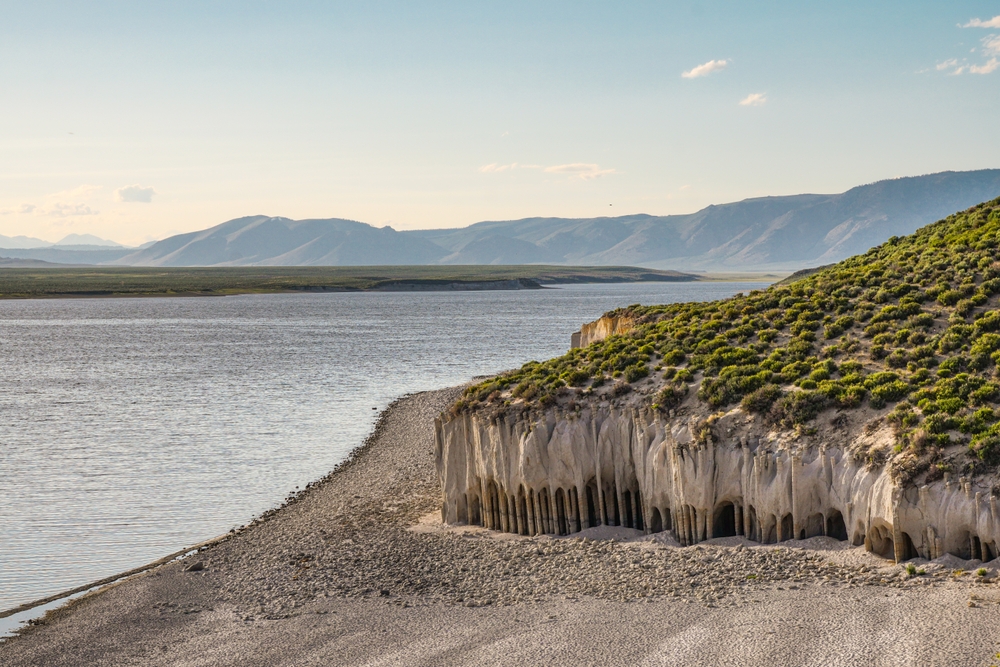
For decades, amateur geologists and tourists speculated that these pillars were the result of columnar jointing, a common phenomenon found in cooling basalt, such as the famous Giant’s Causeway in Ireland. However, recent scientific analysis has debunked this theory. Columnar jointing typically creates tight, hexagonal patterns. The Crowley Lake columns are distinct; they are spaced further apart and possess a unique internal structure that requires a different explanation.
The Science of Hydrothermal Convection
In a comprehensive study conducted by researchers at the University of California, Berkeley, scientists utilized advanced computer modeling, X-ray diffraction, and electron microscopy to understand the genesis of the pillars. The findings, led by geologist Noah Randolph-Flagg, point to a process known as hydrothermal convection.
According to the research, the columns were formed shortly after the volcanic eruption as the Bishop Tuff was still cooling. Cold groundwater seeped into the hot, porous ash, creating a volatile interface between liquid water and steam. This interaction caused the water to boil, creating localized convection currents. As the water moved, it transported dissolved minerals—specifically mordenite, a zeolite mineral—upward through the ash. This mineral-rich steam acted as a natural cement, binding the volcanic ash together into vertical, heat-resistant tubes.
The process was surprisingly rapid in geological terms. Scientists estimate that the columns were fully formed within approximately 100 years of the initial volcanic event. Because the cemented columns were more resistant to environmental stressors than the surrounding, unhardened ash, they remained standing while the softer, adjacent material eroded over the ensuing millennia.
The Role of the Los Angeles Department of Water and Power
While the columns are prehistoric, their visibility is a relatively modern development linked to human intervention. The creation of Crowley Lake in the early 20th century transformed the landscape. The reservoir, managed by the Los Angeles Department of Water and Power (LADWP), was named in honor of Father John Crowley, a Catholic priest and community advocate who campaigned tirelessly for the region’s development during the water-starved 1920s and 1930s.
Father Crowley’s advocacy was instrumental in securing water infrastructure for local residents, who had previously watched as vital resources were diverted to the rapidly growing metropolis of Los Angeles. Following his untimely death in a car accident, the Long Valley Dam was completed, filling the basin and creating the reservoir.
It was only after the lake was filled and the water levels began to fluctuate that the erosion of the cliffside accelerated. The recurring rise and fall of the water level, combined with the region’s intense freeze-thaw cycles, stripped away the loose, non-cemented tuff, revealing the hidden forest of stone columns and creating the shallow caves that dot the shoreline today.
Access and Environmental Stewardship
Today, the columns remain a destination for intrepid hikers and boaters. However, access is challenging. The site is located in a remote stretch of Mono County, and the off-road trails leading to the shore are steep, uneven, and prone to becoming traps for standard vehicles. Many visitors opt to traverse the final leg of the journey on foot or via kayak.
Environmentalists and local authorities emphasize that while the columns appear robust, they are composed of relatively soft volcanic material. The integrity of the arches and pillars can be compromised by climbing, carving, or excessive contact. As the cliffside continues to recede, experts suggest that more columns will likely be exposed, but they warn that the current structures are subject to constant, slow-motion decay.
Future Risks: Is the Caldera Still Active?
The presence of the columns serves as a constant reminder of the region’s volatile past. The Long Valley Caldera is one of the most closely monitored volcanic systems in the United States. While it is officially classified as dormant, the caldera has shown signs of "breathing" since the 1980s. This activity, characterized by minor seismic swarms and ground deformation, indicates that a deep-seated magma body remains present.

Government agencies, including the U.S. Geological Survey (USGS), maintain a network of sensors throughout the Mammoth Lakes area to track even the most minute shifts in the crust. While there is no immediate evidence to suggest an imminent eruption, the geological history of the region serves as a stark reminder of the forces that shaped the American West. The columns are not just a point of curiosity; they are a window into a time when the Earth’s crust was shattered, re-formed, and cemented by the very heat that continues to bubble beneath the surface today.
As interest in these natural wonders continues to grow through social media and tourism, the focus remains on balancing public access with the preservation of a site that is both a geological laboratory and a monument to the raw, transformative power of the planet.