The Ancient Echoes of the Steppe: How Conservationists and Governments Are Fighting to Save Kazakhstan’s Iconic Saiga Antelope

The rugged expanses of the Central Asian steppe have long served as a theater for endurance, adaptation, and survival. Traversing the muddy, ice-crusted terrain of western Kazakhstan, conservation biologists from the Association for the Conservation of Biodiversity of Kazakhstan (ACBK) navigate tracks defined by centuries of movement. Alongside them, researchers study a landscape that once supported woolly mammoths and saber-toothed cats—megafauna that vanished millennia ago. Yet, one remarkably resilient survivor remains: the saiga antelope (Saiga tatarica).
Today, this prehistoric ungulate faces a modern crisis. As human infrastructure rapidly fragments the ancient migratory corridors of Eurasia, government agencies, international conservation coalitions, and local scientists are locked in a high-stakes race to preserve the saiga’s freedom of movement. Through advanced satellite tracking, innovative engineering, and cross-border policy reform, conservationists are striving to protect an animal that has defined the character of the Eurasian steppe since the Pleistocene epoch.
Main Facts and Historical Context
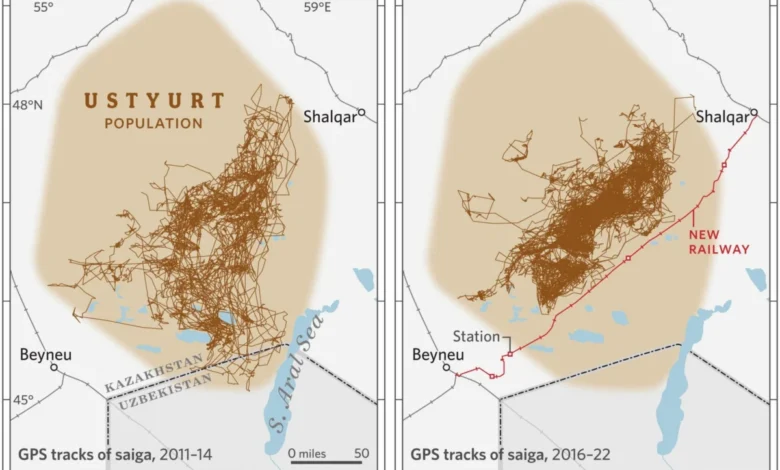
The saiga antelope is instantly recognizable by its signature feature: an oversized, fleshy, proboscis-like nose. This specialized adaptation is essential for survival in the extreme continental climate of Central Asia. During the blistering summers, the saiga’s snout acts as an internal air filter, blocking abrasive dust and particulate matter kicked up across semidesert plains. In the depths of the Siberian winter, the nasal cavity warms the frigid, sub-zero air before it reaches the animal’s lungs.
For millennia, these nomads of the steppe moved in colossal herds numbering in the hundreds of thousands, or even millions. Their annual migrations spanned thousands of miles across what is now Kazakhstan, Russia, Mongolia, and parts of Uzbekistan. Historically, human caravans navigating the perilous overland routes of the early Silk Road relied on the saiga as a navigational guide, tracking the herds to locate reliable seasonal grazing lands and water sources.
However, the twentieth century brought catastrophic disruption. Following the rise of the Soviet Union, mandatory sedentarization policies forced traditionally nomadic human populations into fixed agricultural settlements. Simultaneously, industrialization, widespread poaching, and habitat fragmentation severely depleted saiga populations. By the turn of the 21st century, illegal hunting for meat and horns—particularly the demand for male horns in traditional Asian medicine markets—pushed the species to the absolute brink of extinction. In 2015, a catastrophic epizootic bacterial infection wiped out more than 200,000 saigas in a matter of weeks, destroying roughly 60 percent of the global population in a single localized event.
Chronology of Modern Conservation and Obstacles
Despite these near-fatal setbacks, targeted conservation initiatives over the last two decades have achieved a remarkable population rebound. Kazakhstan’s government, in partnership with organizations like ACBK, enacted strict anti-poaching patrols, established new protected wildlife sanctuaries, and implemented robust monitoring protocols.
The integration of advanced technology has revolutionized these conservation efforts. In the past, field researchers spent weeks fruitlessly scouring the boundless horizon in search of elusive herds. Today, GPS satellite collars provide conservationists with real-time data streams detailing daily movements, seasonal congregation points, and migratory velocity.
This tracking data has directly informed land-use planning. For instance, wildlife sanctuaries established in western Kazakhstan were explicitly mapped using spatial telemetry collected by ACBK researchers. However, as populations have grown—recent estimates place the global saiga population at over 1.9 million individuals, primarily concentrated in Kazakhstan—the animals have increasingly collided with post-Soviet infrastructure.
Supporting Data and Infrastructure Impacts
The proliferation of linear infrastructure represents the most severe contemporary threat to the saiga’s survival. Railroads, multi-lane highways, border fencing, and agricultural expansion have effectively carved up the Eurasian steppe into isolated ecological islands.
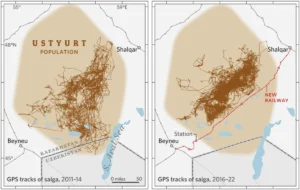
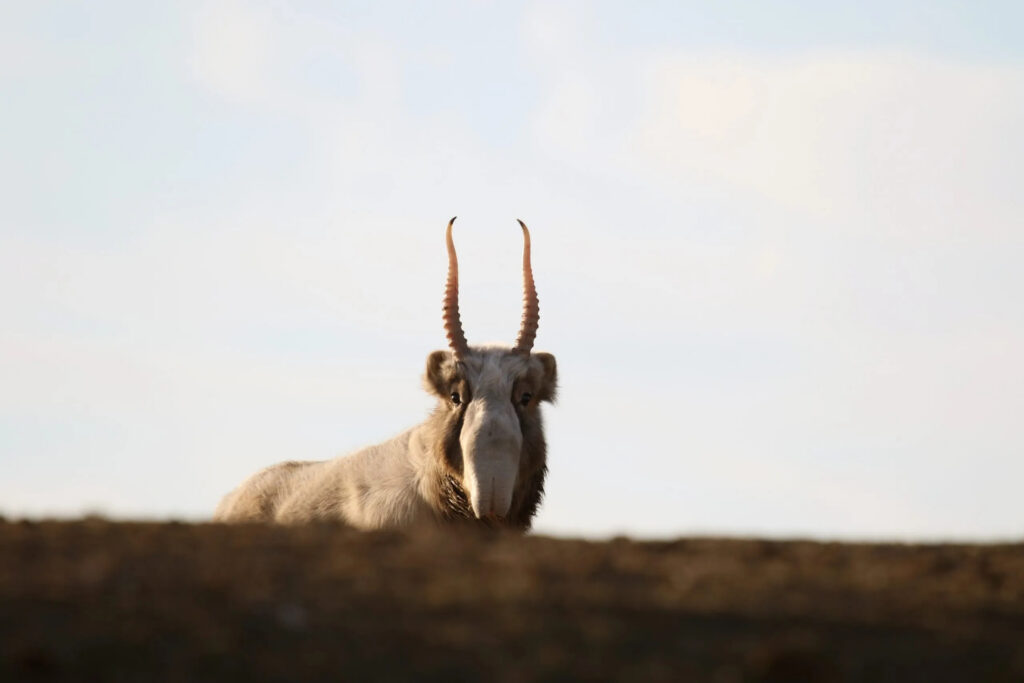
Telemetry maps analyzed by researchers vividly illustrate this fragmentation. Prior to the construction of a major transcontinental railway line in 2014, GPS-collared saiga populations routinely crossed international borders, migrating deep into the seasonal pastures of Uzbekistan. Following the installation of the barrier, tracking data reveals a heartbreaking behavioral shift: individual animals repeatedly pace the northern side of the rail line, unable to cross, while the southern pastures and water sources they depend on wither away.
This physical blockage triggers what conservationists describe as a "collapse in spatial knowledge." Similar to how human populations forced into sedentarization gradually lost their ancestral navigational traditions, young saigas learn migration routes through active social transmission—following older, experienced leaders. When linear barriers block these routes, entire generations lose cultural memory of the landscape, disrupting the species’ evolutionary resilience.
Official Responses and Mitigation Strategies
To reverse this fragmentation, regional governments and conservation groups have deployed targeted, science-based engineering solutions. ACBK, working closely with the Kazakh and Uzbek governments, has spearheaded several critical mitigation projects:
- Saiga-Friendly Railway Crossings: Engineers have constructed dozens of specialized dirt ramps designed to match the height of railway tracks. From a distance, these sloping earthen bridges create a natural visual gap in the barrier, allowing herds to traverse rail lines safely.
- Strategic Fencing Modifications: In collaboration with Uzbek authorities, standard barbed-wire border fences—which historically snared and killed migrating ungulates—have been systematically redesigned. New X-shaped barricades block unauthorized vehicular traffic while leaving precisely engineered clearances at ground level for saigas to slip through.
- Buffer Zones and Cattle Guards: Engineers have positioned heavy-duty cattle guards far away from designated railway crossings, ensuring that freight trains and skittish saiga herds never collide at high-speed intersections.
Albert and Alexandr, veteran field researchers with ACBK who boast over two decades of combined experience tracking the herds, emphasize that restoring trust is vital. If saigas encounter continuous, impassable obstacles, they permanently abandon historical migration routes. By reopening these pathways, conservationists aim to restore the structural integrity of the steppe ecosystem.
Broader Impact and Implications
The ongoing struggle to protect the saiga antelope transcends regional wildlife management; it serves as a bellwether for the health of grasslands globally. The Eurasian steppe is one of the world’s largest remaining intact temperate grassland ecosystems, playing an indispensable role in carbon sequestration, soil stabilization, and biodiversity preservation.
Furthermore, the plight of the saiga highlights a fundamental tension in modern development: how to balance linear economic expansion—such as trade corridors connecting Asia and Europe—with the ecological imperative of preserving migratory connectivity. Scientists warn that failing to account for migratory species in regional infrastructure planning risks triggering cascading ecological collapses.
As winter storms sweep across the vast, white plains of Kazakhstan, thousands of saigas continue to run across the horizon, their hooves striking the frozen earth in an ancient rhythm. Whether this prehistoric survivor will maintain its hard-won freedom in a rapidly industrializing world depends entirely on the ongoing commitment of scientists, policymakers, and international alliances dedicated to keeping the pathways of the steppe open.