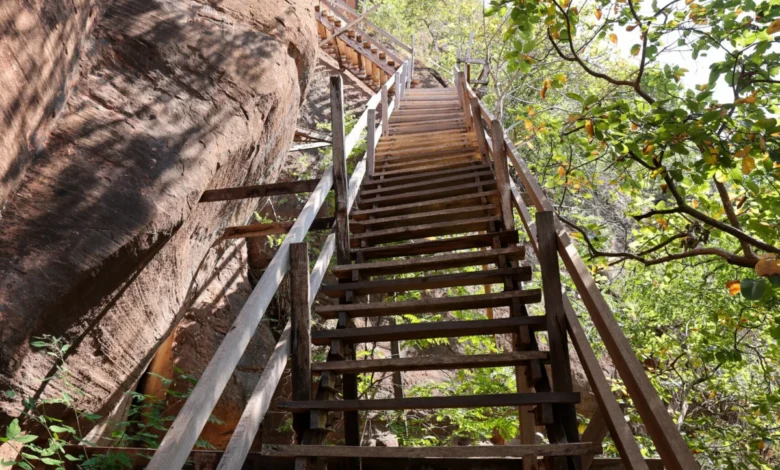
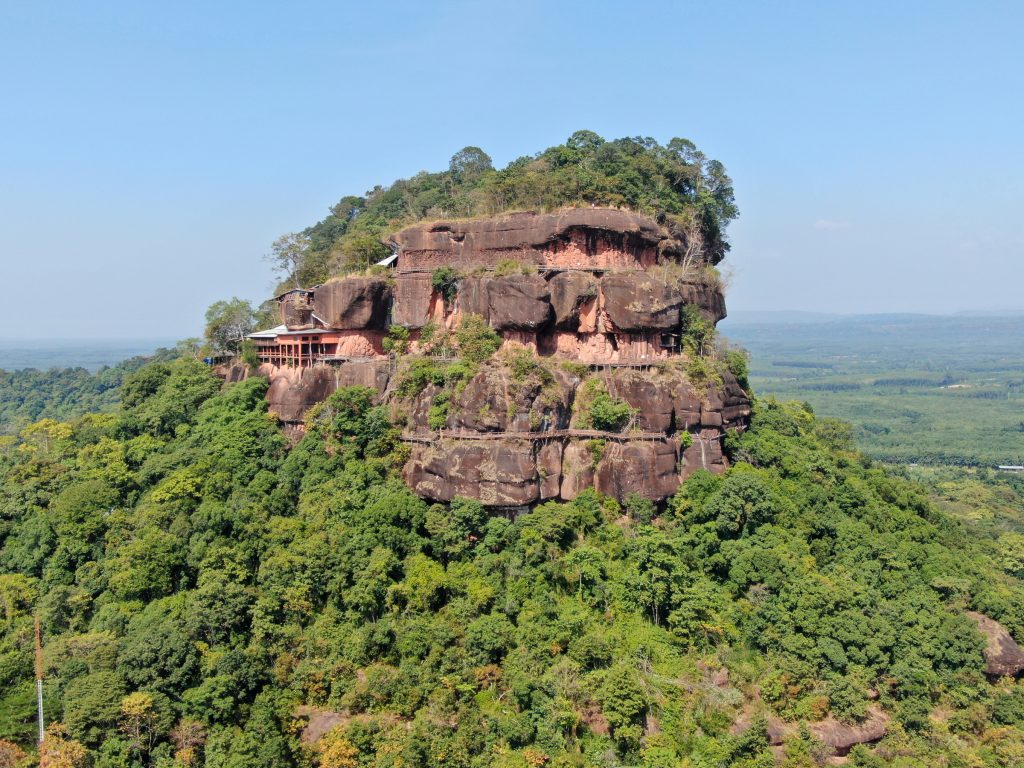
Nestled within the remote expanse of Bueng Kan province in Thailand’s northeastern Isan region, Wat Jetiyakhiri—universally known as Wat Phu Tok—stands as one of the most remarkable and perilous architectural achievements in Southeast Asia. Rising 359 meters straight out of the flat surrounding terrain, this solitary sandstone mountain features a complex, multi-tiered system of handcrafted wooden staircases, ladders, and cantilevered walkways anchored directly into sheer vertical rock faces. The monument serves not only as a dramatic tourist attraction for adventurous travelers seeking to step off the beaten path, but also as a deeply sacred Buddhist meditation complex meticulously designed to mirror the seven stages of spiritual enlightenment.
Main Facts and Geographic Overview
Wat Phu Tok, translating locally from the Isan dialect as the "Lonely Mountain," bears a striking visual resemblance to smaller iterations of global marvels like Sigiriya in Sri Lanka. Located approximately a 30-minute drive from Bueng Kan city, the site is dominated by a rugged geological formation that emerges abruptly from a landscape characterized by peaceful countryside, expansive horizons, and dense tropical foliage. The official designation of the temple complex is Wat Jetiyakhiri, though the mountain itself remains the focal point of travelers and pilgrims alike.

The primary structural feature of the temple is its network of wooden boardwalks and stairways, which span seven distinct levels corresponding to Buddhist cosmological and psychological milestones. While the lower tiers serve as foundational approaches and transition zones, the upper levels—particularly the fifth and sixth tiers—house ordination halls, shrines, and breathtaking panoramic views of the Mekong River basin.
Historical Chronology and Origins

The history of Wat Phu Tok is inextricably linked to the austere traditions of forest Buddhism in Thailand. For generations, the mountain’s rugged terrain, dense undergrowth, and isolated location rendered it largely untouched by human development, serving instead as a natural habitat for diverse wildlife, including numerous species of venomous snakes. This inherent element of danger, combined with profound isolation and pristine natural beauty, made the site an ideal sanctuary for meditation.
The monumental task of transforming the sheer rock face into a habitable monastic complex was initiated by the revered monk Luang Pu Juan. Recognizing the potential of the mountain for spiritual discipline, the monk spearheaded the construction of the intricate network of wooden staircases, ladders, and suspended walkways. These pathways were engineered to connect scattered natural caves, rock shelters, and shrines used by resident monks for ascetic meditation.

Over years of labor, the builders established seven distinct levels, intentionally mapped to the seven stages of Buddhist psychological purification and meditation. Tragically, the visionary founder, Luang Pu Juan, did not live to see the completion of his lifelong project; he perished in a catastrophic commercial airplane accident. Despite this loss, the monastic community and local authorities have continued to maintain the wooden infrastructure, preserving Wat Phu Tok as both an active place of worship and a revered historical landmark.
Structural Layout and Architectural Analysis

The architectural ascent of Wat Phu Tok is an exercise in engineering ingenuity and psychological endurance. Visitors begin their journey at the base of the mountain, where a large monastic compound, a serene lake, and extensive parking facilities welcome travelers. The approach transitions rapidly from a conventional walking path to steep wooden staircases anchored into the earth, which gradually grow steeper as they approach the cliffside.
Upon reaching the fifth level, the terrain levels out significantly, providing visitors with solid ground that hosts the primary ordination hall and numerous secondary shrines. This level acts as a staging area before the more daunting upper ascents. A notable detour on this level leads visitors via elevated rock walkways and a narrow wooden bridge to a secluded rock temple nestled into the side of the mountain.

The architectural centerpiece of the complex is the sixth level. Approximately half of the circumference of this tier consists of cantilevered wooden plank walkways bolted directly into the sheer rock face of the cliff, while the remaining half traverses solid ground. Engineering assessments of the wooden scaffolding indicate a high degree of structural stability, though the psychological impact of walking along a cliffside suspended hundreds of feet in the air remains intense. The walkway requires absolute focus from visitors, as the sheer drop-offs present significant physical risks.
Beyond the sixth tier lies the seventh level, the summit of the mountain. Historically associated with dense populations of venomous snakes, access to the seventh level is undertaken strictly at the visitor’s own risk. Unlike the preceding tiers, the summit lacks elaborate wooden boardwalks or shrines, consisting instead of the natural forest canopy of the mountaintop and intermittent clearings offering sweeping vistas of the Isan region.

Socio-Economic Impact and Tourism Implications
As one of the premier off-the-beaten-path destinations in northeastern Thailand, Wat Phu Tok plays a vital role in the economic development of Bueng Kan—one of the country’s newest and least densely populated provinces, established officially in 2011. Historically overshadowed by tourist hubs in Chiang Mai, Phuket, and Bangkok, the Isan region has increasingly benefited from targeted domestic and international tourism campaigns promoting sustainable, nature-based, and cultural travel.

The influx of visitors to Wat Phu Tok stimulates local economies through hospitality, transportation, and culinary services in Bueng Kan city and surrounding rural communities. However, municipal authorities and temple administrators face the ongoing challenge of balancing tourism promotion with structural preservation and safety. The continuous exposure of the wooden stairways and anchoring bolts to tropical monsoon rains requires rigorous, ongoing maintenance to ensure visitor safety along the sheer cliff edges.
Furthermore, conservationists emphasize the importance of managing tourist traffic to preserve the ecological integrity of the mountain’s surrounding flora and fauna. As a functioning monastery, Wat Phu Tok also requires visitors to maintain respectful decorum, adhering to traditional Buddhist dress codes and behavioral expectations appropriate for a sacred meditation site.

Broader Impact on Regional Travel Trends
The rising prominence of Wat Phu Tok reflects a broader shift in global tourism patterns toward experiential, remote, and culturally immersive destinations. Travelers increasingly seek alternatives to mass-tourism hotspots, favoring locations that offer solitude, historical depth, and physical adventure.

By combining arduous physical exploration with profound spiritual symbolism, Wat Phu Tok offers a unique paradigm for religious tourism in Southeast Asia. It underscores how human ingenuity can harmonize with extreme geographical landscapes to create spaces of contemplation and awe. As infrastructure in the Isan region continues to modernize, sites like Wat Phu Tok are expected to anchor future regional tourism frameworks, drawing travelers eager to experience the lesser-known, rugged dimensions of the Thai landscape.