Conquering Wat Phu Tok: Thailand’s Architectural Wonder and the Seven Levels of Buddhist Enlightenment in Remote Bueng Kan

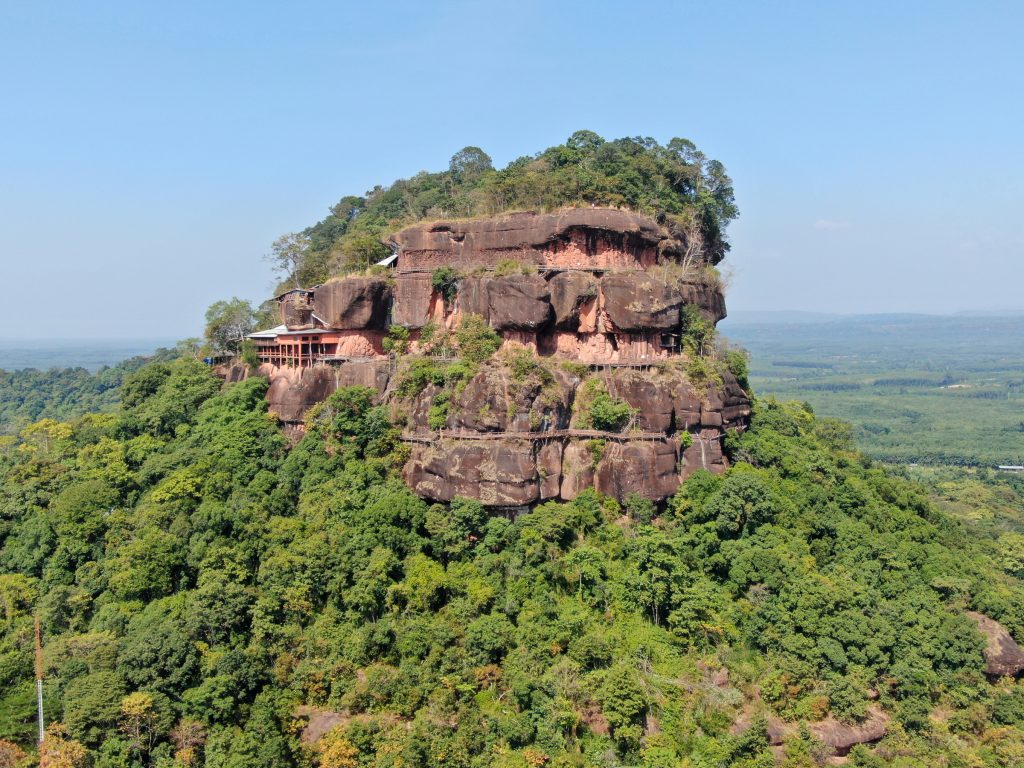
Nestled in the remote and verdant expanse of Bueng Kan province in northeastern Thailand’s Isan region lies Wat Jetiyakhiri, more commonly known by locals as Wat Phu Tok. Translating literally to "lonely mountain" in the regional Isan dialect, this solitary sandstone landform rises 359 meters above the surrounding agricultural plains. The site is globally recognized not merely for its geographical isolation, but for an ambitious, gravity-defying network of wooden staircases, ladders, and cliff-anchored walkways that encircle the peak. Designed to mirror the seven stages of Buddhist spiritual ascension, the temple complex offers a rare intersection of architectural audacity, ecological seclusion, and profound religious devotion, drawing adventurous travelers and devout pilgrims willing to navigate its perilous heights.
Historical Genesis and Architectural Evolution
The history of Wat Phu Tok is inextricably linked to the late revered meditation master, Monk Luang Pu Juan. Seeking absolute isolation, natural serenity, and an environment sufficiently rugged to challenge the human spirit, Luang Pu Juan identified the solitary mountain as an ideal sanctuary for ascetic practice. Historically, the dense surrounding jungle and sheer rocky terrain rendered the formation a hazardous habitat, heavily populated by venomous snakes and aggressive wildlife. Rather than deterring the monk, these elemental challenges aligned with the Buddhist philosophy of overcoming fear and earthly distractions to achieve higher states of consciousness.

Beginning in the late 20th century, Luang Pu Juan, alongside local devotees and monastic craftsmen, spearheaded the monumental task of carving a trail system into the sheer rock face. With minimal modern engineering equipment, laborers manually secured timber beams, constructed rudimentary ladders, and fashioned winding plank pathways along the cliff edges. These wooden arteries were systematically organized into seven distinct vertical tiers, intentionally mirroring the Buddhist doctrinal framework of the seven levels of enlightenment. While tragic circumstances—specifically the untimely passing of Luang Pu Juan in an aviation accident—claimed the life of the temple’s visionary, the monastic community and regional authorities have maintained the integrity of the wooden infrastructure, preserving Wat Phu Tok as a functioning center for Buddhist scholarship and meditation.
Geographical and Logistical Profile

Bueng Kan, officially designated as Thailand’s 77th province in 2011 after separating from Nong Khai, remains one of the country’s least commercialized and most sparsely populated regions. Located along the Mekong River basin bordering Laos, Bueng Kan offers vast open spaces, dramatic geological formations, and an authentic glimpse into rural Isan culture. Wat Phu Tok is situated approximately 30 kilometers south of Bueng Kan city, translating to a seamless 30-minute vehicular journey through rubber plantations and rural hamlets.
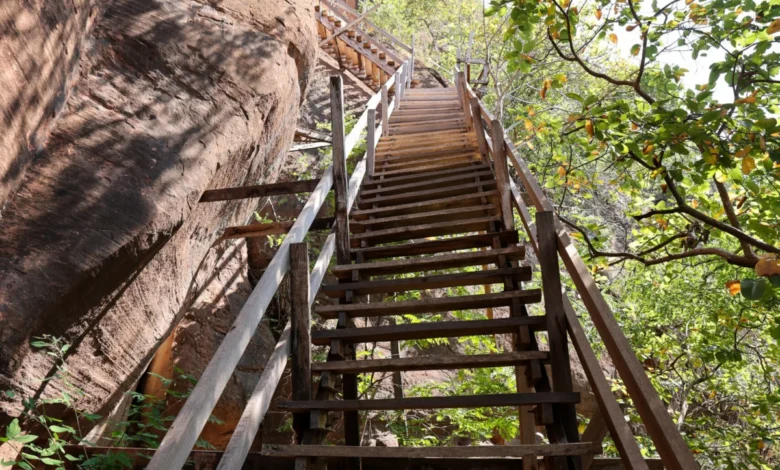
Upon arrival, visitors encounter a sprawling public park, a tranquil lake, and a secondary ground-level temple complex that serves as the administrative and communal hub for the resident monks. The ascent begins gently, guiding hikers through a formalized temple gateway before transitioning rapidly into the foundational steps of the mountain trail. The initial phases present moderate inclines constructed from solid timber planks, gradually escalating in steepness until the architecture transitions into near-vertical wooden ladders anchored directly into the sandstone cliffside. Despite the visual intimidation factor—characterized by wooden boards that may flex slightly underfoot—structural safety audits and ongoing maintenance by temple caretakers ensure the pathways remain robust and secure.

The Seven Stages of Ascent
The structural layout of Wat Phu Tok is divided into seven distinct architectural and spiritual tiers, each offering unique topographical features and varying levels of accessibility.

Levels One through Four serve primarily as transitional zones. The staircases here grow progressively steeper, navigating dense foliage and weathered rock formations. While these tiers feature minor shrines and resting points for weary travelers, monastic tradition encourages visitors to maintain their momentum toward the upper tiers where the concentration of architectural marvels resides.
The Fifth Level marks the administrative and cultural heart of the temple complex. Unlike the narrow cliffside paths of the upper and lower tiers, the fifth level broadens into substantial ground-level terrain. This expansive platform houses the primary ordination hall, alongside numerous secondary shrines, meditation cells, and monastic living quarters. A notable architectural detour branches off the main path on this level, leading adventurous visitors across a narrow elevated rock walkway and a suspension bridge to an isolated rock-face sanctuary. This secondary shrine, embedded seamlessly into the stone, represents one of the most photographed and structurally fascinating components of the entire complex.

The Sixth Level is universally acknowledged as the spatial and experiential climax of Wat Phu Tok. Comprising a half-circumference of suspended wooden plank walkways anchored horizontally into the sheer vertical drop of the red rock cliff, and a secondary half-circumference routed along natural ground, this tier tests the equilibrium and resolve of every visitor. Offering uninterrupted panoramic vistas of the Mekong River basin, the patchwork canopy of the Bueng Kan forests, and distant Laotian mountain ranges, the sixth level combines adrenaline with profound natural beauty. Architectural stability is maintained through deep steel and timber pins driven into the sandstone, though the sheer vertical drop beneath the open wooden slats demands strict spatial awareness and adherence to safety protocols.
The Seventh Level represents the physical and metaphysical summit of the mountain. Accessible via a final, demanding vertical ladder, the uppermost tier is entirely devoid of artificial shrines, tourism infrastructure, or expansive wooden boardwalks. True to its historical reputation, the seventh level remains a wild, untamed sanctuary where local wildlife, including venomous snake species, frequently roam. Monastic authorities permit access to the summit strictly at the traveler’s own risk. While the peak offers supreme isolation and elevated vantage points, the lack of developed pathways means most visitors prioritize the architectural spectacle of the sixth level over prolonged exploration of the summit.

Socio-Economic Impact and Tourism Implications
As Thailand continues to diversify its tourism portfolio away from heavily saturated coastal destinations and metropolitan hubs, remote provinces like Bueng Kan are experiencing a measured influx of domestic and international travelers. Wat Phu Tok functions as a primary economic and cultural anchor for the region, driving localized hospitality, transport, and guide services while preserving traditional Isan monastic culture.

Tourism analysts note that attractions emphasizing eco-tourism, spiritual heritage, and off-the-beaten-path adventure represent a sustainable growth sector for northeastern Thailand. However, balancing the imperatives of tourism promotion with structural safety and ecological preservation remains an ongoing priority. Local administrative bodies work in tandem with temple leadership to monitor visitor capacity along the vulnerable cliffside walkways, ensuring that the heavy foot traffic on the sixth level does not compromise the historical timber infrastructure.
Visitor Advisory and Practical Guidelines

For those planning an excursion to Wat Phu Tok, regional tourism boards and safety officials emphasize several critical logistical recommendations. Climbers are strongly advised to wear sturdy footwear with reliable traction, as morning dew and seasonal humidity can render wooden planks slippery. Due to the high physical exertion required to navigate the seven vertical tiers—particularly the nearly vertical ladders of the upper levels—individuals with severe vertigo, cardiovascular conditions, or mobility impairments are advised to limit their ascent to the ground-level complexes and the expansive fifth tier.
Furthermore, visitors must adhere strictly to local monastic customs. Modest attire covering shoulders and knees is mandatory throughout the entire temple grounds, and respectful silence must be observed near active meditation cells and shrines. By respecting these cultural protocols and exercising cautious navigation along the cliff edges, travelers can safely experience one of Southeast Asia’s most extraordinary architectural and spiritual landmarks.