Scaling the Lonely Mountain: A Journey Through Thailand’s Most Perilous Architectural Marvel

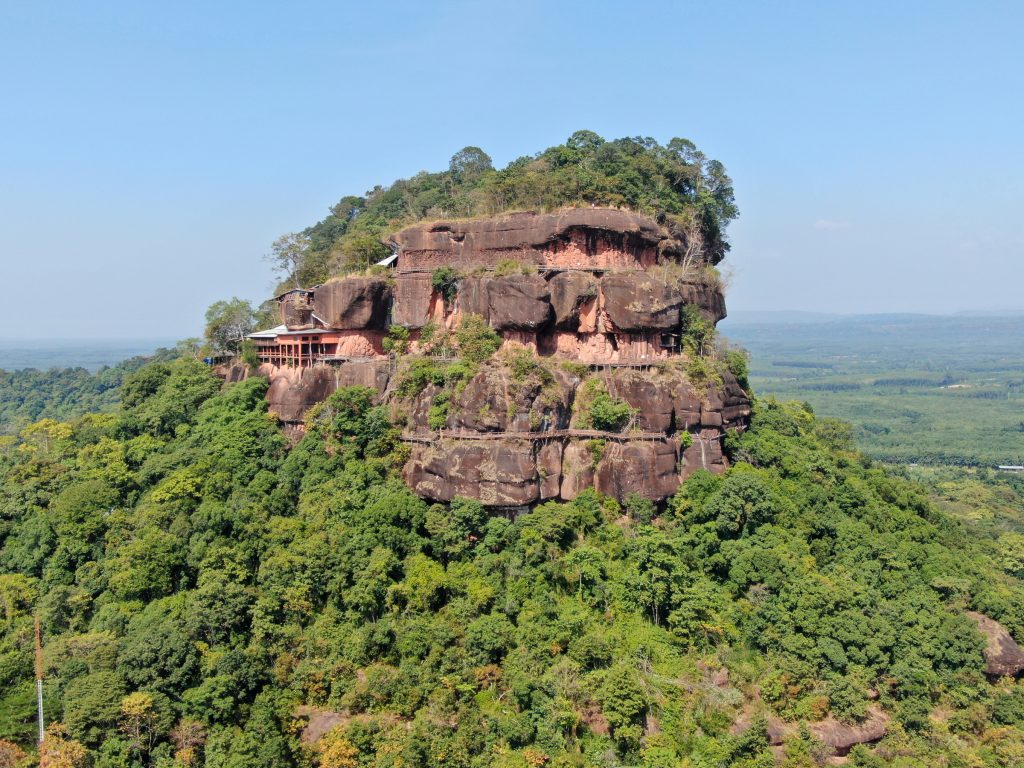
Deep within the remote northeastern Isan region of Thailand, nestled in the sparsely populated province of Bueng Kan, stands Wat Jetiyakhiri—more universally known as Wat Phu Tok. Rising 359 meters above the flat, verdant landscape, this isolated sandstone monolith has steadily gained international renown not only as a functioning Buddhist monastery, but as a masterpiece of daring vernacular engineering. Translating locally from the Isan dialect as the "Lonely Mountain," Phu Tok presents an architectural anomaly that challenges both the physical stamina and the psychological endurance of every pilgrim and traveler who dares to ascend its heights.
Architectural Marvel and Geographical Context
Wat Phu Tok cuts a striking figure against the horizon, bearing a distinct resemblance to a scaled-down version of Sigiriya, the ancient rock fortress in Sri Lanka. Situated approximately 30 minutes by road from Bueng Kan city, the site is characterized by its tranquil isolation, surrounded by endless tracts of undisturbed nature and vast expanses of the Mekong River basin.
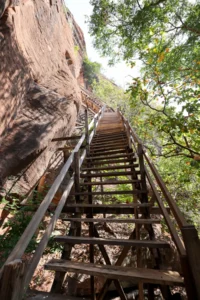
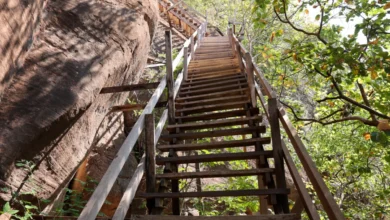
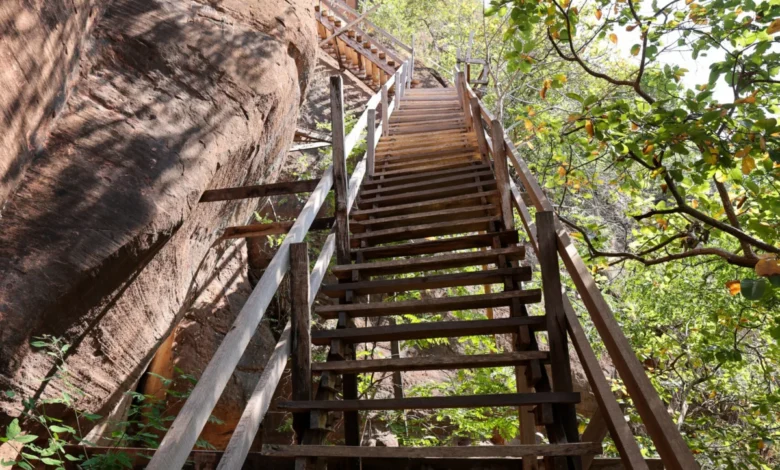
The primary defining feature of the temple complex is its intricate system of wooden staircases, vertical ladders, and suspended cliffside walkways. These structures completely encircle the monolithic red rock formation, engineered to navigate sheer vertical drops and dense jungle foliage. Unlike typical concrete tourist attractions, the pathways of Wat Phu Tok are constructed primarily from timber planks anchored directly into the rock face. As visitors ascend, these walkways frequently bow underfoot, generating a visceral sense of exposure that has earned the site its reputation as one of the most thrilling and perilous cultural attractions in the Kingdom of Thailand.

Historical Origins and Monastic Vision
The development of Wat Phu Tok is inextricably linked to the late venerable Buddhist monk Luang Pu Juan. Recognizing the inherent solitude, rugged terrain, and abundant biodiversity of the mountain, the monk identified the location as an ideal sanctuary for ascetic meditation. In Buddhist tradition, isolation and physical hardship serve as essential tools for mental discipline and spiritual transcendence.
Historically, the isolated mountain was heavily populated by wildlife, most notably dense populations of venomous snakes. This element of mortal peril aligned with the monastic philosophy of confronting fear and impermanence. To facilitate access to various meditation caves and shrines scattered across the upper elevations, Luang Pu Juan orchestrated the construction of the wooden staircases.

The architectural layout of the temple was intentionally designed around the spiritual framework of Buddhism. The mountain was systematically divided into seven distinct levels, directly corresponding to the seven stages of spiritual enlightenment and meditation. Level by level, monks and local laborers hand-built the infrastructure that now allows safe, albeit terrifying, passage across the precipice. Tragically, Luang Pu Juan did not live to see the complete realization of his sanctuary; the founding monk perished in a widely publicized domestic aviation accident. Despite his passing, the monastic community and local authorities have maintained the integrity of the wooden pathways, preserving the site as both an active place of worship and a monument to its founder’s vision.
Navigating the Seven Levels
A visit to Wat Phu Tok is structured as a vertical progression through increasingly dramatic environments, each level offering distinct architectural and spiritual features.

The journey begins at the base of the mountain, where a sprawling park, a large temple complex, and a serene lake greet arrivals. The initial ascent starts innocuously enough, featuring wide, stable ground-level trails that transition rapidly into wooden staircases. While the stairs gradually steepen into nearly vertical ladder formations, the foundational stability remains robust, engineered to withstand the monsoon climate of northeastern Isan.
The lower tiers of the mountain house modest shrines and quiet resting points, serving primarily as transitional zones for the physical climb. However, upon reaching the fifth level, the spatial dynamics shift significantly. Level five features the largest concentration of permanent structures within the complex, including the primary ordination hall. Unlike the narrow cliffside paths above, the fifth level comprises wide, ground-level clearings that accommodate multiple temples and monastic quarters.

Branching off the main trails on the lower-to-middle tiers, visitors frequently encounter hidden rock-carved sanctuaries. A notable detour requires traversing an elevated stone walkway that leads across a narrow wooden suspension bridge to a secluded shrine cantilevered directly over the abyss. This detour highlights the unique integration of religious architecture with the natural geological topography of the sandstone formation.
The Climactic Ascent: Levels Six and Seven
The sixth level of Wat Phu Tok represents the climax of the architectural experience and the primary focal point for adventurous travelers. Roughly half of the circumference of the sixth level consists of cantilevered wooden walkways bolted directly into vertical rock cliffs. Walking this path requires acute spatial awareness; visitors must maintain concentration, as a misstep on the narrow planks above the sheer drop could result in fatal consequences. Despite the visual intimidation, structural engineers and regular maintenance crews ensure the timber remains secure.

From the sixth-level cliffside pathways, visitors are rewarded with panoramic, unobstructed vistas of the surrounding Bueng Kan province and the distant Mekong River basin. The elevated perspective captures a patchwork of agricultural lands, dense forests, and rural homesteads, accompanied by a consistent, cooling mountain breeze.
The final ascent leads to the seventh level, the summit of the Lonely Mountain. True to its historical reputation, the seventh level remains largely wild and untamed. Devoid of the intricate wooden walkways and manicured shrines found on lower tiers, the top of the mountain is characterized by dense brush and serves as a natural habitat for local wildlife, including venomous snakes. Local authorities and temple guardians explicitly warn visitors that access to the seventh level is undertaken entirely at one’s own risk. While the summit offers additional vantage points for those who reach the apex, travel analysts and tourism boards generally emphasize that the architectural and cultural peak of the pilgrimage is definitively achieved on the sixth level.

Socio-Economic Impact and Tourism Implications
As one of the least populated and historically overlooked provinces in Thailand, Bueng Kan has long sought sustainable avenues to stimulate local economic development without compromising its natural tranquility. The designation of Bueng Kan as an official province in 2011—carved out of neighboring Nong Khai—spurred regional infrastructure improvements designed to draw domestic and international travelers away from saturated hubs like Chiang Mai or Phuket.
Wat Phu Tok serves as a primary anchor for regional tourism in Isan. Economically, the steady influx of travelers supports small-scale hospitality ventures, guesthouses, and culinary businesses within Bueng Kan city and the immediate surrounding districts. However, tourism analysts note that the remote geographical location of the province acts as a natural buffer against over-tourism, preserving the quiet, meditative atmosphere that originally drew Luang Pu Juan to the mountain.

From a structural perspective, maintaining a complex wooden engineering marvel anchored to a vertical sandstone cliff presents ongoing logistical and financial challenges. Regional administrative bodies, in coordination with the resident monastic community, allocate resources for continuous timber replacement and safety inspections to mitigate the liabilities associated with high-altitude tourism.
Ultimately, Wat Phu Tok stands as a testament to the intersection of human engineering, religious devotion, and raw geography. By transforming a forbidding, snake-infested monolith into a vertical map of Buddhist enlightenment, its builders created an enduring destination that continues to test the boundaries of travelers seeking off-the-beaten-path experiences in Southeast Asia.
Related posts: