Conquering Wat Phu Tok: Thailand’s Architectural Wonder and the Seven-Level Ascent Into Isan’s Isolated Wilderness

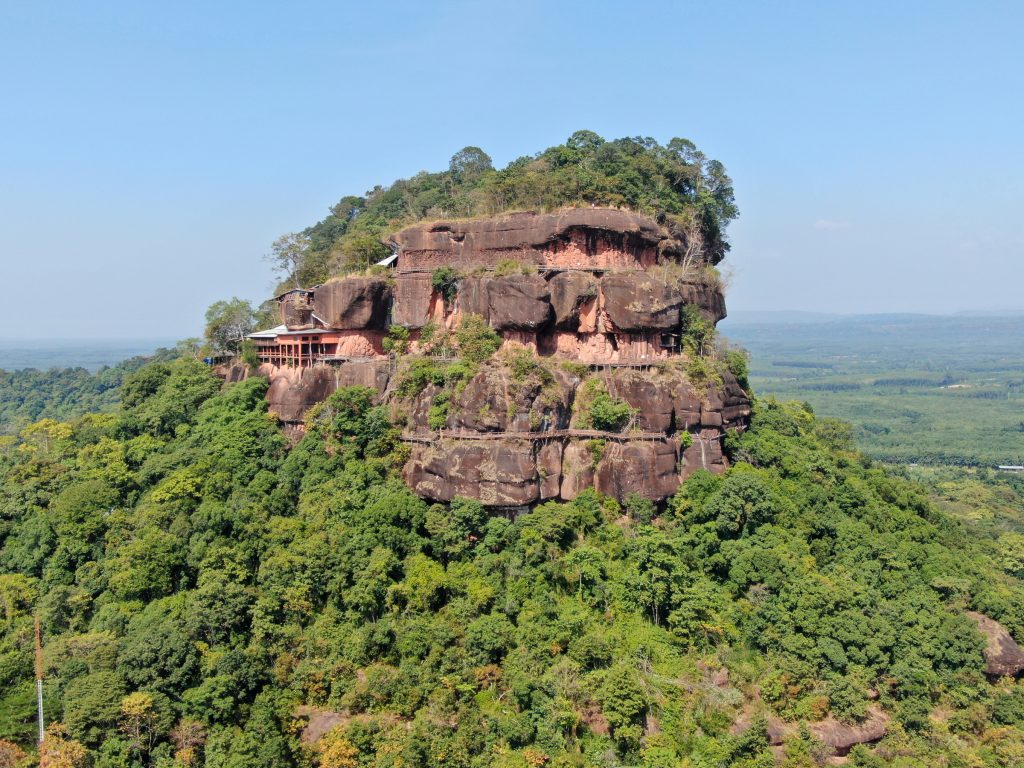
Nestled deep within the remote and tranquil landscapes of Thailand’s northeastern Isan region, Bueng Kan province houses one of the kingdom’s most extraordinary architectural and spiritual feats: Wat Jetiyakhiri, universally recognized as Wat Phu Tok. Rising 359 meters above the surrounding flatlands, this isolated red sandstone inselberg—whose name translates literally from the local Isan dialect as the "lonely mountain"—presents a formidable blend of engineering ingenuity and Buddhist devotion. Featuring a dizzying labyrinth of wooden staircases, vertiginous cliff-side walkways, and secluded meditation shrines suspended over sheer drops, the temple offers an experience that tests the limits of equilibrium while providing a profound encounter with nature and spirituality.
Main Facts and Geographic Overview
Wat Phu Tok stands as the defining landmark of Bueng Kan, Thailand’s seventy-seventh province, which was established as a distinct administrative entity in 2011 after separating from Nong Khai. Located approximately a 30-minute drive from Bueng Kan city, the temple grounds sprawl across the base of a solitary geological formation that immediately draws comparisons to a scaled-down version of Sigiriya in Sri Lanka.

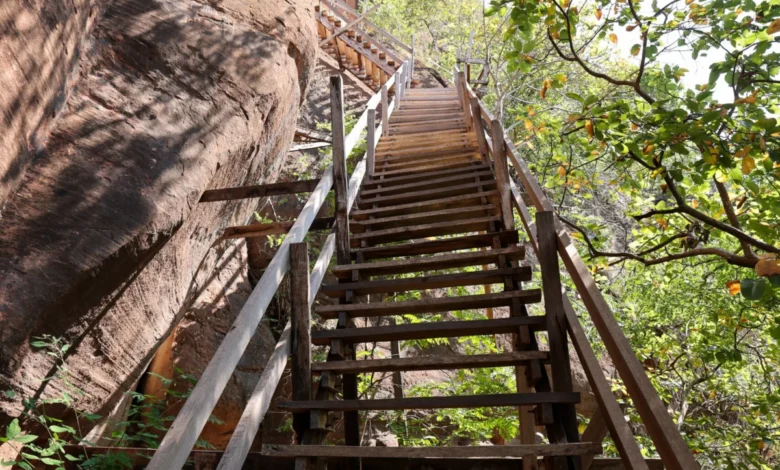
The site is anchored by a large temple complex, a serene lake, and expansive parklands at the foot of the mountain. However, the true focal point of Wat Phu Tok is its intricate ascent system. Constructed entirely of hand-built wooden planks and support beams anchored directly into the vertical rock face, the trail system winds its way upward across seven distinct tiers. These levels are structurally and philosophically designed to mirror the seven stages of spiritual purification and enlightenment in Buddhist doctrine. While the initial ascent begins as a manageable series of dirt paths and timber stairs, the route progressively steepens, eventually transforming into ladder-like configurations and cliff-hugging boardwalks that hover hundreds of feet above the sweeping Mekong River basin.
Historical Origins and Construction Chronology

The history of Wat Phu Tok is deeply intertwined with the ascetic traditions of Thai Buddhism and the vision of a revered forest monk. Decades ago, the rugged, snake-infested terrain of the isolated mountain made it virtually impassable to the general public. Yet, its extreme remoteness and profound silence rendered it an ideal environment for solitary meditation and spiritual endurance.
The monumental task of transforming the perilous mountain into a sanctuary of learning and devotion was spearheaded by the late monk Luang Pu Juan. Recognizing the potential of the terrain to serve as a physical manifestation of the spiritual path, Luang Pu Juan organized local laborers and fellow monastics to begin construction. Over the years, the team meticulously engineered a network of wooden staircases, vertical ladders, and suspended walkways that bridged chasms and connected distant rock shelters.

This multi-year construction chronology culminated in the establishment of the seven-tiered structure. Each level served a specific purpose, transitioning from base encampments and rudimentary meditation cells to sophisticated multi-hall complexes on the mid-levels, and ultimately reaching the desolate, highly restricted summit. Though the founding patriarch, Luang Pu Juan, tragically perished in a domestic commercial aviation accident in 1980—an event that deeply mourned the regional monastic community—his monumental legacy has been continuously preserved and maintained by succeeding generations of monks and local administrative bodies.
Architectural Progression and Tier-by-Tier Breakdown

Navigating Wat Phu Tok requires a methodical journey through its meticulously demarcated levels, each offering distinct architectural features and environmental hazards.
Levels one through four serve primarily as a transitional zone. The terrain shifts from packed earth to increasingly steep wooden steps that bow slightly underfoot, testing the visitor’s confidence. These lower tiers feature intermittent shrines and grottoes carved into the stone, though monastic guidelines encourage climbers to press onward to the more structurally significant elevations.

Upon reaching the fifth level, the architectural density of the temple dramatically increases. Unlike the narrow cliffside paths of the upper tiers, the fifth level features wide, ground-level expanses containing the mountain’s primary ordination hall (Ubosot) and numerous secondary shrines. This level acts as a central hub where monastics and pilgrims congregate. It also provides access to a celebrated detour: an elevated stone walkway bridging the main mountain mass to an isolated rock temple perched on a distant outcrop. This detour delivers sweeping panoramic views before directing travelers toward the psychological crucible of the ascent.
The sixth level is universally acknowledged as both the architectural masterpiece and the most perilous segment of Wat Phu Tok. Spanning roughly half the mountain’s circumference, the trail on this level consists entirely of narrow wooden plank walkways bolted directly into the vertical sandstone cliffs. With sheer drops measuring hundreds of meters on one side and cold stone on the other, the pathway demands absolute concentration. Despite inducing vertigo in even seasoned travelers, structural engineering assessments note that the heavy timber framing is rigorously maintained by temple caretakers to ensure load-bearing stability. From this vantage point, climbers are rewarded with unobstructed, 360-degree vistas encompassing the verdant canopy of Bueng Kan and the distant waters defining the borderlands.

The ascent culminates at the seventh level, the summit of the mountain. Known historically as a natural habitat for various species of venomous snakes, this top tier is approached by visitors strictly at their own risk. Devoid of the intricate wooden infrastructure or religious shrines found on the lower levels, the summit is a wild, untamed expanse of rock and brush that offers a final, unobstructed perspective of the vast Isan topography.
Socio-Economic Implications and Tourism Impact

The ongoing accessibility of Wat Phu Tok highlights a broader economic strategy within Thailand’s tourism sector: the promotion of secondary and tertiary provinces to distribute visitor traffic away from saturated urban and coastal hubs. Bueng Kan, historically reliant on rubber plantations and cross-border trade with Laos, has seen a steady influx of domestic and international travelers drawn specifically to off-the-beaten-path ecological and religious attractions like Wat Phu Tok.
Regional tourism boards and hospitality providers have noted that while the sheer physicality of the temple limits mass-market bus tours, it has successfully attracted a dedicated demographic of adventure tourists, nature photographers, and cultural heritage enthusiasts. This specialized tourism injects vital capital into local accommodations, dining establishments, and transport services in Bueng Kan city, fostering sustainable economic diversification.

Safety Protocols and Recommendations for Visitors
Local authorities and temple administrators maintain strict advisories regarding safety, given the hazardous nature of the elevated wooden structures. Visitors are strongly advised to wear appropriate footwear with high traction, as morning dew and seasonal rainfall can render the wooden planks slick. Furthermore, health officials recommend that individuals with severe acrophobia, cardiovascular conditions, or mobility impairments abstain from attempting the upper tiers beyond the fifth level.

As Wat Phu Tok remains an active place of worship and a functioning Buddhist monastery, travelers are expected to adhere to standard Thai temple etiquette, including modest dress that covers the shoulders and knees, as well as maintaining a respectful, quiet demeanor along the meditation paths. Through a delicate balance of preservation, spiritual dedication, and calculated risk management, Wat Phu Tok endures as a testament to human determination and architectural harmony with the natural world.