The Ultimate Guide to Berlin Christmas Markets: History, Dates, and Top Locations for the Holiday Season

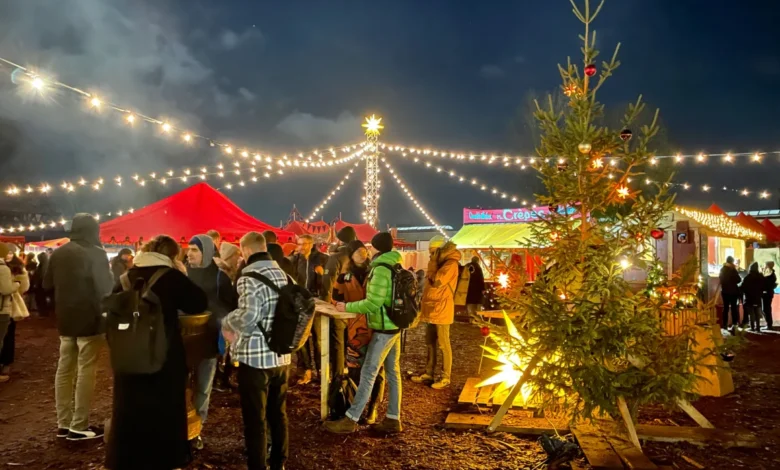
The German holiday season is characterized by a distinctive cultural phenomenon that transforms public squares and historical courtyards into vibrant centers of community life: the Christmas market, known locally as the Weihnachtsmarkt or Adventsmarkt. While cities such as Munich, Nuremberg, and Stuttgart are historically renowned for their singular, centuries-old central markets, the German capital presents a decentralized alternative. Berlin features roughly 70 distinct Christmas markets scattered across its diverse neighborhoods, offering an expansive array of experiences that blend centuries-old traditions with the city’s contemporary, eclectic identity.
Historical Evolution of Berlin’s Holiday Markets
Unlike traditional German urban centers structured around a single, dominant market square, Berlin’s modern layout reflects its complex geopolitical history and lack of a unified historical city center. Consequently, holiday celebrations developed organically across distinct boroughs, resulting in a rich tapestry of localized markets rather than a monolithic civic event.

Historically, Berlin’s markets lagged behind southern German counterparts in terms of international renown. However, over the past two decades, the capital has cultivated a distinct holiday culture. Today’s markets range from high-end artisan bazaars set against neoclassical backdrops to alternative, community-driven winter festivals hosted along the Spree River. This decentralization allows visitors to experience varying facets of German holiday traditions without traveling between different municipalities.
Chronology and Operating Schedules

The Berlin Christmas market calendar generally follows a standardized operational timeline tied to the Christian liturgical season of Advent. The vast majority of Berlin’s holiday markets open their gates in late November—typically the Monday following the Protestant Sunday of the Dead (Totensonntag)—and continue operations through December 23 or 30. A select few extend their festivities into the New Year.
Because Berlin experiences a pronounced winter climate with sunset occurring before 4:00 p.m. throughout December, the operational window heavily favors evening visits. Atmospheric illumination, featuring thousands of twinkling lights and carefully curated architectural lighting, serves as a primary draw for both residents and international travelers.

Prominent Traditional and Architectural Markets
For travelers seeking classic German holiday architecture and high-end craftsmanship, several prominent markets serve as anchor points during the Advent season.

WeihnachtsZauber Gendarmenmarkt
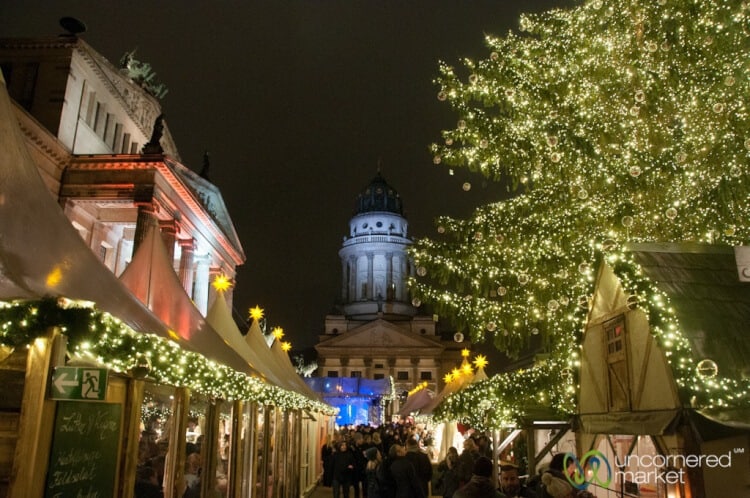
Positioned between the monumental structures of the Deutscher Dom, the Französischer Dom, and the Konzerthaus Berlin, the Gendarmenmarkt market offers a visually striking setting. This market distinguishes itself through a rigorous selection process for vendors, prioritizing luxury handicrafts, fine art, and gourmet culinary offerings over mass-produced goods. Visitors frequently gather around the central tent to consume traditional feuerzangenbowle—a punch made of red wine, rum, and burnt sugar—or order warm beverages mit schuss, indicating the addition of a spirit such as rum or amaretto. A nominal entrance fee of one euro is typically charged to support local cultural initiatives.
Schloss Charlottenburg Christmas Market
Situated in the shadows of Berlin’s largest surviving royal palace, the Schloss Charlottenburg market provides a distinct baroque aesthetic. Constructed over 300 years ago, the palace grounds host massive traditional Christmas pyramids, festive light displays, and high-end culinary chalets, offering a distinctly regal atmosphere within the Charlottenburg-Wilmersdorf district.
Regional and Thematic Variations
Beyond traditional German markets, Berlin’s multicultural demographics and architectural diversity have inspired specialized cultural events.

Lucia Christmas Market at Kulturbrauerei
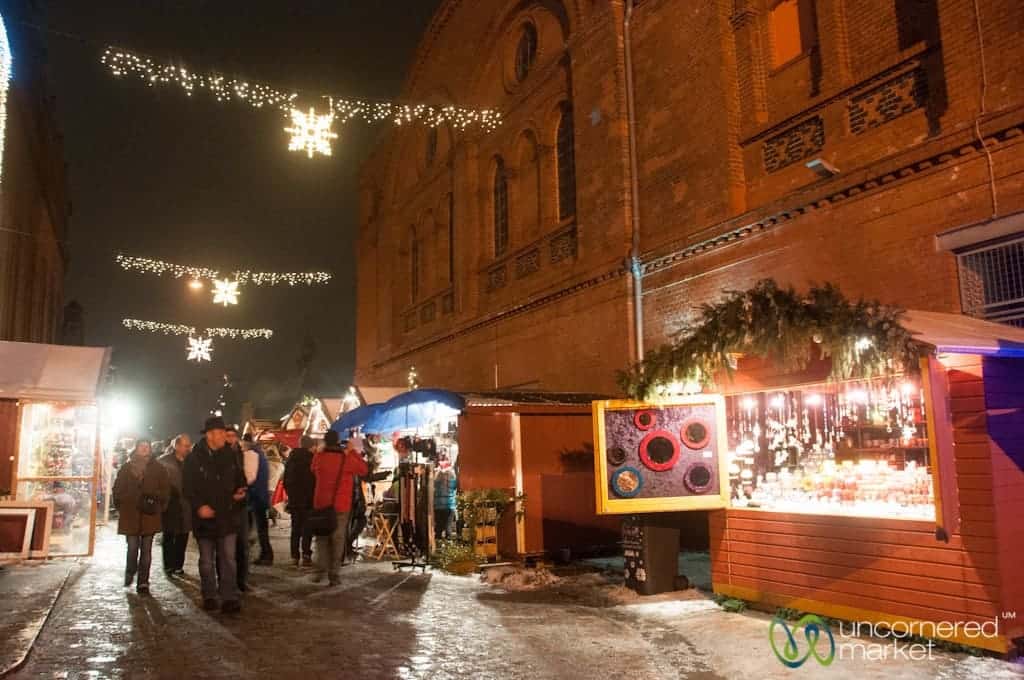
Located in the Prenzlauer Berg district within a 19th-century red-brick industrial brewery complex, the Lucia Christmas Market focuses entirely on Nordic and Scandinavian traditions. Named after the Swedish festival of light, the market features authentic Scandinavian mulled wines (glögg), reindeer meat specialties, and open-air fire loungers set within the winding courtyards of the historic industrial site.
Historical Christmas Market at RAW Cultural Center
For visitors interested in historical reenactment, the Friedrichshain district hosts a medieval-themed market on the grounds of the RAW urban cultural site. Complete with hand-operated wooden carousels, archery ranges, axe-throwing stations, and heavy ceramic mugs filled with hot mead or spiced wine, this market intentionally recreates a pre-modern village atmosphere.

Neighborhood and Weekend-Only Communities
In addition to major installations running throughout Advent, Berlin’s boroughs host localized weekend markets organized by community groups, schools, and civic associations.

Alt-Rixdorfer Christmas Market
Held for only a single weekend in early December at Richardplatz in Neukölln, the Alt-Rixdorfer market exemplifies community-driven festive programming. Local charities, schools, and volunteer organizations operate the stalls, selling handmade goods to raise funds for social causes. The historic village green and surrounding smithy provide an authentic backdrop complete with pony rides and historical demonstrations.
Heissa Holzmarkt
Positioned along the Spree River in Friedrichshain, Holzmarkt transforms its year-round creative community space into an urban winter festival during Advent weekends. Combining traditional elements with contemporary Berlin culture, the market features riverfront bonfires, silent disco installations, international street food, and independent art displays.

Economic and Cultural Implications
The proliferation of Christmas markets across Berlin generates significant seasonal economic activity, driving tourism, hospitality revenue, and local artisan sales during the slowest quarter of the retail year. City tourism authorities estimate that hundreds of thousands of domestic and international visitors frequent the capital specifically for the winter markets, providing a critical financial boost to small businesses, independent craftspeople, and the gastronomy sector.

However, the rapid expansion of these markets—surpassing 70 distinct locations in recent years—has prompted municipal discussions regarding commercialization and crowd management. While suburban and neighborhood initiatives like Schloss Britz or Domäne Dahlem maintain an intimate, community-focused ambiance, central locations often manage heavy pedestrian traffic, requiring careful logistical planning by city authorities.
Practical Planning for Visitors

Travelers planning a winter excursion to Berlin should review specific operational dates in advance, as weekend-only markets operate on strict, limited schedules compared to city-wide fixtures. Accommodations in central districts such as Mitte, as well as culturally vibrant neighborhoods like Kreuzberg, Friedrichshain, and Neukölln, provide optimal access to the capital’s extensive public transit network, ensuring seamless travel between the city’s diverse winter attractions.
Related posts: