Palisade, Colorado, renowned for its abundant fruit orchards and burgeoning wine region, offers a unique and invigorating way to explore its scenic landscape and award-winning vineyards: by bicycle. This guide provides a comprehensive overview for visitors planning a cycling wine tour, detailing everything from rental logistics and route planning to accommodation and local insights, ensuring a memorable and safe experience.
Securing Your Two-Wheeled Transport
The journey through Palisade’s wine country often begins with securing reliable transportation. For visitors without their own bicycles, Palisade Cycle and Shuttle is the primary provider of rental services. Daily rentals for a standard cruiser bike are priced at $45, while an electric-assist model is available for $55. Upon arrival for bike pickup, customers will receive a detailed map of the area’s wineries, along with crucial information regarding current biking conditions and potential hazards. This proactive approach by rental companies aims to equip cyclists with the knowledge needed for a safe and enjoyable ride. For those seeking maps independently, the Palisade Chamber of Commerce also offers these resources.
A critical piece of advice for any cyclist embarking on a wine tour in Palisade, especially during the summer months, is to prioritize hydration. Temperatures regularly ascend into the upper 90s Fahrenheit, and the combination of physical exertion from cycling and alcohol consumption from wine tastings can lead to rapid dehydration. Experts consistently recommend carrying a hydration pack, such as a CamelBak, filled with cold water. Sipping water consistently throughout the ride not only mitigates the risk of dehydration but also significantly reduces the likelihood of experiencing a severe hangover, a common consequence of overindulgence in warm weather. This simple yet vital practice ensures that the focus remains on enjoying the wine and scenery, rather than managing the after-effects of insufficient hydration.
Charting Your Course: The Fruit & Wine Byway
The designated routes through Palisade’s wine country are primarily on paved roads, offering a generally smooth cycling experience. However, it’s important to note that many of the driveways leading directly into the vineyards are unpaved, often consisting of gravel or rock. Standard cruiser bikes are well-equipped to handle these conditions. The entire network is clearly marked with signs identifying it as the "Fruit & Wine Byway," a system designed to guide cyclists seamlessly between destinations and highlight points of interest. These markers are invaluable for navigation, preventing missed turns and directing riders to scenic overlooks, such as the iconic Book Cliffs rock formations and the meandering Colorado River as it flows through the Grand Valley.
The Fruit & Wine Byway encompasses three distinct organized routes. Two are categorized as "easy cruisers," designed for a more relaxed pace, while one route is considered a challenge, even for experienced cyclists, particularly when contending with high temperatures. For those returning to cycling after a hiatus or new to the region, the West Cruiser Loop is the recommended starting point. This route offers numerous opportunities for brief respites, with town parks and lodging facilities conveniently located nearby.
A key characteristic of the Palisade wine touring experience is the proximity of tasting rooms. Cyclists will rarely find themselves riding for more than ten minutes without encountering a potential stop. In many instances, tasting rooms are situated less than a mile apart. This close clustering encourages a leisurely pace, but it also presents a strategic consideration for riders aiming to maintain clarity of mind. Visiting every winery along a route may prove counterproductive if the goal is to fully appreciate each tasting. Furthermore, it’s important to be aware that not all tasting rooms offer food services. The majority of the town’s restaurants are concentrated in the small downtown area surrounding the main bike rental shops. Therefore, carrying snacks or packing a picnic lunch is a prudent measure for those planning extended rides or wishing to avoid potential hunger pangs between winery visits.
The West Cruiser Loop: A Palate-Pleasing Circuit
The West Cruiser Loop stands as the most popular cycling route in Palisade, renowned for its flat terrain and gentle gradients. This seven-mile roundtrip journey from downtown Palisade offers an intimate tour of the town as it winds its way between seven distinct wineries. A particularly inviting stop on this loop is Riverbend Park, providing a welcome opportunity to rest weary legs and seek refuge from the heat beneath the shade of mature cottonwood trees.
This route also boasts the greatest diversity in terms of wine offerings and tasting room experiences. Departing from Palisade Cycle and Shuttle, cyclists will navigate through downtown to reach establishments like The Ordinary Fellow and Grand River Vineyards. The Ordinary Fellow distinguishes itself by offering a broad selection of fruit wines alongside classic varietals such as Cabernet Sauvignon and Chardonnay. Grand River Vineyards, conversely, specializes in dry red and white wines, with notable mentions for their Viognier and Meritage white blends.
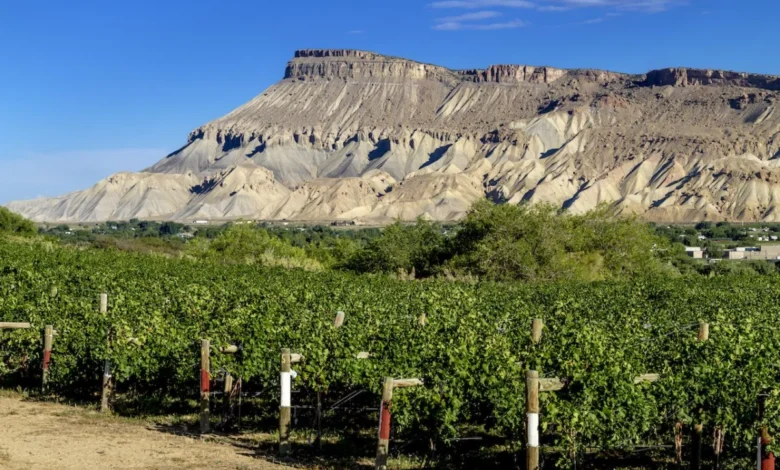
A unique stop on the West Cruiser Loop is Cliff Dweller Wine Co., celebrated for its Malbec. The tasting room’s patio provides breathtaking panoramic views of Mt. Garfield, an iconic desert peak that dominates the landscape northwest of town. Regardless of the specific tasting rooms chosen, the loop culminates harmoniously at Maison La Belle Vie. This French-inspired establishment features an extensive collection of predominantly red wines and offers pastries, providing a welcome source of energy for the ride back to town. A particular highlight is their Vin de Pêche, crafted from Palisade’s famously succulent peaches, a fruit for which the region is arguably even more renowned than its wine.
The East Cruiser Loop: Scenic Vistas and Varietals
The East Cruiser Loop is an excellent choice for cyclists who wish to immerse themselves in the region’s high-desert scenery, with wine tasting serving as a delightful accompaniment. The route meanders past expansive vineyards and orchards, leading to the first tasting room, Colterris. As the largest winery operation in the valley, Colterris offers the distinctive option of purchasing their wines in both cans and bottles, catering to various preferences.
From Colterris, the route follows US-6 alongside the Colorado River to reach Bookcliff Vineyards. This newer tasting room is recognized for its full-bodied Malbec, a testament to the region’s high-altitude grape-growing capabilities. While Colterris and Bookcliff are the sole tasting rooms directly on this loop, a brief ten-minute ride through downtown from Bookcliff provides convenient access to TerraVin Cellars. Opting for a route with fewer wineries allows for a more leisurely pace and the opportunity to fully savor each tasting experience.
The East Orchard Mesa Loop: A Challenging Ascent and Diverse Flavors
For those seeking a more vigorous workout alongside their wine exploration, the East Orchard Mesa Loop presents an enticing challenge. This 25-mile roundtrip excursion builds upon the East Cruiser Loop, commencing where it concludes. Instead of crossing the river, riders turn left just before it onto 38 Road, beginning the ascent onto East Orchard Mesa, following the Fruit & Wine Byway signs toward Talbott’s and Carlson Vineyards. The initial climb to the mesa is the route’s sole significant incline, a demanding, approximately ten-minute ascent. A dedicated bicycle sidewalk is available, which cyclists should utilize to maintain separation from vehicle traffic and to pause and recover their breath if needed. The loop then descends the mesa, rejoining a portion of the West Cruiser Loop on its return journey into downtown Palisade.
Atop the mesa, Talbott’s Cider Company offers a welcome respite from grape-based beverages with glasses of crisp hard cider, available in a range of flavors from peachy to hoppy. Talbott’s also boasts an on-site farmer’s market, offering a selection of fresh local fruits and vegetables, ideal for packing into a backpack for later enjoyment.
Continuing from Talbott’s, the route on East Orchard Mesa is characterized by a series of precise, right-angle intersections surrounded by orchards, creating a navigational experience akin to following an intricate map. The tasting rooms are clearly signposted. Even if the entire loop is not completed, a push to Restoration Vineyards is highly recommended. This tasting room, which opened last fall, is home to what is widely considered the valley’s finest Sauvignon Blanc. Also noteworthy is their Barbera, a rich red wine with pronounced blackberry notes and a smooth finish. Further along, Carlson Vineyards features a small tasting room that evokes the intimacy of sampling wine in a winemaker’s home kitchen. Their "NSFW" (Not Safe For Work) Red and Rosé are particularly popular choices, serving as excellent options for a nightcap.
Alternative Exploration: Beyond the Bicycle
For those who prefer not to cycle, Palisade offers alternative methods for experiencing its wine country. Whitewater Hill Winery, often cited as one of the finest in Palisade, embodies the region’s deep agricultural roots and mastery of viticulture. However, reaching it by bicycle involves a considerable 24-mile roundtrip ride. For visitors with a designated driver, parking is available at all tasting rooms.
While a horse and carriage can provide a leisurely mode of transport, it is considerably slow and requires careful planning to ensure sufficient wine is available for the journey. A more novel and stylish option is provided by Pali-Tours. This unique service offers rides through town in a distinctive 6×6 military "duckie," a far more engaging experience than a conventional limo. Pali-Tours also offers a "Water to Wine" package, which combines an afternoon of wine touring with a morning rafting excursion on the Colorado River, appealing to those seeking a blend of adventure and indulgence.
Accommodation: Immersing in the Local Vibe
Palisade’s accommodation options reflect the town’s character: century-old bed and breakfasts, a relaxed pace of life, and a high likelihood of interacting directly with the proprietors who may also be pouring your wine. While chain hotels are available in nearby Grand Junction, booking accommodation within Palisade itself offers a more authentic immersion into Colorado’s wine country experience.
The Wine Country Inn, situated adjacent to two highly regarded wineries, features a grand Victorian-style lodge with 80 guest rooms. It provides a hot breakfast and hosts guest tastings each afternoon. Located directly downtown, the Wine Valley Inn is a bed and breakfast characterized by a spacious porch and an outdoor tasting area. Its central location ensures easy access to the town’s shops and restaurants on foot. For a more contemporary stay, the Spoke and Vine Motel offers modern, clean rooms, and importantly, has on-site bike rentals, eliminating the need for separate arrangements with a bike shop.
Deciphering Palisade’s Unique Street Naming Convention
A distinctive feature of Palisade is its unconventional street naming system. Visitors will encounter roads labeled with numbers, such as "29 Road," and more peculiar designations like "36 3/10 Road." This system is not an arbitrary exercise in mathematics but rather a logical, geographically-based grid. Roads running north to south are numbered according to their distance in miles from the Colorado-Utah border. For instance, "36 3/10 Road" is located 36.3 miles west of the border. Consequently, a mile separates consecutive numbered roads, with "29 Road" being one mile west of "28 Road."
East-west streets, conversely, are designated by letters, with each letter representing a mile. Therefore, a turn onto "F 1/4 Road" signifies a location a quarter-mile north of "F Road" and three-quarters of a mile south of "G Road." This highly unusual system was originally conceived as a straightforward method for identifying farm plots and has evolved into a unique characteristic of the Palisade landscape.