Two Decades of Metadata Bias: How Hurricane Katrina Photo Captions Standardized a Flawed Legacy of Visual Journalism

Two decades after Hurricane Katrina submerged New Orleans, a digital archival relic remains frozen on Getty Images and Associated Press databases, serving as a permanent textbook example of caption bias in modern photojournalism. Getty Images image number 53509740 continues to feature its original August 29, 2005 description: "Two residents wade through chest deep water after finding bread and soda from a local grocery store after Hurricane Katrina came through the area on August 29, 2005 in New Orleans, Louisiana." Side-by-side in news streams two decades ago, an Associated Press photograph captured a young Black man similarly navigating chest-deep water while carrying a case of Pepsi and a full garbage bag, but with a starkly different editorial designation: he was labeled a looter.
This juxtaposition of two nearly identical survival actions—one labeled as "finding" for lighter-skinned subjects and the other as "looting" for a young Black man—sparked a global controversy that persists today. Yet, examining the mechanics behind these historical metadata entries reveals a much deeper, structural vulnerability within digital news dissemination: the invisible, unchecked power of the photo caption field. Two photographers working under catastrophic conditions typed single verbs into metadata fields, and those unchecked verbs were instantly transmitted to millions of screens worldwide, setting a dangerous precedent for how digital journalism handles emergency reporting.
Chronology of a Crisis: August 29–September 2, 2005
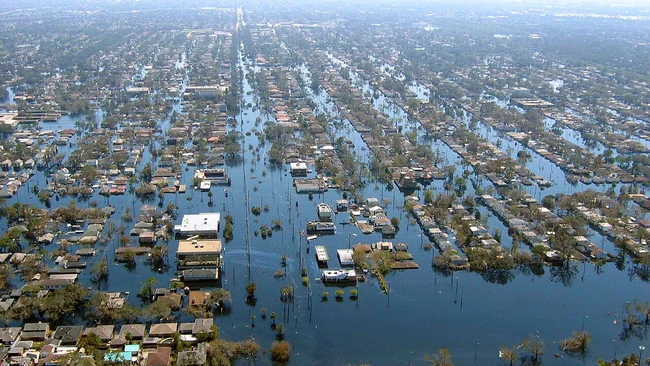
The dissemination of these contrasting images unfolded rapidly during the immediate aftermath of Hurricane Katrina, a disaster that breached New Orleans’ levees and left 80 percent of the city underwater.
On August 29, 2005, Hurricane Katrina made landfall along the Gulf Coast, resulting in catastrophic infrastructure failures, widespread devastation, and thousands of stranded residents. Amidst the rising floodwaters, photojournalists deployed across the metropolitan area to document the unprecedented humanitarian crisis.
By August 30, 2005, photographs from the field began populating aggregator platforms like Yahoo News. Dave Martin, an experienced Associated Press staff photographer, captured the frame of the young Black man in chest-deep water. Simultaneously, Chris Graythen, working for AFP and Getty Images, photographed two residents—identified later by publications like Salon as a white man and a light-skinned woman—retrieving items from the water near a deeply flooded grocery store.
On August 31, 2005, public backlash began mounting across online forums. At 6:10 p.m., Chris Graythen posted a detailed defense on the SportsShooter message board. Displaced, exhausted, and having eaten his first real meal in three days, Graythen explained that the items were floating freely from a store with over five feet of water and no doors, noting that the goods would have drifted away regardless. He emphasized that the subjects were simply retrieving floating provisions rather than forcing entry into a business.
By September 2, 2005, Salon magazine published an investigation reaching out to the major news agencies for accountability. Jack Stokes, AP’s director of media relations, defended Martin’s caption, stating that the photographer had witnessed the individual take the goods from the shop. Santiago Lyon, AP’s director of photography, outlined the wire service’s operational standard at the time: entering a business and taking goods was classified as "looting," whereas simply carrying items down a road was termed "carrying items." Meanwhile, Getty’s representatives acknowledged that Graythen had discussed his frame with an editor, affirming that without witnessing an explicit theft, the photographer could not confirm looting. Yahoo’s public relations management famously dismissed editorial oversight regarding wire metadata, stating flatly, "We don’t edit photo captions."
Examining the Metadata Pipeline: How Wire Captions Travel
To understand how these contrasting labels survived unedited, one must examine the technical architecture of digital image distribution. A photo caption is not merely a piece of accompanying editorial text typed into a webpage; it is embedded directly into the file’s metadata structure. Under the International Press Telecommunications Council (IPTC) standard, this resides in legacy specification fields such as Description/Abstract (property 2:120) with a historical 2,000-byte ceiling, accompanied by a Description Writer field (property 2:122) designated for author initials.
This metadata travels inside the image file itself and moves alongside structured feeds directly into subscribers’ publishing content management systems (CMS). When news aggregators pull from agency feeds, automated systems frequently render web pages straight from these database fields without human intervention. In 2005, Brian Nelson’s assertion that Yahoo did not edit photo captions was not an admission of journalistic negligence, but rather an accurate description of high-volume digital aggregation pipelines. Because manual verification of thousands of incoming visual files daily is economically unfeasible at scale, the initial characterization typed by a photographer standing in contaminated floodwaters instantly becomes the immutable truth across every digital platform the image touches.
Official Responses and Policy Evolution
In the two decades following Hurricane Katrina, major news organizations have revised their editorial guidelines regarding visual reporting, fairness, and terminology, though direct constraints on caption assertions remain rare.
The Associated Press updated its foundational news values to explicitly address visual integrity and fairness. While the AP’s November 2005 ethics policy focused primarily on prohibiting image alteration or manipulation, subsequent revisions added important safeguards. Modern AP guidelines urge caution against generic photos that could unfairly link individuals in images to illicit activity. Furthermore, AP’s standing fairness clause mandates that whenever an individual is portrayed in a negative light—such as being accused of a crime—a concerted effort must be made to obtain a response from that person. In disaster zones where communication is severed and physical safety is compromised, applying labels like "looter" without offering a right of reply represents a systemic failure of editorial judgment.
The AP Stylebook also evolved significantly, driven largely by civil rights movements and social unrest coverage in 2020. Specific entries were introduced for terms like "looting" and "rioting," instructing journalists to apply such labels strictly and precisely while avoiding broad stigmatization of communities or protesters. Additionally, the stylebook’s race-related guidance cautioned writers against unnecessarily identifying individuals by race, noting that doing so can be perceived as perpetuating bias.
Getty Images maintains editorial policies holding photographs to rigorous standards of accuracy, requiring prompt corrections when metadata errors occur. Meanwhile, international photojournalism organizations, such as World Press Photo, enforce clear methodological rules: photographers must accurately describe visible subjects and actions while strictly attributing any contextual information or unverified background events they did not directly witness.
Fact-Based Analysis and Broader Implications
The Katrina photo controversy offers enduring lessons regarding implicit bias, professional ethics, and editorial accountability in modern journalism.
First, the incident demonstrates that wire captions routinely conflate observable physical actions with legal characterizations. Describing a physical action—such as "a man wading through water carrying a case of soda"—is objective and verifiable. Conversely, labeling that same action as "looting" introduces a legal allegation that cannot be authenticated visually by a consumer reviewing only the frame.
Second, the contrast between the two captions highlights the vulnerability of real-time reporting under extreme pressure. Photojournalists operating in disaster zones are subjected to profound physical danger, cognitive overload, and tight filing deadlines. Expecting field operatives to flawlessly separate immediate visual observations from broader conclusions in a single clause is structurally flawed.
Finally, the persistence of these uncorrected metadata entries underscores a systemic failure in downstream accountability. News organizations routinely update and correct written body copy when factual inaccuracies are uncovered, yet archival metadata fields frequently remain unmonitored and uncorrected. As digital archives expand and automated aggregation pipelines accelerate, establishing rigorous metadata discipline—including strict attribution rules, clear separation of observable facts from auxiliary claims, and mandatory sign-offs via writer identification fields—remains an essential imperative for modern newsrooms.