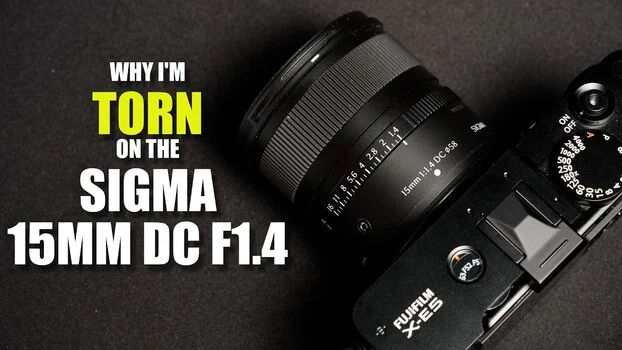
In the ever-evolving landscape of photographic equipment, the pursuit of perfection often leads to lenses that excel in quantifiable metrics but can falter in delivering the intangible essence of compelling imagery. The Sigma 15mm f/1.4 DC, a recent addition to the ultra-wide prime lens category, stands as a compelling case study in this often-observed chasm between raw specifications and the visceral experience of image creation. Renowned photographer and reviewer Luca Petralia recently delved into this dichotomy, examining why a lens boasting an impressive spec sheet might ultimately fail to resonate with a photographer’s creative spirit, particularly when tested on the Fujifilm X-E5 camera body.
Examining the Physical and Technical Prowess
The initial impression of the Sigma 15mm f/1.4 DC is undeniably positive, largely due to its robust physical construction and thoughtful design. Weighing in at a modest 225 grams, the lens manages to avoid the common pitfall of making even a compact camera system feel unbalanced or front-heavy. This lightweight characteristic is particularly advantageous for photographers who prioritize portability and agility, such as street photographers or travel enthusiasts.
A significant design element that garners praise is the inclusion of a physical aperture ring. Petralia highlights this feature as a notable advancement for Sigma’s contemporary DC line, marking it as a first for the series alongside the recently introduced 12mm lens. The presence of an aperture ring offers a tactile and intuitive control over exposure, a characteristic highly valued by many photographers who prefer a direct, hands-on approach to their craft, often reminiscent of classic film cameras. This direct control can facilitate quicker adjustments and a more immersive shooting experience, particularly in fast-paced environments.
Further bolstering the lens’s practical appeal is its weather-sealing. The incorporation of a gasket at the lens mount provides a crucial barrier against dust and moisture, offering peace of mind for photographers who venture into challenging environmental conditions. The build quality, characterized by the use of high-quality plastics, suggests durability and resilience, essential attributes for professional-grade equipment.
Priced between $500 and $600, the Sigma 15mm f/1.4 DC presents a highly competitive offering in the ultra-wide aperture lens market. The confluence of an f/1.4 aperture, an ultra-wide focal length, and a compact form factor at this price point leaves little room for objective criticism regarding its value proposition. On paper, it appears to tick nearly every box for photographers seeking a versatile and capable wide-angle lens without a prohibitive cost.
Image Quality: Precision Without Passion
The objective evaluation of the Sigma 15mm f/1.4 DC’s image quality continues the narrative of technical excellence. Petralia describes the lens’s output as "clinical," a descriptor that, while indicative of precision, often carries connotations of a lack of artistic character. Wide open at f/1.4, the lens exhibits remarkable sharpness in the central portion of the frame, a testament to its advanced optical design. The corners, while initially softer, demonstrate a commendable improvement, reaching parity with the center around f/5.6. However, the persistent sharpness of the central area often renders stopping down for corner improvement visually negligible, even when employing a high-resolution sensor such as the 40-megapixel unit found in some Fujifilm models.
Vignetting, a common characteristic of wide-angle lenses, is effectively managed, becoming negligible by f/2.8. Similarly, chromatic aberration, while present, is subtle enough to require deliberate effort to detect in post-processing. The lens’s bokeh, or the aesthetic quality of the out-of-focus areas, is surprisingly smooth for an ultra-wide lens, maintaining its pleasing characteristics even when the aperture is stopped down.
Despite this array of impressive technical attributes, Petralia identifies a more profound reservation – the absence of what he terms "soul." The lens, in his assessment, produces images that are technically flawless but emotionally uninspiring. This sentiment points to a growing trend in modern lens design where the emphasis on eliminating optical imperfections can inadvertently lead to a sterile rendering.
Autofocus performance is reported as satisfactory, with Petralia taking care to attribute any missed shots in continuous autofocus mode to the Fujifilm X-E5 camera body itself, rather than the lens. This observation suggests a consistent behavior across various lenses being tested on the same camera, reinforcing the idea that the lens’s optical characteristics are primarily responsible for the perceived creative limitations.
The Unquantifiable Divide: Character Versus Correction
Petralia’s critique of the Sigma 15mm f/1.4 DC transcends a mere review of a single piece of equipment; it touches upon a fundamental truth that resonates throughout the photographic community: the distinction between "character" and technical correction. In the contemporary era, lens manufacturers have achieved extraordinary advancements in minimizing optical aberrations, flattening field curvature, and delivering edge-to-edge sharpness. While these achievements are commendable from an engineering perspective, they have, in many instances, led to lenses that are characterized by their clinical precision.
This pursuit of technical perfection raises a crucial question for photographers: what do they truly desire from their images? A lens engineered for maximum correction provides a clean, predictable, and consistent output. Such lenses are ideally suited for documentary work, travel photography, and everyday shooting scenarios where reliability and a straightforward, untainted representation of reality are paramount. The photographer can confidently point and shoot, knowing the result will be technically sound.
Conversely, lenses possessing more pronounced optical "personality" often trade some degree of technical consistency for a rendering style that can evoke strong emotional responses. This personality can manifest in unique bokeh patterns, specific color rendition, or even controlled aberrations that contribute to a distinctive aesthetic. Such lenses can be polarizing; photographers may either fall in love with their rendering or find themselves battling against their inherent characteristics. Neither approach is inherently superior, but understanding one’s preference is key to avoiding the scenario of acquiring a technically perfect lens and subsequently feeling that the images lack depth or impact.
Comparative Analysis: Navigating the Options
The true value of Petralia’s analysis emerges in his comparative assessment of the Sigma 15mm f/1.4 DC against other lenses within the Fujifilm ecosystem and beyond. This detailed comparison provides a valuable roadmap for photographers with differing priorities and budgets.
For those seeking the absolute pinnacle of image quality within the Fujifilm system, Petralia continues to champion the Fujifilm 18mm f/1.4. Despite its significantly higher cost (roughly double that of the Sigma), larger size, and increased weight, this Fujifilm lens is lauded for its "soulful" rendering, a characteristic that the Sigma lens, in Petralia’s view, lacks. This recommendation underscores the premium placed on artistic rendering over pure technical specifications for some photographers.
On the more budget-conscious end of the spectrum, the Viltrox 15mm f/1.7 emerges as a compelling alternative. Priced at approximately half the cost of the Sigma, it sacrifices half a stop of aperture and the aperture ring. However, Petralia finds that it delivers a more characterful and, crucially, more enjoyable shooting experience for the money. This option caters to photographers who prioritize a fun and engaging creative process, even if it means compromising on some technical refinements.
For Sony E-mount users, the calculus shifts. The Sony 15mm f/1.4 presents itself as a direct competitor to the Sigma, exhibiting a similarly clinical look but at a higher price point. This comparison highlights the specific market positioning of each lens and its intended audience. Petralia’s detailed explanation of where each of these lenses fits within the broader market, and his personal reflections on moving on from his favored 18mm despite acknowledging its unique qualities, are crucial insights for any potential buyer.
The Verdict: A Niche Appeal for a Specific Photographer
Ultimately, the Sigma 15mm f/1.4 DC carves out a distinct but well-defined niche for a particular type of photographer. Petralia’s verdict suggests that this lens is an excellent choice for individuals who specifically desire a compact, lightweight, f/1.4 ultra-wide prime lens with an aperture ring, and who are drawn to a clinical, technically precise rendering at the approximately $500 price point. For this discerning user, the Sigma 15mm f/1.4 DC delivers precisely what it promises.
The decision of which 15mm lens ultimately graces a camera bag hinges on a nuanced understanding of individual creative aspirations. Petralia’s comprehensive review, available in its full video format, provides the detailed comparisons and personal insights necessary to make an informed choice. It serves as a potent reminder that while specifications can guide us, the ultimate measure of a lens’s success lies not just in its ability to capture light, but in its capacity to ignite inspiration and translate the photographer’s vision into images that truly speak. The Sigma 15mm f/1.4 DC, while a triumph of engineering, prompts a deeper conversation about what we truly seek in our photographic tools: technical perfection or the evocative power of artistic expression.