Auroville: India’s Utopian Experiment Grapples with Governance, Development, and its Foundational Ideals

On a recent visit to southeastern India, journalist and photographer Nicola Zolin found himself at Auroville—an experimental, international township established in the late 1960s. What began as a bold vision for human unity and spiritual evolution now faces a critical juncture, as internal divisions and external pressures challenge its foundational principles and raise questions about the future of this unique utopian dream.

The Genesis of a Universal City: A Dream Born in the 1960s
Auroville, meaning "City of Dawn," was inaugurated on February 28, 1968, a period globally marked by counter-cultural movements and a search for alternative ways of living. Its visionary founders, French-born spiritual teacher Mirra Alfassa, known as ‘the Mother’, and her collaborator, one of the 20th century’s most influential Indian philosophers, Sri Aurobindo, envisioned a universal township "where men and women of all countries are able to live in peace and progressive harmony, above all creeds, all politics and all nationalities." The ambition was to create a living laboratory for human evolution, transcending greed, ego, and division.

The inauguration ceremony itself was symbolic of this global aspiration. Representatives from 124 nations and 23 Indian states gathered, each depositing a handful of their native soil into a marble urn at the site of what would become the Matrimandir, the spiritual heart of Auroville. This act represented the symbolic unity of humanity, fostering a collective identity beyond national borders. The Mother articulated her profound hope: "For in this ideal place, money would no longer be the sovereign lord; individual worth would have a far greater importance than that of material wealth and social standing."
Physically, Auroville was designed by French architect Roger Anger as a sprawling 7.7 square mile (20 square kilometer) eco-community, laid out in a galactic pattern radiating from the Matrimandir. The master plan, known as the "Galaxy Plan," envisioned a city for 50,000 residents, complete with residential, cultural, industrial, and international zones, all enveloped by a verdant "Green Belt." This Green Belt was not merely an aesthetic feature but a crucial ecological project aimed at transforming arid land into a self-sustaining forest ecosystem.

Early Struggles and Environmental Triumphs
The early days of Auroville were marked by immense challenges and unwavering idealism. Pioneers, a diverse group of "idealistic wanderers, hippies, and spiritual seekers," as described by early resident Frederick Schulze Buxloh, arrived with fervent commitment but often limited practical skills. Buxloh, a restless young German who journeyed to India in 1959 after being drawn to the philosophies of Hermann Hesse and Arthur Schopenhauer, was deeply impacted by his encounter with the Mother. He went on to build Auroville’s first house, a testament to the pioneering spirit that defined the nascent community.

"We had fire inside us," Buxloh recalled, reflecting on the arduous task of transforming the landscape. The chosen land was largely barren, ravaged by decades of deforestation and erosion. Water scarcity was a critical issue. In response, early Aurovilians embarked on ambitious reforestation programs, planting hundreds of trees daily. They implemented innovative rainwater harvesting tanks, earthen dams, and groundwater recharge systems. Natasha Storey, a resident of the ‘Evergreen’ community, vividly recounted this period: "Seeing water return to the wells felt like witnessing a process of healing. We live with the forest, not separated from it." This collective effort led to a remarkable ecological transformation, with the Green Belt evolving into a thriving, biodiverse forest – a significant achievement in sustainable living.
Beyond environmental regeneration, the community established farms, workshops, and experimental homes, fostering a culture of self-sufficiency and collaborative work. The Mother’s emphasis on "work, even manual work, as something indispensable for the inner discovery" resonated deeply, guiding daily life towards a holistic integration of spiritual pursuit and practical contribution.

Governance and the Auroville Foundation Act
Recognizing the unique nature and international significance of Auroville, the Indian Parliament enacted the Auroville Foundation Act in 1988. This landmark legislation granted Auroville the status of an autonomous body corporate, effectively safeguarding its continuity and principles under the aegis of the Indian government. The Act established a tripartite governance structure:

- The Residents’ Assembly: Comprising all Aurovilians aged 18 and above, intended to be the primary decision-making body for the community’s internal affairs.
- The Governing Board: Appointed by the Central Government of India for a four-year term, responsible for overseeing the Foundation’s assets and ensuring the proper implementation of Auroville’s ideals.
- The International Advisory Council: Consisting of eminent scholars and elders from across the globe, also appointed by the Indian Government, providing guidance and international perspective.
The Act aimed to strike a balance between allowing Auroville its autonomy and ensuring accountability, while upholding its founding charter. All land and assets within Auroville are held by the Auroville Foundation, considered collective property, with no private ownership – a core principle established by the Mother.
The Current Conundrum: Development Versus Preservation

Despite its successes, Auroville has always grappled with the inherent tension between its idealistic vision and the practicalities of growth and governance. Today, the township houses approximately 3,500 residents from nearly 60 different nationalities, a figure significantly less than the 50,000 envisioned in Roger Anger’s original master plan. This disparity forms the backdrop for the current crisis.
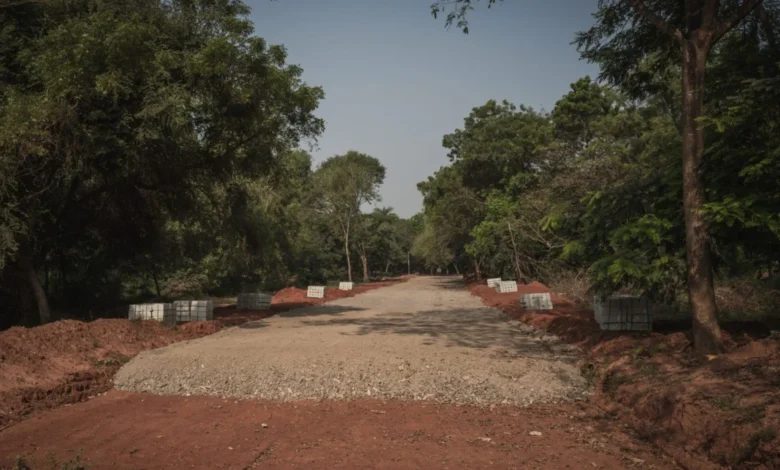
The tranquility of Auroville was abruptly shattered in December 2021 when bulldozers forcibly entered forested areas within the Green Belt, initiating construction on a new radial road. This project, part of the "Crown" development – a network of radial roads central to Anger’s original galactic city plan – was intended to expand the city towards its envisioned scale. However, it sparked immediate and fierce opposition from a significant portion of the residents.

Residents like Natasha Storey stood in front of the bulldozers, appealing for the respect of the Residents’ Assembly’s established decision-making processes. They argued that the project had been approved without proper consultation and consensus from the community, effectively bypassing the very democratic structures enshrined in the Auroville Foundation Act. The greenlight for the construction had come from Dr. Jayanti Ravi, a public servant appointed as the new Secretary to the Governing Board of the Auroville Foundation earlier that year. This move ignited a deep schism within the community, polarizing residents into those who supported the accelerated development to fulfill the Mother’s original vision and those who prioritized ecological preservation and community self-governance.
Allegations of Centralization and Eroding Autonomy

The road construction incident was not an isolated event but, for many, symptomatic of a broader trend towards increased centralization of power within the Auroville Foundation, allegedly at the expense of the Residents’ Assembly’s autonomy. Reports emerged of internal communications being disrupted, with email accounts changed and administrative access stripped without clear explanation. Concerns were also raised about the Governing Board’s influence over the visa application process, which requires a recommendation letter from the Foundation’s secretary for Auroville’s special visa category. Allegations of this letter being withheld, potentially to exert pressure, further fueled anxieties about control and fundamental rights.
Supporters of the expansion, often represented by the Governing Board, contend that these developments are necessary to realize the Mother’s full urban vision for a 50,000-strong community. They argue that the original master plan, including the "Crown" roads, is sacrosanct and that any deviation from it would betray Auroville’s founding intent. From this perspective, the current population size represents an unfulfilled potential, and strategic development is crucial for the township’s long-term viability and growth as a universal city.

Conversely, opposing residents emphasize that Auroville’s evolution must be organic and harmonious, not imposed. They point to the ecological devastation wrought by the bulldozing of mature forest areas within the Green Belt, a zone painstakingly cultivated over decades. For them, the spirit of Auroville lies not merely in its physical layout but in its commitment to sustainable living and consensual decision-making. They fear that a top-down approach, disregarding community input and environmental stewardship, undermines the very essence of the experiment.
Implications and the Path Forward

The ongoing dispute has plunged Auroville into a period of profound introspection and crisis. The community’s monthly newspaper, Auroville Today, features appeals for reconciliation alongside warnings against polarization, reflecting the deep divisions. The conflict highlights the inherent challenges of maintaining a unique governance model within the framework of a national legal system, particularly when different interpretations of founding ideals clash.
The situation in Auroville is a microcosm of broader global debates surrounding sustainable development, community autonomy, and the implementation of visionary urban planning. How does an intentional community, founded on spiritual principles and collective ownership, navigate growth and modernization without sacrificing its core values? Can the "City of Dawn" maintain its ecological integrity while pursuing its demographic ambitions?

Frederick Schulze Buxloh, reflecting on the current turbulence, offered a philosophical perspective: "Every crisis can be useful. These are precisely the moments that accelerate evolution. We learned not to possess anything and to understand a form of love that is not possession but unity. Here I learned to let everything go." He further mused while browsing an archival photobook, "Today I see Auroville differently. Maybe the time has come to carry this experience beyond Auroville itself. Many other utopian places like this one are emerging all around the world. The experience of what we have done here will never be lost."
Indeed, Auroville stands as a powerful symbol of humanity’s aspiration for a more harmonious way of living. Its current struggles, while painful, illuminate the complexities of nurturing such an ambitious vision. They underscore the delicate balance required between adherence to original plans and adaptive evolution, between external oversight and internal self-determination. The outcome of this internal conflict will not only shape Auroville’s future but also offer valuable lessons for other intentional communities and for the broader global quest for sustainable and unified human societies. The courage shown by many residents in living aligned with their beliefs, continuing to create small projects that foster an emerging world, suggests that the spirit of Auroville, despite its present trials, remains resilient.