Holafly Launches Global eSIM Subscription Plans to Streamline International Connectivity for Long-Term Travelers

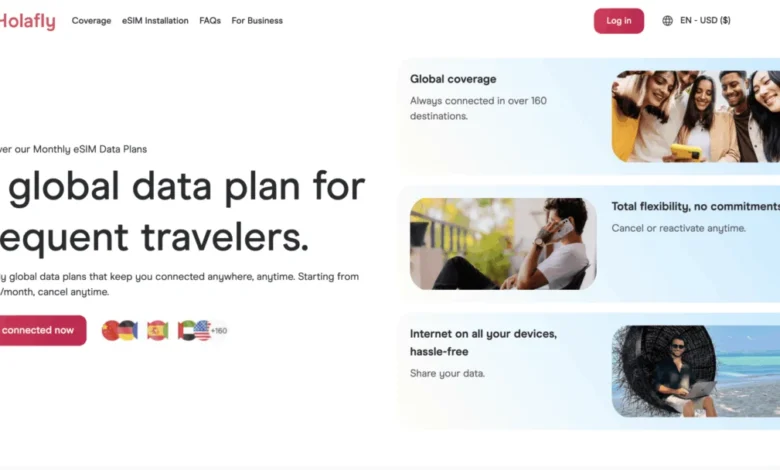
The international telecommunications landscape is undergoing a significant structural shift as travel technology providers move beyond traditional short-term product offerings toward recurring subscription models. In response to the growing demand for seamless cross-border connectivity, travel tech provider Holafly has officially introduced Holafly Plans, a continuous global eSIM subscription service designed to eliminate the logistical friction traditionally associated with international mobile data.
Operating across more than 160 destinations, the newly launched service allows users to maintain a single digital subscriber identity module (eSIM) across multiple international borders without the need for manual carrier swapping, QR code redeployments, or localized physical SIM card purchases. This development marks a departure from conventional travel data models, offering a hybrid solution that bridges the gap between local short-term tourism data packages and expensive domestic carrier international roaming add-ons.
The Evolution of Digital SIM Technology and Market Context
To understand the operational significance of Holafly Plans, one must examine the rapid technological progression of the embedded subscriber identity module (eSIM). Unlike traditional physical plastic SIM cards that require physical insertion into a mobile device’s hardware tray, an eSIM is a software-based architecture embedded directly into the smartphone’s motherboard during manufacturing.
Since commercial adoption accelerated in the late 2010s—spearheaded by major smartphone manufacturers such as Apple and Samsung—the technology has fundamentally altered how consumers manage telecommunication services. Users are no longer tethered to a single domestic provider or forced to pay exorbitant roaming fees when crossing international boundaries. Instead, travelers can store multiple profiles simultaneously, enabling dual-SIM functionality that accommodates a home number alongside international data packages.

Historically, travel data providers focused on single-destination or regional prepaid packages valid for fixed durations, typically ranging from seven to ninety days. While these products successfully served vacationers and short-term tourists, they created a recurring administrative burden for digital nomads, frequent business travelers, and long-term backpackers. Every time a traveler crossed an international border where their current package was invalid, they were required to purchase a new eSIM, scan a fresh QR code, and configure network settings. Holafly Plans was developed to address this operational inefficiency by offering a persistent, borderless data pipeline.
Product Structure: Tiers, Pricing, and Technical Specifications
Holafly Plans operates on a subscription-based framework available in monthly, quarterly, and annual billing cycles, offering tiered options depending on consumer usage profiles. The service is divided into two primary categories: the Light Plan and the Unlimited Plan.
The Light Plan provides subscribers with a 25GB monthly data allowance across the entire 160-plus destination network. It retains core functionality such as mobile hotspot capabilities, allowing users to tether external devices like laptops and tablets. This tier is marketed toward travelers whose usage patterns rely primarily on navigation software, messaging applications, and moderate web browsing.
Conversely, the Unlimited Plan caters to heavy data users, remote workers, and digital nomads. It features unthrottled data consumption with no hard caps, accompanied by an unlimited mobile hotspot allowance. This addresses a common limitation among major domestic carriers, which frequently throttle data speeds or restrict tethering capacities when operating on foreign partner networks. Furthermore, the Unlimited Plan includes a local virtual phone number originating from the United States, the United Kingdom, or Canada, enabling subscribers to receive incoming SMS verification codes and text messages globally—a critical requirement for international banking and professional communications.
Both subscription tiers incorporate an automated contingency feature designated as "Always On." This protocol provides users with 1GB of auxiliary backup data each month across more than 150 destinations, ensuring baseline connectivity even if the primary data allowance is exhausted or if the user eventually cancels the broader subscription.
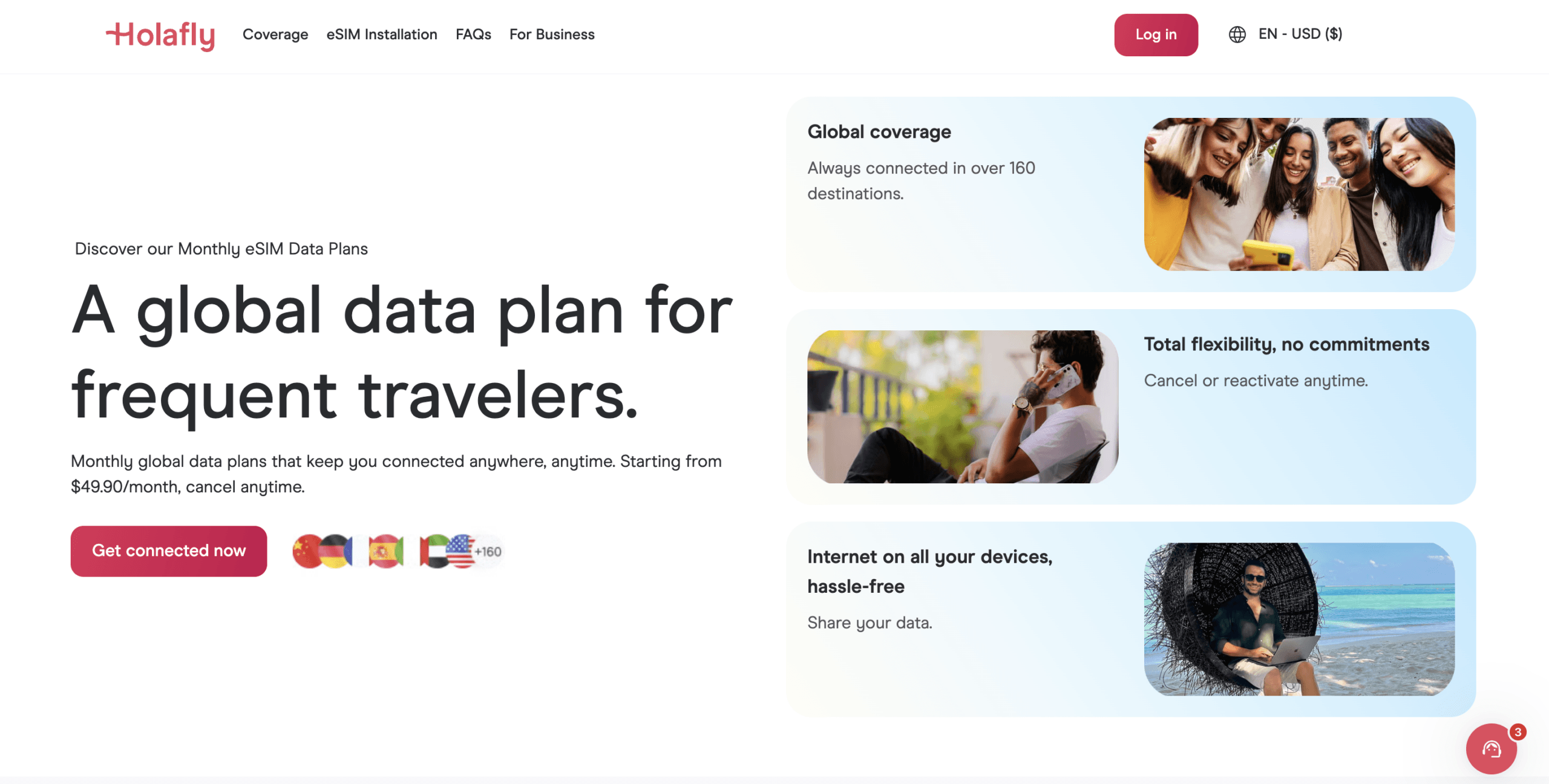
From a financial perspective, the pricing model is structured to undercut legacy international roaming charges levied by major telecommunications operators. For instance, annual commitments for the Unlimited Plan reduce the monthly expenditure to approximately $55 USD, while quarterly agreements yield a roughly 10% discount compared to month-to-month billing. This pricing strategy positions the service competitively against domestic carrier international passes, which routinely cost between $10 and $15 per day—translating to monthly bills exceeding $300 for continuous overseas usage.
Comparative Analysis: Holafly Plans Versus Legacy Alternatives
The introduction of global subscription eSIMs alters the competitive dynamic between three distinct consumer connectivity models: major carrier international roaming passes, traditional single-destination prepaid eSIMs, and local physical SIM cards.
Major domestic carriers, particularly in North America and Europe, have historically dominated international data delivery through daily roaming add-ons. While these services offer the convenience of retaining a primary phone number, they come with substantial financial penalties and aggressive data throttling thresholds. Users routinely face reduced speeds after consuming a nominal daily allotment, typically capped at 512MB to 1GB of high-speed data.
In contrast, traditional prepaid eSIMs—including Holafly’s legacy product line—remain the optimal financial choice for isolated, short-duration trips. A traveler embarking on a two-week vacation to a single country generally incurs lower total costs by purchasing a dedicated, single-destination eSIM rather than committing to an ongoing monthly subscription.
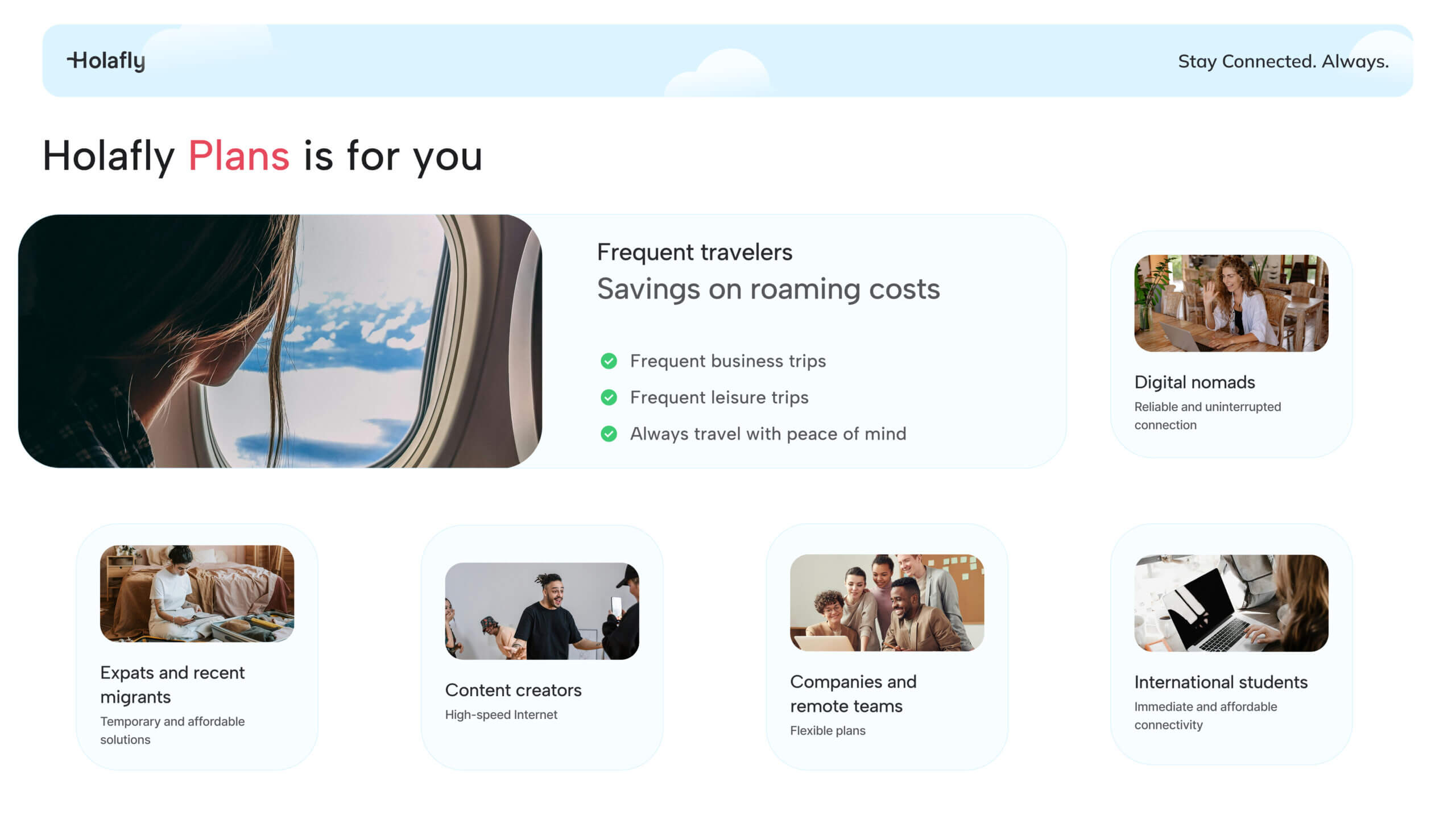
However, for individuals maintaining a nomadic lifestyle characterized by frequent border crossings within a single thirty-day window, traditional products introduce friction. Each relocation requires transaction processing and network reconfiguration. Holafly Plans mitigates this administrative overhead by maintaining continuous connectivity, automatically negotiating local network handshakes upon arrival in a new country without user intervention.
Implementation, Consumer Demographic, and Market Implications
The onboarding process for Holafly Plans mirrors standard digital provisioning protocols. Subscribers select their desired tier, complete the checkout process, and receive a digital installation profile via email or application prompt. Once installed onto a compatible smartphone, the eSIM remains active for the duration of the subscription lifecycle, supported by around-the-clock technical customer service infrastructure.
Industry analysts note that the proliferation of global eSIM subscriptions reflects a broader maturation in the travel technology sector. As remote work policies stabilize globally and international travel volumes return to pre-pandemic highs, consumer expectations have shifted toward frictionless, utility-style digital services. Telecommunication analysts suggest that traditional carriers may face mounting pressure to revise their international roaming fee structures as subscription-based eSIM alternatives gain market share among high-frequency travelers.
While Holafly Plans may not displace short-term prepaid packages for the average vacationer, its introduction signifies an important milestone in the commoditization of global mobile data. By decoupling international connectivity from traditional domestic network monopolies, the service provides an alternative framework for maintaining digital infrastructure across borders.