Sketching your way through Jet lag: Why travel artists keep a watercolor kit in their carry-on

The intersection of creative expression and physiological recovery has birthed a growing movement among frequent international travelers: the use of portable watercolor kits to combat the effects of jet lag and transit-induced stress. While traditional advice for managing circadian rhythm disruption—scientifically known as desynchronosis—typically revolves around melatonin supplements, strategic hydration, and light exposure, a significant demographic of "slow travelers" is turning to analog art-making as a grounding mechanism. This practice, once the domain of 19th-century explorers, is seeing a modern resurgence as travelers seek to reclaim "dead time" in airports and train stations, transforming the grueling experience of long-haul layovers into opportunities for cognitive anchoring and memory preservation.
The Phenomenon of Sensory Disconnection in Transit
Jet lag is frequently categorized as a sleep disorder, yet for the modern traveler, it manifests more broadly as a sensory and cognitive problem. The experience of being in transit—moving through the "non-places" of international airports and sterile departure lounges—often induces a state of "floaty disconnection." In this state, the body is physically present in one time zone while the brain remains tethered to another, leading to a sense of unreality.
Travelers like Oscar Davis, a Leeds-based writer who documented his experience painting a bowl of congee at Bangkok’s Don Mueang Airport during a five-hour layover at 4:17 a.m., argue that painting forces a level of observation that digital photography cannot replicate. By attempting to mix the specific grey of a terminal’s floor tiles or capturing the exact turquoise of a gate agent’s uniform, the artist’s brain is forced to "re-anchor" in the immediate environment. This active engagement with the physical surroundings serves as a psychological tether, mitigating the dissociative feelings common during high-speed global travel.

A Chronology of the Travel Artist’s Evolution
The practice of documenting journeys through watercolor has a storied history that predates modern aviation. Understanding the current trend requires a look at how the tools and motivations have shifted over the centuries:
- The Era of the Grand Tour (18th–19th Century): Aristocratic travelers and professional artists like J.M.W. Turner hauled massive wooden painting boxes across the Alps. These kits included heavy glass jars, raw pigments that required grinding, and large-format papers. Art was the primary method of visual recording before the invention of the camera.
- The Rise of Portable Sets (Mid-20th Century): The development of "half-pans"—small cakes of dried pigment—allowed for smaller, metal-boxed kits. However, the need for a separate water source and bulky brushes kept the practice relatively niche for casual travelers.
- The Digital Saturation Point (2000s–2010s): The ubiquity of smartphone cameras led to a "shutter-click" culture. While travelers captured thousands of images, the "photo-taking impairment effect" began to emerge—a psychological phenomenon where the act of taking a photo actually reduces the brain’s ability to remember the details of the scene.
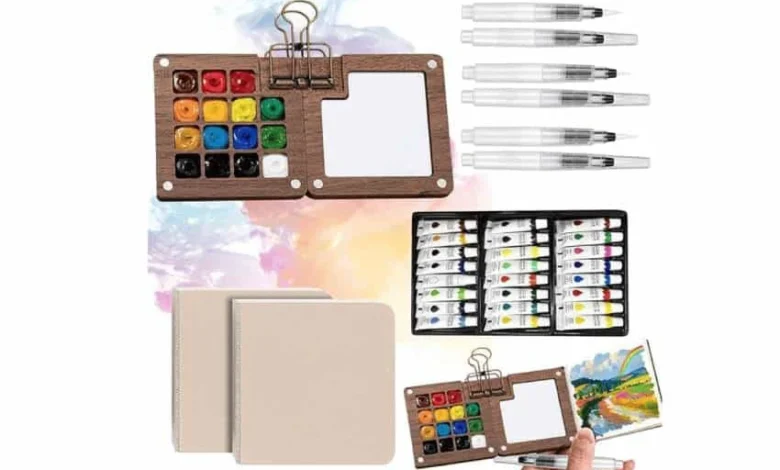
- The Analog Revival and the All-in-One Kit (2020s–Present): A shift toward mindfulness and "slow travel" has popularized ultra-portable, TSA-friendly kits. Innovations such as the water brush—a synthetic brush with a built-in water reservoir—and compact systems like Tobio’s Kits have removed the logistical barriers of airport security and cramped seating, allowing for "zero-setup" painting in transit.
Scientific Foundations: Memory Encoding and Cortisol Reduction
The benefits of travel sketching are supported by neuroscientific and psychological research. Daniel Schacter, a prominent neuroscientist at Harvard University, has extensively documented the concept of "active encoding." Unlike the passive recording of a camera, the process of painting requires the brain to synthesize information: selecting what to include, analyzing color values, and translating a three-dimensional scene onto a two-dimensional surface. This deep level of processing burns the scene into the long-term memory with significantly more clarity than a digital photograph.
Furthermore, a 2016 study published in the journal Art Therapy by Girija Kaimal and her colleagues at Drexel University demonstrated the physiological impact of art-making. The study found that just 45 minutes of creative activity significantly reduced levels of cortisol—the body’s primary stress hormone—in 75% of participants, regardless of their prior artistic experience or skill level. In the high-stress environment of an airport terminal, characterized by crowds, noise, and the anxiety of delays, even a ten-minute sketching session can shift the traveler’s mental state from "survival mode" to a state of calm focus.
The Practicality of Modern "Carry-On" Art
For decades, the primary obstacle to travel painting was the "gear question." Transporting liquids, tubes of paint, and fragile brushes through airport security was a logistical deterrent. However, the modern market has responded with specialized equipment designed for the "urban sketcher" and the international commuter.
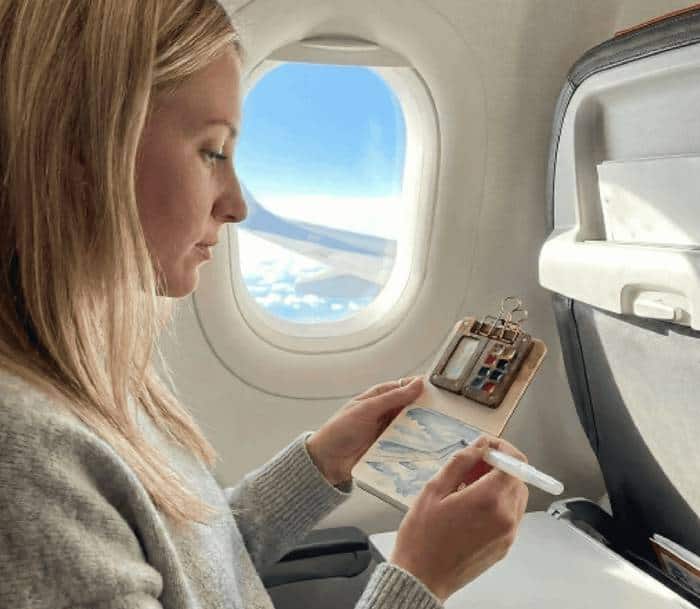
Modern kits are often no larger than a paperback novel. Key components include:
- Water Brushes: These eliminate the need for a separate water cup, which is prone to spilling on tray tables or in lounges. The brush uses a valve system to release water into the bristles as needed.
- Dry Pigment Pans: Because the watercolors are in a solid state until activated by a wet brush, they do not count toward the TSA’s liquid restrictions.
- Cotton Paper: High-quality travel sketchbooks now utilize cotton-based paper, which is more absorbent and resistant to buckling than wood-pulp paper, allowing for professional results in a portable format.
Industry analysts note that the "hobbies and crafts" sector has seen a marked increase in the demand for "miniature" and "portable" versions of traditional tools, reflecting a broader societal trend toward mobile creativity.
Sociological Implications: The Social Icebreaker
Beyond the personal psychological benefits, painting in public spaces like airports and train stations has significant social implications. In an era where travelers are typically isolated by noise-canceling headphones and glowing screens, the act of painting serves as a unique "third space" bridge.
Reports from solo travelers suggest that an open sketchbook is one of the most effective conversation starters in international settings. Unlike digital devices, which signal a desire for privacy, art-making invites curiosity. This "social side" of travel sketching allows for brief but meaningful interactions with strangers—ranging from airport staff to fellow passengers—fostering a sense of human connection that is often missing from modern transit.
Strategic Analysis: The "Ugly" Painting and the Talent Myth
A common barrier to entry for travelers is the perceived need for artistic talent. However, the travel sketching movement emphasizes the process over the product. The objective is not to produce gallery-quality art but to engage in a "grounding practice."
Experts suggest that the "low stakes" of an airport gate are actually ideal for beginners. Because the environment is inherently mundane—featuring subjects like half-eaten croissants, tarmac views, or coffee cups—there is less pressure to create a "masterpiece" than there would be at a major landmark like the Eiffel Tower. This shift in perspective allows the traveler to focus on the sensory details: the yellow cast of overhead fluorescent lights, the smell of chili oil, or the sound of rain on a terminal window.
Broader Impact on the Travel Industry
The rise of the "travel artist" reflects a broader shift in the travel industry toward "experiential" and "mindful" tourism. As travelers become increasingly wary of "over-tourism" and the hollow nature of "Instagrammable" moments, there is a growing value placed on personal, un-curated records of a journey.
A watercolor sketch represents a personal record that no algorithm can curate and no cloud service can delete. It is a physical artifact of a specific moment in time—one that transforms the "lost" hours of a layover into a restorative and permanent memory. As more travelers adopt this practice, we may see a shift in airport design and lounge amenities, with more spaces dedicated to quiet, analog activities that support mental well-being during the stresses of global movement.

In conclusion, the inclusion of a watercolor kit in a carry-on is more than a hobbyist’s quirk; it is a strategic tool for maintaining mental health, enhancing memory, and reclaiming the human element of travel. Whether the resulting painting is a "beige puddle" or a detailed architectural study, the act of looking remains one of the most effective antidotes to the disorientation of the modern world.